Category: Hermeneutics

  • The Lord’s Supper and the New Covenant – pt.7

    The Lord’s Supper and the New Covenant – pt.7

    Scripture Reading

    13 Therefore, having girded your minds for action, being sober in spirit, fix your hope completely on the grace to be brought to you at the revelation of Jesus Christ.

    14 As obedient children, not being conformed to the former lusts which were yours in your ignorance,

    15 but like the Holy One who called you, be holy yourselves also in all your conduct;

    16 because it is written, “You shall be holy, for I am holy.”

    17 And if you address as Father the One who impartially judges according to each one’s work, conduct yourselves in fear during the time of your sojourn,

    18 knowing that you were not redeemed with corruptible things like silver or gold from your futile conduct inherited from your forefathers,

    19 but with precious blood, as of a lamb unblemished and spotless, the blood of Christ.  (1 Peter 1:13–19, LSB)

    Introduction

    Review:

    Paul wrote,

    25 In the same way He took the cup also after supper, saying, “This cup is the new covenant in My blood; do this, as often as you drink it, in remembrance of Me.”  (1 Corinthians 11:25, LSB)

    The importance of the Lord’s last meal with His disciples is directly linked to the importance of the New Covenant.

    As Paul wrote to the Corinthians, Jesus is “our Passover,” a statement of monumental importance.

    “our” = the church, believers, Jews and Gentiles who believe in the Messiah.

    Clean out the old leaven so that you may be a new lump, just as you are in fact unleavened. For Christ, our Passover lamb, also was sacrificed.  (1 Corinthians 5:7, LSB)

    He is not the Passover Lamb of the Exodus.

    His blood “speaks better than that of Abel,” and the Passover lamb of the Exodus.

    22 But you have come to Mount Zion and to the city of the living God, the heavenly Jerusalem, and to myriads of angels,

    23 to the festal gathering and assembly of the firstborn who are enrolled in heaven, and to God, the Judge of all, and to the spirits of the righteous made perfect,

    24 and to Jesus, the mediator of a new covenant, and to the sprinkled blood, which speaks better than the blood of Abel.  (Hebrews 12:22–24, LSB)

    The blood of Christ, which is a reference to His death, which was a predetermined death “instead of” the death for the sins of the elect, accomplished more and was from a better Man than even that of Abel.

    “…saying, “The Son of Man must suffer many things and be rejected by the elders and chief priests and scribes, and be killed and be raised up on the third day.”  (Luke 9:22, LSB)

    22“Men of Israel, listen to these words: Jesus the Nazarene, a man attested to you by God with miracles and wonders and signs which God did through Him in your midst, just as you yourselves know—

    23 this Man, delivered over by the predetermined plan and foreknowledge of God, you nailed to a cross by the hands of lawless men and put Him to death.

    24 “But God raised Him up again, putting an end to the agony of death, since it was impossible for Him to be held in its power.  (Acts 2:22–24, LSB)

    What was the result of His death?

    1. His death justified the sons of God.

    1. 45“For even the Son of Man did not come to be served, but to serve, and to give His life a ransom for many.”  (Mark 10:45, LSB)
      1. 11 As a result of the anguish of His soul,
        He will see it and be satisfied;
        By His knowledge the Righteous One,
        My Servant, will justify the many,
        As He will bear their iniquities.
        12 Therefore, I will divide for Him a portion with the many,
        And He will divide the spoil with the strong;
        Because He poured out His soul to death,
        And was numbered with the transgressors;
        Yet He Himself bore the sin of many,
        And interceded for the transgressors.  (Isaiah 53:11–12, LSB)

    2. His death pleased the Father.

    1. 16 “And I have other sheep, which are not from this fold; I must bring them also, and they will hear My voice; and they will become one flock with one shepherd.
      17 “For this reason the Father loves Me, because I lay down My life so that I may take it again.
      18 “No one takes it away from Me, but from Myself, I lay it down. I have authority to lay it down, and I have authority to take it up again. This commandment I received from My Father.”  (John 10:16–18, LSB)
    1. But Yahweh was pleased
      To crush Him, putting Him to grief;
      If You would place His soul as a guilt offering,
      He will see His seed,
      He will prolong His days,
      And the good pleasure of Yahweh will succeed in His hand.  (Isaiah 53:10, LSB)

    1. His death condemned Satan.

    1. And I will put enmity
      Between you and the woman,
      And between your seed and her seed;
      He shall bruise you on the head,
      And you shall bruise him on the heel.”  (Genesis 3:15, LSB)
      1. 9 And the great dragon was thrown down, the serpent of old who is called the devil and Satan, who deceives the whole world. He was thrown down to the earth, and his angels were thrown down with him.
        10 Then I heard a loud voice in heaven, saying,
        Now the salvation, and the power, and the kingdom of our God and the authority of His Christ have come, for the accuser of our brothers has been thrown down, he who accuses them before our God day and night.
        11 “And they overcame him because of the blood of the Lamb and because of the word of their witness, and they did not love their life even to death.  (Revelation 12:9–11, LSB)

    1. His death confirmed the New Covenant.

    1. 13 For if the blood of goats and bulls and the ashes of a heifer sprinkling those who have been defiled sanctify for the cleansing of the flesh,
      14 how much more will the blood of Christ, who through the eternal Spirit offered Himself without blemish to God, cleanse your conscience from dead works to serve the living God?
      15 And for this reason He is the mediator of a new covenant, so that, since a death has taken place for the redemption of the trespasses that were committed under the first covenant, those who have been called may receive the promise of the eternal inheritance.  (Hebrews 9:13–15, LSB)
      1. 10 We have an altar from which those who serve the tabernacle have no authority to eat.
        11 For the bodies of those animals whose blood is brought into the holy places by the high priest as an offering for sin, are burned outside the camp.
        12 Therefore Jesus also, that He might sanctify the people through His own blood, suffered outside the gate.  (Hebrews 13:10–12, LSB)

    1. His death was the means of the resurrection.

    1. 3 For I delivered to you as of first importance what I also received, that Christ died for our sins according to the Scriptures,
      4 and that He was buried, and that He was raised on the third day according to the Scriptures,  (1 Corinthians 15:3–4, LSB)
      1. 20 Now the God of peace, who brought up from the dead the great Shepherd of the sheep through the blood of the eternal covenant, our Lord Jesus,
        21 equip you in every good thing to do His will, by doing in us what is pleasing in His sight, through Jesus Christ, to whom be the glory forever and ever. Amen.  (Hebrews 13:20–21, LSB)

    The hidden plan of God, although hinted at in the OT, was that the Lamb of God, the Son, would be put to death in a particular fashion (crucifixion), with a particular means (betrayal), and by particular parties (Jewish leaders).

    7 In Him we have redemption through His blood, the forgiveness of our transgressions, according to the riches of His grace

    8 which He caused to abound to us in all wisdom and insight,

    9 making known to us the mystery of His will, according to His good pleasure which He purposed in Him

    10 for an administration of the fullness of the times, that is, the summing up of all things in Christ, things in the heavens and things on the earth in Him.  (Ephesians 1:7–10, LSB)

    Therefore, the purpose of God was that the Son would pay the death penalty on behalf of men, such that He could rescue them from death, the penalty of Adam’s sin.

    This leads us into the final consideration of the plan of God regarding the New Covenant:

    1. The New Covenant is the very core of the gospel of Jesus Christ.
    2. The New Covenant unites the OT and the NT.
    3. The New Covenant clarifies who Israel is.

    4. The New Covenant clarifies who the church is.

    5. The New Covenant is the only covenant made with Israel which forgives sins.

    6. Without the New Covenant, all the elect would remain in their sins.

    The Incognito Ministry of the Messiah

    And He earnestly warned them not to tell who He was.  (Mark 3:12, LSB)

    And He gave them orders not to tell anyone; but the more He was ordering them, the more widely they continued to proclaim it.  (Mark 7:36, LSB)

    And He gave them strict orders that no one should know about this, and He said that some food should be given to her to eat.  (Mark 5:43, LSB)

    The Lord established in His ministry the constant order to hold back from telling the people Who He was.

    This meant that He was not wanting the people to know about Him as Messiah, but only that He would do the works of the Messiah letting people to draw the conclusions based upon that.

    This was so that the true nature of the leadership of Israel would become evident, thus leading to the crucifixion, the necessary death of the New Covenant Lamb of God.

    13 Now when Jesus came into the district of Caesarea Philippi, He was asking His disciples, saying, “Who do people say that the Son of Man is?”

    14 And they said, “Some say John the Baptist; and others, Elijah; but still others, Jeremiah, or one of the prophets.”

    15 He said to them, “But who do you say that I am?”

    16 And Simon Peter answered and said, “You are the Christ, the Son of the living God.”

    17 And Jesus answered and said to him, “Blessed are you, Simon Bar-Jonah, because flesh and blood did not reveal this to you, but My Father who is in heaven.

    18 “And I also say to you that you are Peter, and upon this rock I will build My church; and the gates of Hades will not overpower it.

    19 “I will give you the keys of the kingdom of heaven; and whatever you bind on earth shall have been bound in heaven, and whatever you loose on earth shall have been loosed in heaven.”

    20 Then He warned the disciples that they should tell no one that He was the Christ.

    21 From that time Jesus began to show His disciples that He must go to Jerusalem, and suffer many things from the elders and chief priests and scribes, and be killed, and be raised up on the third day.  (Matthew 16:13–21, LSB)

    Have you ever wondered why Jesus would say this? 
    

    It is because of the requirement that He would draw out the murderous hearts of the leadership, their jealousy, by His works, and drive them to the murder that would 1) seal their eternal damnation, and 2) secure the atoning sacrifice of the Lamb.

    36 “But the witness I have is greater than the witness of John; for the works which the Father has given Me to finish—the very works that I do—bear witness about Me, that the Father has sent Me.

    37 “And the Father who sent Me, He has borne witness about Me. You have neither heard His voice at any time nor seen His form.

    38 “And you do not have His word abiding in you, for you do not believe Him whom He sent.  (John 5:36–38, LSB)

    This death, produced by the jealousy of the leadership of Israel as they witnessed His works, instead of snuffing out His influence, secured the atoning sacrifice for the sins of Israel and Gentiles…forever!

    Therefore, His kingdom was secured by His death and resurrection, but not through the nation of Israel, although the Mosaic Law is the keep component in fulfilling that kingdom promise, which was communicated in the Abrahamic Promise.

    His Kingdom, then, has been taken away from the nation of Israel, and given to the nations of the world!

    The Parable:

    33 “Listen to another parable. There was a landowner who planted a vineyard and put a wall around it and dug a wine press in it, and built a tower, and rented it out to vine-growers and went on a journey.

    34 “Now when the harvest time approached, he sent his slaves to the vine-growers to receive his fruit.

    35 “And the vine-growers took his slaves and beat one, and killed another, and stoned a third.

    36 “Again he sent another group of slaves larger than the first; and they did the same thing to them.

    37 “But afterward he sent his son to them, saying, ‘They will respect my son.’

    38 “But when the vine-growers saw the son, they said among themselves, ‘This is the heir; come, let us kill him and seize his inheritance.’

    39 “And they took him, and threw him out of the vineyard and killed him.

    40 “Therefore when the owner of the vineyard comes, what will he do to those vine-growers?”

    41 They said to Him, “He will bring those wretches to a wretched end, and will rent out the vineyard to other vine-growers who will pay him the proceeds at the proper seasons.”

    42 Jesus said to them, “Did you never read in the Scriptures,

    ‘The stone which the builders rejected,

    This has become the chief corner stone;

    This came about from the Lord,

    and it is marvelous in our eyes’?

    43 “Therefore I say to you, the kingdom of God will be taken away from you and given to a nation, producing the fruit of it.

    44 “And he who falls on this stone will be broken to pieces; but on whomever it falls, it will scatter him like dust.”

    45 And when the chief priests and the Pharisees heard His parables, they understood that He was speaking about them.

    46 And although they were seeking to seize Him, they feared the crowds, because they were regarding Him to be a prophet.  (Matthew 21:33–46, LSB)

    The Son came into the world, and the world did not receive Him-neither the Jews nor the Romans.

    The end result was that the Son would be killed, and made to look like the enemy of the world.

    This death, seeming to be the execution of a failed insurrectionist, in realty secured the atonement needed to accomplish the plan of God.

    This death, as described for the last 6 weeks, has a vast array of accomplishments.

    Not the least of which is the creation of a following known as the “church.”

    The New Covenant clarifies who the church is.

    It is this following that Jesus came to create.

    17 And Jesus answered and said to him, “Blessed are you, Simon Bar-Jonah, because flesh and blood did not reveal this to you, but My Father who is in heaven.

    18 “And I also say to you that you are Peter, and upon this rock I will build My church; and the gates of Hades will not overpower it.  (Matthew 16:17–18, LSB)

    The church is a group of people, chosen before the foundation of the world, who will inherit the promise to the Son, i.e. sonship.

    The means by which these people will become sons and daughters is the sacrifice of the Man, Christ Jesus, satisfying the Father, and permitting their own justification.

    This group, then, is different from Israel in that, unlike Israel, it has received the benefits of the New Covenant.

    Israel has not received the promises of the New Covenant because they have not confessed their sins, as John the Baptist, and Jesus Christ, commanded them to do.

    Therefore, the New Covenant is experience of the church, and not Israel.

    13 and are not like Moses, who used to put a veil over his face so that the sons of Israel would not look intently at the consequence of what was being brought to an end.

    14 But their minds were hardened; for until this very day at the reading of the old covenant the same veil remains unlifted, because it is brought to an end in Christ.

    15 But to this day whenever Moses is read, a veil lies over their heart,

    16 but whenever a person turns to the Lord, the veil is taken away. (2 Corinthians 3:13–16, LSB)

    One of the clearest distinctions, if not the most clear, between the church and Israel is that the church has received the benefits of the New Covenant, and Israel has not.

    It is really that simple; that basic.

    The New Covenant is the only covenant made with Israel which forgives sins.

    33 “But this is the covenant which I will cut with the house of Israel after those days,” declares Yahweh: “I will put My law within them, and on their heart I will write it; and I will be their God, and they shall be My people.

    34 “And they will not teach again, each man his neighbor and each man his brother, saying, ‘Know Yahweh,’ for they will all know Me, from the least of them to the greatest of them,” declares Yahweh, “for I will forgive their iniquity, and their sin I will remember no more.”  (Jeremiah 31:33–34, LSB)

    The previous covenants with Israel (Abrahamic, Priestly, Mosaic, Davidic) do nothing to take away sins.

    8 The Holy Spirit is indicating this, that the way into the holy places has not yet been manifested while that first part of the tabernacle is still standing,

    9 which is a symbol for the present time. Accordingly both gifts and sacrifices are offered which cannot make the worshiper perfect in conscience,

    10 since they relate only to food and drink and various washings, requirements for the body imposed until a time of reformation.  (Hebrews 9:8–10, LSB)

    Sin is the symptom of a spiritually dead person.

    In order to make a worshipper clean, he must become perfect in conscience, and in order to do that, he must become new since he is dead to God.

    This power to re-create the dead person is simply the work of God to join a spiritually dead person to Jesus Christ in His death.

    It is also the work of God to join the spiritually dead person to Jesus Christ in His resurrection.

    This power is inherent to the New Covenant.

    NOTE: Jeremiah 31 does not tell us HOW God is going to accomplish this work of 1) forgiveness of sins, 2) indwelling of the Holy Spirit, 3) making a new heart (Ezekiel 36). 
    

    But, we now know that all these things are accomplished by the death of Jesus Christ.

    6. Without the New Covenant, all the elect would remain in their sins.

    As stated, there are no arrangements, with Israel nor anyone else, in which a person who is dead to God would be made alive to Him.

    The only means by which God can accomplish His eternal purpose is by forgiveness of sins.

    And the only means by which He can forgive sins is if someone die in the place of the sinner.

    The Death of the Mediator

    15 And for this reason He is the mediator of a new covenant, so that, since a death has taken place for the redemption of the trespasses that were committed under the first covenant, those who have been called may receive the promise of the eternal inheritance.

    16 For where a covenant is, there must of necessity be the death of the one who made it.  (Hebrews 9:15–16, LSB)

    We learn that the requirements of the Old Covenant were that the agreement was made, and Israel failed to follow through.

    That created a binding to the agreement from which Israel could not release herself.

    Therefore, in order to realize the Abrahamic Covenant, sins had to be forgiven, but they could not be forgiven in a vacuum.

    Rather, sins had to be forgiven of the guilty by means of the death of the innocent, and thereby the death of the guilty.

    3 Or do you not know that all of us who were baptized into Christ Jesus were baptized into His death?

    4 Therefore we were buried with Him through baptism into death, so that as Christ was raised from the dead through the glory of the Father, so we too might walk in newness of life.

    5 For if we have become united with Him in the likeness of His death, certainly we shall also be in the likeness of His resurrection,

    6 knowing this, that our old man was crucified with Him, in order that our body of sin might be done away with, so that we would no longer be slaves to sin;

    7 for he who has died has been justified from sin.  (Romans 6:3–7, LSB)

    THIS IS HOW WE HAVE BEEN JUSTIFIED-WE DIED, IN AND ALONG WITH, HIM!

    “Christ’s death alone is the ground of our justification, and when we make that our own by faith we are united with Christ—united with him in his death, united with him in his burial, united with him in his rising again, united with him in life.”1

    Isaiah 53:11 (LSB)

         11 As a result of the anguish of His soul, 
         He will see it and be satisfied; 
         By His knowledge the Righteous One, 
         My Servant, will justify the many, 
         As He will bear their iniquities.
    

    The Death of the Believer

    Not only has the Passover Lamb died, but we, previously dead to God (in Adam), died in union with Him.

    12 having been buried with Him in baptism, in which you were also raised up with Him through faith in the working of God, who raised Him from the dead.

    13 And you being dead in your transgressions and the uncircumcision of your flesh, He made you alive with Him, having graciously forgiven us all our transgressions.2  (Colossians 2:12–13, LSB)

    The reality, when God made the promise of the New Covenant to Israel, all the while knowing that they would not repent, and all the while knowing what He would do, He then took those promises to Israel and have given them to the church, Gentiles.

    Further, the mystery of the kingdom is that we are united with Him in His death, burial, and resurrection.

    This is unique to the church, and is not what will happen to Israel in the future.

    25 of which I was made a minister according to the stewardship from God given to me for you, so that I might fully carry out the preaching of the word of God,

    26 that is, the mystery which has been hidden from the past ages and generations, but has now been manifested to His saints,

    27 to whom God willed to make known what is the riches of the glory of this mystery among the Gentiles, which is Christ in you, the hope of glory.  (Colossians 1:25–27, LSB)

    In no way does this destroy the need for Israel to repent.

    In no way does this remove the land, kingdom, Abrahamic promise from Israel .

    In no way does this remove the national condition of Israel in the future.

    However, in this Messianic age, this Kingdom age, this Church Age, the promise to forgive sins, indwell men with the Spirit of God, give a new heart/spirit, are all promises given to the church due to Israel’s refusal to repent.

    Without the New Covenant, all the elect would remain in their sins.

    Ephesians 2:1–7 (LSB)

    1 And you were dead in your transgressions and sins, 
    2 in which you formerly walked according to the course of this world, according to the ruler of the power of the air, the spirit that is now working in the sons of disobedience, 
    3 among whom we all also formerly conducted ourselves in the lusts of our flesh, doing the desires of the flesh and of the mind, and were by nature children of wrath, even as the rest. 
    4 But God, being rich in mercy because of His great love with which He loved us, 
    5 even when we were dead in our transgressions, made us alive together with Christ—by grace you have been saved—
    6 and raised us up with Him, and seated us with Him in the heavenly places in Christ Jesus, 
    7 so that in the ages to come He might show the surpassing riches of His grace in kindness toward us in Christ Jesus.
    

    “Even as the rest”

    = the elect were just as dead to God as those who will never be saved.

    The conclusion of this is that we were by nature children of wrath.

    That is to say that we were destined for wrath just as the wicked are.

    “When we were dead in our transgressions…”

    = dead

    Romans 5:12 (LSB)

    12 Therefore, just as through one man sin entered into the world, and death through sin, and so death spread to all men, because all sinned—
    

    Summary

    As you can see, the statement by the Lord that His blood was the “blood of the New Covenant” was a huge and vast statement spanning many different situations and conditions.

    Here is the review of it all:

    1. The Corinthians had degenerated their assembly to remember the Lord’s Last Supper to a scramble for privilege and priority.
      1. This completely contradicted the Lord’s example in washing the feet of the disciples.
        1. This also contradicted the cross, upon which the Lord shed His blood for a sacrifice.
      2. The disciples and the Lord met over the Passover meal in order to commemorate the Passover in Exodus.
        1. However, the Lord took liberties pertaining to washing, the Passover meal, the cup, and Himself.
        2. In doing so, He demonstrated that He is the Passover Lamb of God, not of the Exodus.
        3. His body and blood were to be commemorated by the disciples thereafter.
      3. The body of Jesus Christ was designed and created by the Father to bear the punishment of sins, although He, Himself, was sinless.
        1. His bodily death would establish that the Father’s plan to make sons and daughters of God has been accomplished.
        2. Since the children were spiritually dead, so the Son of God became a Man in order to rescue (“seek and save the lost” – Luke 19:10; cf Hebrews 2:9-14).
      4. The blood of Jesus Christ was “poured out”3 on behalf of the “many.”
        1. This blood was His life, His “soul.”
        2. This blood was from “our Passover,” the Passover of the New Covenant.
      5. Israel was called to the Kingdom of the Messiah, the Kingdom of Heaven, but they would not repent.
        1. The Kingdom was handed over to the nation producing the fruit of it, the Gentiles.
        2. They became the church, a collection of the elect who believe in Jesus Christ as Messiah.
      6. The nation of Israel will, one day, by the means of the New Covenant, keep their covenant, confessing their sins, and the sins of their fathers, and look at the One they pierced with incredible regret and repentance.
        1. This will usher in the Kingdom of God.
        2. This will also fulfill the promise to the Son.
      7. As a result, the church is the bearer of the New Covenant ministry of the Messiah by means of the gospel of Jesus Christ.
        1. When we preach Christ, and Him crucified, we are preaching the sacrifice of the Lamb for the New Covenant.
        2. Men and women can have their sins forgiven, be in dwelt with the Holy Spirit, and receive a new heart fit for likeness to Jesus Christ.
        3. These are the promises of the New Covenant.

    Conclusion

    The Lord Jesus Christ must not be minimized, neglected, nor misrepresented by the Corinthian’s sinful selfishness in their commemoration of the Lord’s Supper.

    By their scramble for the chiefs seats in Titius’ home, the neglect of the poorer brethren, and the self-elevation based upon their favorite, idolized teachers, the Corinthians completely denied the Lord they professed.

    15 To the pure, all things are pure, but to those who are defiled and unbelieving, nothing is pure, but both their mind and their conscience are defiled.

    16 They profess to know God, but by their works they deny Him, being detestable and disobedient and unfit for any good work.  (Titus 1:15–16, LSB)

    The contemporary church also does the Lord’s Supper in similar selfishness when she takes it with ignorance, selfish self-righteousness, and a general unwillingness to conduct themselves among the body with love and self-denial, as Jesus did in that upper room that night.

    1. Leon Morris, The Epistle to the Romans, The Pillar New Testament Commentary (Grand Rapids, MI; Leicester, England: W.B. Eerdmans; Inter-Varsity Press, 1988), 247.
    2. This is the New Covenant!!
    3. Psalm 2:6; cp. Isaiah 53:12
  • The Lord’s Supper and the New Covenant – pt.6

    Scripture Reading

    1 Peter 1:6–12 (LSB)

    6 In this you greatly rejoice, even though now for a little while, if necessary, you have been grieved by various trials, 
    7 so that the proof of your faith, being more precious than gold which is perishable, even though tested by fire, may be found to result in praise and glory and honor at the revelation of Jesus Christ. 
    8 And though you have not seen Him, you love Him, and though you do not see Him now, but believe in Him, you rejoice with joy inexpressible and full of glory, 
    9 receiving as the outcome of your faith the salvation of your souls. 
    10 Concerning this salvation, the prophets, who prophesied of the grace that would come to you, made careful searches and inquiries, 
    11 inquiring to know what time or what kind of time the Spirit of Christ within them was indicating as He was predicting the sufferings of Christ and the glories to follow. 
    12 It was revealed to them that they were not serving themselves, but you, in these things which now have been declared to you through those who proclaimed the gospel to you by the Holy Spirit sent from heaven—things into which angels long to look.
    

    Introduction


    Especially, as the return of the Lord approaches, the need to define Israel is critical.

    There are very few nations in the world who have existed as long as Israel has.

    And, in light of that, we need to know what and who Israel is since, being in existence for so long, there appears to be a reason for their existence all these millennia.

    Egypt has existed longer than Israel.

    Persia = Iran (600 BC)

    Babylon = Iraq (Creation)

    India = India (Flood-2600 BC)1

    Israel = Abraham (2166 BC)

    Yet, we do not see Hittites, Amorites, etc… nationally in the world.

    But, there are those early ANE nations who are still in the world.

    Israel is unique.

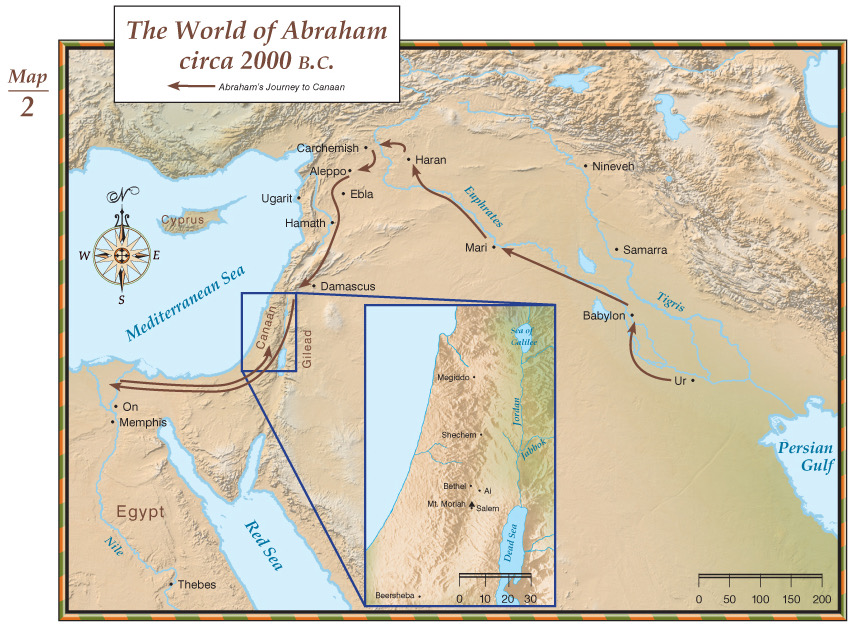
    It is beginning with Abraham in Mesopotamia/Ur, then Haran, then Canaan.

    Abraham’s Route
    Abraham’s Route

    Abraham was called while in Ur,2 and again in Haran.3

    He was called to enter into the country of Canaan, and claim that country as his own.

    That activity would begin the specific work of God in relation to His redemptive plan, the plan of Psalm 2:6-9 = the purpose of God to give to the Son the inheritance of Jerusalem, and a people, and the nations, on the earth as brethren.

    The key to the purpose of God, and one that has caused the most confusion for the contemporary church, is the role of Israel in that redemptive purpose.

    Remember:

    Jesus said:

    25 In the same way He took the cup also after supper, saying, “This cup is the new covenant in My blood; do this, as often as you drink it, in remembrance of Me.”  (1 Corinthians 11:25, LSB)

    The New Covenant, whatever that is, must have been important since He said that His blood secures it.

    His death, then, is the New Covenant “sacrifice” of some sort in order to accomplish the arrangement.

    And, the purpose of His death is also summed up in the New Covenant.

    The end result is that we are supposed to remember His death, and these things, when we participate in the Lord’s Supper.

    To be unaware of these things is to take the supper in ignorance, leading to ritualism, or, more likely, leads to eating and drinking in an unworthy manner.

    What we see, when we examine the death of Christ, and the New Covenant, carefully are the following:

    1. The New Covenant is the very core of the gospel of Jesus Christ.
    2. The New Covenant unites the OT and the NT.
    3. The New Covenant clarifies who Israel is.
    4. The New Covenant clarifies who the church is.
    5. The New Covenant is the only covenant made with Israel which forgives sins.
    6. Without the New Covenant, all the elect would remain in their sins.

    We have covered that: the New Covenant is the core of the gospel since it is the means of:

    • a new heart
    • the forgiveness of sins
    • Indwelling Holy Spirit
    • Provision of obedience to Mosaic Law, thus completing the Abrahamic promise (Leviticus 26:40-41)

    The New Covenant uniting the OT and NT in that all the OT covenants are with Israel and are the result of, and means of, the eternal purpose of God on earth through Christ.

    • Noahic Covenant
    • Abrahamic Covenant
    • Priestly Covenant
    • Mosaic Covenant
    • Davidic Covenant
    • New Covenant

    Today, we need to clarify who Israel is, and is not, in order to see how the New Covenant reflects on them.

    Without the clarity of who Israel is, we are also confused concerning the New Covenant as well as the Kingdom of God as a whole.

    NOTE: in the church today, we can see the grandchildren of the movement that equates the church with Israel, and vice-versa.

    • baptism equated with circumcision
    • land promises conflated to spiritual blessings
    • the Law of Moses equal to the church’s responsibility
    • the general promises of a kingdom to Israel given to the church thus removing them from Israel altogether.

    Overall, the modern church has little to no comprehension that Israel is the key to the fulfillment of the Father’s promise to the Son.

    The Origin of Israel

    The Mosaic Covenant

    The Apostasy of Israel

    Idolatry and the Crucifixion of Christ

    The Repentance of Israel

    The Holy Spirit and the New Covenant

    Once we have a clear handle on these things, we can see that:

    The church is not Israel.

    Israel is not the church.

    The Origin of Israel

    How did Israel begin?

    Since the New Covenant is a covenant with Israel alone, where did they come from?

    The origin of the nation of Israel began with one man, Abraham, and his wife Sarah. 
    

    14 And Yahweh said to Abram, after Lot had separated from him, “Now lift up your eyes and look from the place where you are, northward and southward and eastward and westward;

    15 for all the land which you see, I will give it to you and to your seed forever.

    16 “And I will make your seed as the dust of the earth, so that if anyone can number the dust of the earth, then your seed can also be numbered.

    17 “Arise, walk about the land through its length and breadth; for I will give it to you.”

    18 Then Abram moved his tent and came and lived by the oaks of Mamre, which are in Hebron, and there he built an altar to Yahweh.  (Genesis 13:14–18, LSB)

    And, the people who left Egypt at the Exodus were the descendants, the “seed,” of Abraham.

    Then God said to Abram, “Know for certain that your seed will be sojourners in a land that is not theirs, and they will be enslaved and mistreated four hundred years.

    14 “But I will also judge the nation to whom they are enslaved, and afterward they will come out with many possessions.

    15 “As for you, you shall go to your fathers in peace; you will be buried at a good old age.

    16 “Then in the fourth generation they will return here, for the iniquity of the Amorite is not yet complete.”  (Genesis 15:13–16, LSB)

    It was when they left Egypt that the seed went from a coalition of descendants of Abraham alone, to a functioning nation, who, over 40 years from the Exodus, entered the land God promised Abraham.

    The Exodus from Egypt identified the Hebrews as the nation of Jacob’s descendants, Israel.

    The Mosaic Covenant brought Israel into an agreement with YHWH in that, if they obeyed it fully, then YHWH would give to them the promise to Abraham.

    They had the Law, entered a land, had God as their King (until Saul), a means of sacrifice, and a working military.

    This was the point at which they became a nation.4

    They were separate from Egypt, Canaan, Amorites, and other nations.

    This was the fulfillment of God’s promise to Abraham…initially.

    The nation of Israel, then, endured existence from 1400 BC to around 586 BC as an independent, self-governing, and at times even a dominant nation, in the world.

    In 586 BC, Nebuchadnezzar took Judah into captivity and, after leaving some in the land, brought thousands of captives back to Babylon (Iraq).5

    Furthermore, all the leaders of the priests and the people were very unfaithful following all the abominations of the nations; and they defiled the house of Yahweh which He had set apart as holy in Jerusalem.  (2 Chronicles 36:14, LSB)

    15 And Yahweh, the God of their fathers, sent word to them again and again by the hand of His messengers, because He had compassion on His people and on His habitation;

    16 but they continually mocked the messengers of God, despised His words and scoffed at His prophets, until the wrath of Yahweh arose against His people, until there was no remedy.

    17 Therefore He brought up against them the king of the Chaldeans who killed their choice men with the sword in the house of their sanctuary, and had no compassion on choice man or virgin, old man or infirm; He gave them all into his hand.

    18 And all the articles of the house of God, great and small, and the treasures of the house of Yahweh, and the treasures of the king and of his officials, he brought them all to Babylon.

    19 Then they burned the house of God and tore down the wall of Jerusalem, and burned all its palaces with fire and destroyed all its valuable articles.

    20 And those who had escaped from the sword he took away into exile to Babylon; and they were slaves to him and to his sons until the rule of the kingdom of Persia,

    21 to fulfill the word of Yahweh by the mouth of Jeremiah, until the land had made up for its sabbaths. All the days of its desolation it kept sabbath until seventy years were fulfilled.  (2 Chronicles 36:15–21, LSB)

    The Apostasy of Israel

    Israel was under covenant with YHWH in order that they would confess their sins, offer sacrifices for their sins, walk in His righteousness, and love Him with all their heart.

    However, they almost never fulfilled their covenant with YHWH.

    In the 3,473 years of existence, there have only been (4) times of national faithfulness to YHWH:

    – The generation of Joshua, the commander of the army with Moses.

    • 16 And they answered Joshua, saying, “All that you have commanded us we will do, and wherever you send us we will go.
      17 “Just as we listened to Moses in all things, so we will listen to you; only may Yahweh your God be with you as He was with Moses.
      18 “Anyone who rebels against your command and does not listen to your words, in all that you command him, shall be put to death; only be strong and courageous.”  (Joshua 1:16–18, LSB)
      • 31 And Israel served Yahweh all the days of Joshua and all the days of the elders who survived Joshua, who knew all the work of Yahweh which He had done for Israel.  (Joshua 24:31, LSB)
        • 7 And the people served Yahweh all the days of Joshua and all the days of the elders who survived Joshua, who saw all the great work of Yahweh which He had done for Israel.  (Judges 2:7, LSB)

    – The generation under David’s rule

    5:1 Then all the tribes of Israel came to David at Hebron and said, “Behold, we are your bone and your flesh.

    2 “Previously, when Saul was king over us, you were the one who led out and brought in Israel; and Yahweh said to you, ‘You will shepherd My people Israel, and you will be a ruler over Israel.’”

    3 So all the elders of Israel came to the king at Hebron, and King David cut a covenant with them in Hebron before Yahweh; then they anointed David king over Israel.

    4 Now David was thirty years old when he became king, and he reigned forty years.  (2 Samuel 5:1–4, LSB)

    – The generation under Asa

    • 9 And he gathered all Judah and Benjamin and those from Ephraim, Manasseh and Simeon who sojourned with them, for many defected to him from Israel when they saw that Yahweh his God was with him.
      10 So they assembled at Jerusalem in the third month of the fifteenth year of Asa’s reign.
      11 And they sacrificed to Yahweh that day 700 oxen and 7,000 sheep from the spoil they had brought.
      12 They entered into the covenant to seek Yahweh, the God of their fathers, with all their heart and soul;
      13 and whoever would not seek Yahweh, the God of Israel, should be put to death, whether small or great, man or woman.  (2 Chronicles 15:9–13, LSB)

    – The generation under Josiah

    • 27 because your heart was soft and you humbled yourself before God when you heard His words against this place and against its inhabitants, and because you humbled yourself before Me, tore your clothes and wept before Me, I truly have heard you,” declares Yahweh.  (2 Chronicles 34:27 , LSB)

    The culmination of the apostasy of Israel was the generation of the Messiah, Jesus Christ.

    The generation which existed when Christ came was the generation most responsible for the height of hypocrisy and evil of all the generations of the nation of Israel.

    Nothing compares to the darkness of that generation in that:

    – Their father was the devil

    • “You are of your father the devil, and you want to do the desires of your father. He was a murderer from the beginning, and does not stand in the truth because there is no truth in him. Whenever he speaks a lie, he speaks from his own nature, for he is a liar and the father of lies.  (John 8:44, LSB)

    – The “hour of darkness” was theirs to use freely

    • “While I was with you daily in the temple, you did not stretch out your hands against Me, but this hour and the authority of darkness are yours.”  (Luke 22:53, LSB)

    – They resisted the believing in Christ

    • 24 The Jews then gathered around Him, and were saying to Him, “How long will You keep us in suspense? If You are the Christ, tell us openly.”
      25 Jesus answered them, “I told you, and you do not believe; the works that I do in My Father’s name, these bear witness of Me.
      26 “But you do not believe because you are not of My sheep.
      27 “My sheep hear My voice, and I know them, and they follow Me;
      28 and I give eternal life to them, and they will never perish—ever; and no one will snatch them out of My hand.  (John 10:24–28, LSB)

    – They tried to keep thousands out of the kingdom

    • 13 “But woe to you, scribes and Pharisees, hypocrites, because you shut off the kingdom of heaven from people; for you do not enter in yourselves, nor do you allow those who are entering to go in.  (Matthew 23:13, LSB)

    That generation of the Jews who were present at the coming of Christ, those in leadership and directing the affairs of the Temple, those established as the architects of Judaism and rabbinic theology, they, empowered by Satan and established by their own systemic and profound hypocrisy, executed the Messiah, who willingly owned their own guilt, and went to their graves with nothing but jealous hatred for God.

    At the judgment of God in the future, God will affect upon them all the guilt of all the righteous blood shed upon the earth in the entire history of Israel.

    They will even persecute the church (“prophets,” “wise men,” “scribes”), chasing them down to death and excommunication.

    34 “On account of this, behold, I am sending you prophets and wise men and scribes; some of them you will kill and crucify, and some of them you will flog in your synagogues, and persecute from city to city,

    35 so that upon you may fall the guilt of all the righteous blood shed on earth, from the blood of righteous Abel to the blood of Zechariah, the son of Berechiah, whom you murdered between the sanctuary and the altar.

    36 “Truly I say to you, all these things will come upon this generation.  (Matthew 23:34–36, LSB)

    It can appear that all hope is lost for the realization of the promise to Abraham.

    Remember, the promise to Abraham can only be realized by the admission of sin and guilt by the nation of Israel.

    40If they confess their iniquity and the iniquity of their fathers, in their unfaithfulness which they committed against Me, and also how they walked in hostility against Me—

    41 I also was walking in hostility against them, to bring them into the land of their enemies—or if their uncircumcised heart becomes humbled so that they then make up for their iniquity,

    42 then I will remember My covenant with Jacob, and I will remember also My covenant with Isaac and My covenant with Abraham as well, and I will remember the land.  (Leviticus 26:40–42, LSB)

    However….

    The Repentance of Israel

    8 ‘And it will be in that day,’ declares Yahweh of hosts, ‘that I will break his yoke from off your neck and will tear off your bonds; and strangers will no longer make them their slaves.

    9 ‘But they shall be a slave to Yahweh their God and David their king, whom I will raise up for them.

    10 ‘Fear not, O Jacob My servant,’ declares Yahweh,

    ‘And do not be dismayed, O Israel;

    For behold, I will save you from afar

    And your seed from the land of their captivity.

    And Jacob will return and will be quiet and at ease,

    And no one will make him tremble.  (Jeremiah 30:8–10, LSB)

    When that nation is made right with YHWH, by the keeping of their covenant, then all the promise God made to Abraham, the national transcendence, the people, and the land of Abraham, will be seen visibly in the world.

    13 For the promise to Abraham or to his seed that he would be heir of the world was not through the Law, but through the righteousness of faith.  (Romans 4:13, LSB)

    And, if the promise to Abraham is the very same promise to the Son, then how can the plan of the Father, the promise, be accomplished?

    It can only be accomplished by the repentance of Israel.

    Therefore, it is critical to the eternal purpose of God that Israel repent and believe in Messiah.

    NOTE: Yet, their unbelief produced the crucifixion of the Messiah, thus the atonement, and the fulfillment of the Word of God.

    “Then after the sixty-two weeks the Messiah will be cut off and have nothing, and the people of the prince who is to come will destroy the city and the sanctuary. And its end will come with a flood; even to the end there will be war; desolations are decreed.  (Daniel 9:26, LSB)

    How could Israel EVER circumcise their heart, love YHWH with all their heart, soul, and mind, and undo the damage done by the execution of the Messiah?!

    By the New Covenant

    The New Covenant

    31“Behold, days are coming,” declares Yahweh, “when I will cut a new covenant with the house of Israel and with the house of Judah,

    32 not like the covenant which I cut with their fathers in the day I took them by the hand to bring them out of the land of Egypt, My covenant which they broke, but I was a husband to them,” declares Yahweh.

    33 “But this is the covenant which I will cut with the house of Israel after those days,” declares Yahweh: “I will put My law within them, and on their heart I will write it; and I will be their God, and they shall be My people.

    34 “And they will not teach again, each man his neighbor and each man his brother, saying, ‘Know Yahweh,’ for they will all know Me, from the least of them to the greatest of them,” declares Yahweh, “for I will forgive their iniquity, and their sin I will remember no more.”  (Jeremiah 31:31–34, LSB)

    This new covenant, which is written like a promise, will not set aside the Old Covenant, as if that bilateral covenant does not need to be kept.

    In fact, unless the New Covenant comes, the nation of Israel cannot keep the Mosaic Covenant, which they promised to keep.

    The Lord’s Supper

    25 In the same way He took the cup also after supper, saying, “This cup is the new covenant in My blood; do this, as often as you drink it, in remembrance of Me.”  (1 Corinthians 11:25, LSB)

    This is the reason for the death of the Messiah.

    His death confirmed the New Covenant-the Lamb/sacrifice of the Son in order to provide the payment of the sins of Israel, and all who are elected of God.

    The means, then, by which God will truly atone for sins, not simply cover over them, but actually make the sinner new, is through the sacrifice of the Son of God on their behalf.

    But, here is the important question:

    How will the Son of God be sacrificed for Israel, and their once-for-all atonement?

    How will God accomplish the necessary security of a new sacrifice, not like the system of sacrifices of the Mosaic Covenant, and yet, secures the Abrahamic promise which depends upon the Mosaic Covenant?

    The Incognito Ministry of the Messiah

    And He earnestly warned them not to tell who He was.  (Mark 3:12, LSB)

    And He gave them orders not to tell anyone; but the more He was ordering them, the more widely they continued to proclaim it.  (Mark 7:36, LSB)

    And He gave them strict orders that no one should know about this, and He said that some food should be given to her to eat.  (Mark 5:43, LSB)

    The Lord established in His ministry the constant order to hold back from telling the people Who He was.

    This meant that He was not wanting the people to know about Him as Messiah, but only that He would do the works of the Messiah letting people to draw the conclusions based upon that.

    This was so that the true nature of the leadership of Israel would become evident, thus leading to the crucifixion, the necessary death of the New Covenant Lamb of God.

    13 Now when Jesus came into the district of Caesarea Philippi, He was asking His disciples, saying, “Who do people say that the Son of Man is?”

    14 And they said, “Some say John the Baptist; and others, Elijah; but still others, Jeremiah, or one of the prophets.”

    15 He said to them, “But who do you say that I am?”

    16 And Simon Peter answered and said, “You are the Christ, the Son of the living God.”

    17 And Jesus answered and said to him, “Blessed are you, Simon Bar-Jonah, because flesh and blood did not reveal this to you, but My Father who is in heaven.

    18 “And I also say to you that you are Peter, and upon this rock I will build My church; and the gates of Hades will not overpower it.

    19 “I will give you the keys of the kingdom of heaven; and whatever you bind on earth shall have been bound in heaven, and whatever you loose on earth shall have been loosed in heaven.”

    20 Then He warned the disciples that they should tell no one that He was the Christ.

    21 From that time Jesus began to show His disciples that He must go to Jerusalem, and suffer many things from the elders and chief priests and scribes, and be killed, and be raised up on the third day.  (Matthew 16:13–21, LSB)

    Have you ever wondered why Jesus would say this? 
    

    It is because of the requirement that He would draw out the murderous hearts of the leadership, their jealousy, by His works, and drive them to the murder that would 1) seal their eternal damnation, and 2) secure the atoning sacrifice of the Lamb.

    36 “But the witness I have is greater than the witness of John; for the works which the Father has given Me to finish—the very works that I do—bear witness about Me, that the Father has sent Me.

    37 “And the Father who sent Me, He has borne witness about Me. You have neither heard His voice at any time nor seen His form.

    38 “And you do not have His word abiding in you, for you do not believe Him whom He sent.  (John 5:36–38, LSB)

    This death, produced by the jealousy of the leadership of Israel as they witnessed His works, instead of snuffing out His influence, secured the atoning sacrifice for the sins of Israel and Gentiles…forever!

    Therefore, His kingdom was secured by His death and resurrection, but not through the nation of Israel, although the Mosaic Law is the keep component in fulfilling that kingdom promise, which was communicated in the Abrahamic Promise.

    His Kingdom, then, has been taken away from the nation of Israel, and given to the nations of the world!

    Conclusion

    33 “Listen to another parable. There was a landowner who planted a vineyard and put a wall around it and dug a wine press in it, and built a tower, and rented it out to vine-growers and went on a journey.

    34 “Now when the harvest time approached, he sent his slaves to the vine-growers to receive his fruit.

    35 “And the vine-growers took his slaves and beat one, and killed another, and stoned a third.

    36 “Again he sent another group of slaves larger than the first; and they did the same thing to them.

    37 “But afterward he sent his son to them, saying, ‘They will respect my son.’

    38 “But when the vine-growers saw the son, they said among themselves, ‘This is the heir; come, let us kill him and seize his inheritance.’

    39 “And they took him, and threw him out of the vineyard and killed him.

    40 “Therefore when the owner of the vineyard comes, what will he do to those vine-growers?”

    41 They said to Him, “He will bring those wretches to a wretched end, and will rent out the vineyard to other vine-growers who will pay him the proceeds at the proper seasons.”

    42 Jesus said to them, “Did you never read in the Scriptures,

    ‘The stone which the builders rejected,

    This has become the chief corner stone;

    This came about from the Lord,

    and it is marvelous in our eyes’?

    43 “Therefore I say to you, the kingdom of God will be taken away from you and given to a nation, producing the fruit of it.

    44 “And he who falls on this stone will be broken to pieces; but on whomever it falls, it will scatter him like dust.”

    45 And when the chief priests and the Pharisees heard His parables, they understood that He was speaking about them.

    46 And although they were seeking to seize Him, they feared the crowds, because they were regarding Him to be a prophet.  (Matthew 21:33–46, LSB)

    Footnotes:

    1. See Paul Tanner, “Old Testament Chronology and Its Implications For The Creation and Flood Accounts” Bibliotheca Sacra, vol. 172, Jan-Mar, 2015’ pp.24-44.
    2. And he said, “Hear me, brothers and fathers! The God of glory appeared to our father Abraham when he was in Mesopotamia, before he lived in Haran,
      3 and said to him, ‘Leave your country and your relatives, and come into the land that I will show you.’
      4 “Then he left the land of the Chaldeans and settled in Haran. From there, after his father died, God had him move to this country in which you are now living.  (Acts 7:2–4, LSB)
    3. So Abram went forth as Yahweh had spoken to him; and Lot went with him. Now Abram was seventy-five years old when he departed from Haran.  (Genesis 12:4, LSB)
    4. I am referring to the entire exodus event. This includes leaving Egypt, arriving at Mt. Sinai, receiving the Law from God, and being independent of any country around.
    5. At the return under Cyrus, there were 42,360 present.
      The whole assembly together was 42,360,  (Ezra 2:64, LSB)
  • No Room For Cowards In The Kingdom

    No Room For Cowards In The Kingdom

    Matthew 8:23–27 (LSB)

    23And when He got into the boat, His disciples followed Him.

    24And behold, there arose a great storm on the sea, so that the boat was being covered with the waves; but Jesus Himself was sleeping.

    25And they came to Him and got Him up, saying, “Save us, Lord; we are perishing!”

    26And He said to them, “Why are you so cowardly, you men of little faith?” Then He got up and rebuked the winds and the sea, and it became perfectly calm.

    27And the men marveled, and said, “What kind of a man is this, that even the winds and the sea obey Him?”

    While writing an essay this morning, I was struck by time when the veteran sailors were caught in a squall on the Sea of Galilee and Jesus was asleep on the floor of the boat’s hull.1The men were desperate, fearing they were going to capsize and drown. They even said as much to the Lord, who, Himself, was asleep on the floorboards. Mark tells us that the boat was filling up with water and the wind seemed near to breaking the mast, and sail.2

    Matthew (and Mark) records Jesus’ response to their panic and fear. He said, “Why are you so cowardly?!” Matthew and Mark record it correctly using the term “cowardly.” This is a Greek term which means just that, “lacking courage.” It is only used a handful of times in the New Testament, but the meaning is always the same – a reasonable, but sinful, lack of courage to remain faithful.

    That might seem innocuous and nonchalant in that there is essentially no harm to anyone if a man is a coward once in a while. After all, who can blame these men for lacking courage against a severe storm which can, and historically has, claimed the lives of men before?

    And yet, this same term describes men (and women) who are not allowed into the Kingdom of God.

    Revelation 21:8 (LSB)

    8 “But for the cowardly and unbelieving and abominable and murderers and sexually immoral persons and sorcerers and idolaters and all liars, their part will be in the lake that burns with fire and brimstone, which is the second death.”

    The cowardly rank in the category of those who cannot, and will not, enter the precious Kingdom the Father has prepared for the Son. They are effectively, says John, “unbelieving…abominable…murderous” and they are linked in with the immoral, sorcerers, idolaters, and liars. Surely, none of these qualities are harmless, right?

    Why, then, is being a coward so bad?

    Cowardice is bad for the following reasons:

    1. Jesus said it was. Jesus told the disciples in John 14:27 that they must not let their hearts become cowardice. The world has its peace, and Christ has His peace. Being at peace in the world manifests cowardice towards Christ.
    2. Cowardice also evidences being ashamed of Jesus and His Word. Those who are completely convinced of the nature of Jesus Christ, and the truthfulness of His Word, are courageous and bold. However, those who attribute supreme influence to other things in the world, will find the commands of Christ to be shameful to them.
    3. Cowardice is also evidence of a lack of regeneration. Regeneration makes a man bold and strong in the Lord. However, cowardice evidences that that new creation by God has not taken place in the heart of the person.
    4. Cowardice is also evidence of a lack of love for God. A love for God will be impervious to the fear of men.

    The nature of God, and His Kingdom, is such that its glory and power cannot be hidden nor can it be treated lightly. To be ashamed of either is to display a horrible lack of priorities. The beauty, power, light, and eternal glory of Jesus Christ, the Father, and the Spirit, as recorded in the Word, does not give room to a man who refuses to ascribe to them such glory. This is what a coward is. He is a man who cannot, either in the heart or in public, ascribe the unmatched and unfathomable glory due to God, even in the midst of taunting storms.

    1. See Matthew 8:23-27; Mark 4:36-41; Luke 8:22-25
    2. Mark 5:36-37
  • Why Study Protology?

    Why Study Protology?

    Protology is the study of “first things.” First things refers to whatever information we have in Scripture about things before creation, at creation, and immediately following creation.1 Just as eschatology is the study of “last things,” things related to the end of time, protology is the study of things before, and at, the beginning of time.

    As I mentioned in my last essay, there is an imbalance between the two. Much weight is put on eschatology, and rightly so, but almost none is put on protology. The result is a shot-in-the-dark approach to understanding why God created the world, and how that informs His purpose throughout time, and into eternity. That guess-work has produced some very shoddy theologies that cannot hold up under biblical scrutiny. The result of that is an unsanctified church that does not know her Father’s will.

    My goal in this essay is to begin to explain in greater detail exactly what happened before creation which motivated the forming of creation itself. In doing that, we will also deal with God’s purpose, motives, and plan for all things. The Bible does give us that information. And the church is the steward of that information, a stewardship that is not being handled properly.

    The Problems With Modern Theology

    Dispensationalism has no real answer for the question, “What was God’s purpose for creating the world?” The most oft response is, “It was created for His glory.” This is a true statement, but the answer appears more of a catch-all phrase used when you really don’t know the answer. It is akin to the term “pan-millennialism” when asked about eschatology; “It will all pan out in the end.” Well, in reality, that is no answer.

    Covenantalists believe there was a council, or series of councils, in which the Father, Son, and Holy Spirit worked out the plan and roles of creation and redemption by pact, or “covenant.” They claim that God covenanted the various aspects of which One of God would be the Redeemer, Regenerator, and the Initiator of redemption of sinners. It was decided by “pact,” or covenant in the eternal councils before time.

    That is no answer either since the information for such a council, or councils, is scant. It is obvious that there was some kind of conversation within God that produced the existence of the world, and permitted the fall in order to manufacture redemption. These monumental things simply don’t happen by accident. However, their answer is no answer either since the ideals of a pact and the details imagined by Covenantalists simply don’t comport with the revelation of Scripture.

    Some Dispensationalists even affirm such covenants as above simply by concession, and not by evidence. It is unfortunate that some Dispensationalists concede such ideals when they know very well that the fruit of such a system is not consistent with Scripture (i.e. infant baptism, replacement/fulfillment of Israel with the church, Amillennialism/Postmillennialism, etc). But, since they haven’t been able to discover the information necessary to understand what actually happened in God to motivate the creation of the world, and the activities of redemption, they simply set aside convictions against the covenants of Covenant Theology and move on to the debates of more sure footing.

    However, this is not necessary. It is not necessary for Dispensationalists to hand over what is arguably the most critical and fundamental aspect of theology, the study of first things, simply for concession. As one who has for at least 30 years grappled with the doctrines, problems, successes, and failures of Dispensationalism and Covenant Theology, I can tell you that we have a definitive piece of revelation in Scripture, a theological “smoking gun” if you will, that fills in the ethereal “all things are for the glory of God” statement with data. These data, which I will produce in this series, is enough to rewrite, and revise, a proper and true theology that is consistent with Scripture throughout. For that I am excited! I am excited because this means that more questions can be answered, greater clarity can be had, Truth can be more definitively understood, and God’s plan, being understood in greater detail, can give Him the due glory in greater measure.

    Before “In the Beginning”

    Ge 1:1 In the beginning God created the heavens and the earth.  (Genesis 1:1, LSB)

    At the beginning of the first day of the six days of the creation week, the seventh day being the creation of a day of rest since God rested from His creation work, God created the heavens and the earth. I believe that this is a statement of the creation of the dark matter in the cosmos and our planet before the land appeared out of water. The creation of the heavens and the earth started the creation clock ticking. Since that time, God has been working (John 5:17), working His purpose in history and time.

    But, what is that purpose? What was the motivation for creating the heavens and the earth, and filling them with the stellar bodies, creatures, and ultimately the man and woman? Is there a motive that can be read and understood in the proper reading of Scripture?

    Yes.

    Foundation

    Jesus gives us His Word concerning the creation of the man, Adam, and the subsequent fall of Adam by work of Satan. This is found in the parable section of Matthew 13. There, along with other parables meant to describe and explain the Kingdom of Heaven in light of its impending mystery form, Jesus tells us what happened in Genesis 1-3.

    I am referring to the parable of the Tares and the Wheat (Matthew 13:24-30). That parable contains a detail that is unique to Tare and Wheat parable alone. The tense of the verb that Matthew records there is unique, and significant. Although the verb is repeated in all seven parables of Matthew 13, only in v.24 is the verb aorist passive indicative. Those three terms indicate for us a lot of information.

    Aorist

    A.T. Robertson wrote the definitive work on Koine Greek, the language of the New Testament (NT). When addressing the issues surrounding the aorist “tense,” he wrote:

    “It is true that in the expression of past time in the indicative and with all the other moods, the aorist is the tense used as a matter of course, unless there was special reason for using some other tense.”2

    However, the sense of past time action is not in the aorist tense. Aorist indicates “punctiliar” action, and can be further divided into tense, as it were, from a combination of the stem of the verb, the context, and the aorist vs. other tenses used. To get to the point, when the aorist tense is used, and it wants to describe an action in the past, which is the default mood to show that as per the above quote, we call it the “ingressive aorist.” That is, the aorist is describing the action, or state, of the verb as having begun in the past at some point in time.

    Passive

    When a verb is wanting to describe an action that happens to a subject, it is in the passive. If I hit a ball, that is active. I hit the ball. However, it is a different matter if the ball hit me; I was hit by the ball. The second example is passive. The ball hit me, and it hurt.

    The verb Jesus used in Matthew 13:24 is passive. The subject of the verb is the Kingdom of Heaven. The subject is acted upon by the verb, which, in this case, is a description of the subject, the Kingdom.

    Indicative

    In Greek grammar, this is called the “mood” of the verb. It tells us the kind of statement something is. It is the “mood” of the verb that is on display. Indicative mood tells us that the verb is a statement, a factual idea indicating a fact of something. There are other moods that describe other kinds of things and descriptions of the subject.

    Summary

    I took the time to look at some of the skeleton of the verse. I also took some liberties to explain things that most don’t readily see in the text, unless they know Greek. But, I did this in order to try and give some justification for what I am about to say, and to have opportunity for scrutiny from those who know Greek better than I do.

    The summary of Jesus’ words in Matthew 13:24-30 is this:

    “The Kingdom of Heaven was/began to be like…” The parable goes on to describe various aspects of the Kingdom of Heaven. Its original intention was for the sons of God to grow and thrive, like wheat plants in a field.

    But, an enemy of the farmer planted weeds in the field of the wheat, forcing the farmer to wait until the harvest to separate them lest the wheat gets accidentally damaged, and the crop is ruined.

    The metaphor is explained to the disciples, and us, that each component in the parable corresponds to an actual historical person, or object.

    The sum of Jesus’ teaching is that the Son of Man created man to live on the earth with Him. The Devil came and introduced sons of his own. These two populate the earth from that point forward.

    The Kingdom of Heaven, then, was the original creation as recorded in Genesis 1:1-2. The fall of Adam was the introduction of evil into the Kingdom, as recorded in Genesis 3. Currently, in the Kingdom, which refers to the creation of man and the earth (Psalm 2:8), there are sons of God (i.e. elect), and the sons of the devil (i.e. non-elect). The sons of God were determined by Father, and created for the Son, to exist forever in the Kingdom.3

    Conclusion

    To end this essay, we just need to see a few things. First, the Kingdom of God was the original design of God, recorded for us in Genesis 1-2. Next, God created the earth for the sons of God to live with Him forever.4 Finally, that design was corrupted by the enemy of God, Satan. His work caused God to take the life of Adam and Eve. Satan effectively ruled the world, the kingdom, from that point.5

    1. On the basis of the inerrancy of Scripture, and the dubious character of extra-biblical accounts of creation (i.e. Enuma Elish), I reject all supposed creation accounts extant in the cultures of the Ancient Near East.
    2. A. T. Robertson, A Grammar of the Greek New Testament in the Light of Historical Research (Logos Bible Software, 2006), 831.
    3. See Revelation 22:5 for some evidence that ruling, reigning, with God (v.3) was the original design of God since the eternal end result was just that.
    4. See Luke 3:38
    5. Luke 4:6; cp. 1 John 5:19
  • What Comes First: Hermeneutics or Exegesis?

    What Comes First: Hermeneutics or Exegesis?

    The Ridge or the Base

    For those who are aware of the issues, the above question is a significant one. For those who are not aware of the issues, let me summarize for you so that this essay makes some contribution to the next time you open the Bible and read.

    The issue raised by this question is the quandary of whether a man A) should read Scripture with interpretation in mind first, or B) whether he should disband the attempt to interpret until after he has done the work of exegesis. Or, in other words, should the Bible be read with a intent to interpret, or should he deal with the words on the page as words before he can interpret?

    The position of this essay is B. It will become evident that before any interpretation can be done, a man must work through the meaning of the words on the page of Scripture first. That work is called “exegesis.” It is similar to scaling a mountain by establishing a base in order to begin the ascent to the ridge.

    Definitions

    In order to make sure we are all playing the same game, we need to understand the definitions of the terms germane to our discussion.

    • Inerrancy
      • The quality and nature of the Bible, the 66 books of the Protestant canon, being from God through the pens of men, make the Bible a singular revelation, self-disclosure.
      • This collection of writings, in the original forms, were without error in form, content, and syntax.
    • Exegesis
      • “Exegesis” is the critical or technical application of hermeneutical principles to a biblical text in the regional language with a view to the exposition or declaration of its meaning.”1
      • I will take some liberties with this definition pertinent to our discussion.
    • Hermeneutics 2
      • “Hermeneutics is the science of interpretation.
      • It is a science, and not an art.
    • Exposition
      • “’Exposition’ is defined as a discourse setting forth the meaning of a passage in a popular form.” 3
      • In other words, “exposition” is the proclamation a man does after he has worked hard at Exegesis and Hermeneutics.

    These definitions are not my own, necessarily. However, I believe these definitions as my own. I will make a distinction in the term Exegesis that needs to be clarified, but otherwise they are what I believe.

    First Step

    The basis of exegetical, hermeneutical, and expositional work is Inerrancy. Once Inerrancy is removed, redefined, or altered in any way, the other three components come crashing down. Inerrancy is the quality of the original manuscripts and are the only manuscripts of that nature in history. 4 Therefore, with that as the basis, how we work through the text of Scripture will reveal how well we understand and respect Inerrancy.

    The process of the determination of whether Exegesis comes before Hermeneutics, or the other way around, is based upon Inerrancy. Inerrancy affirms that every word, word form, word arrangement, and every detail of those arrangements, in the original languages, is inspired and cannot be altered without doing harm to the Spirit-inspired meaning of the text.

    For example, Paul wrote:

    Galatians 3:16 (LSB)

    16 Now the promises were spoken to Abraham and to his seed. He does not say, “And to seeds,” as referring to many, but rather to one, “And to your seed,” that is, Christ. 5

    The Greek text is as follows:

    Galatians 3:16 (UBS5)

    16 τῷ δὲ Ἀβραὰμ ἐρρέθησαν αἱ ἐπαγγελίαι καὶ τῷ σπέρματι αὐτοῦ. οὐ λέγει, Καὶ τοῖς σπέρμασιν, ὡς ἐπὶ πολλῶν ἀλλʼ ὡς ἐφʼ ἑνός, Καὶ τῷ σπέρματί σου, ὅς ἐστιν Χριστός. 6

    In this example, one of many that I could use, Paul demonstrates his argument of the Messianic Kingdom, as promised to Abraham and his “seed,” with the noun “seed” as singular. Paul tells that the original text of Genesis 17:7, as found in the Hebrew language there, is not plural as in “seeds.” But, if we look into that passage, we do see that the covenant was made with Abraham as well as the Seed, the Christ. However, that is for another discussion.

    The point is, the fact that the original language has a singular noun there, and that Paul based his argument upon that singularity, gives us indication of the nature of Inerrancy. The Spirit of God put that direct object as a singular, masculine, noun-a male seed from the man Abraham.

    In this particular case, it is not possible to come to a conclusion of the meaning apart from this kind of work. We must be committed to, and understand the extent of, Inerrancy so that we can organize our studies correctly.

    Next Step

    Once we commit ourselves to Inerrancy, we must determine the meaning of the words of the text. This is not Hermeneutics. Hermeneutics is the science of Bible interpretation, but unless we know the meanings of the words, the arrangements of the words, and the syntax of those words, we simply cannot take the next step of determining the meaning of the passages that contain those words.

    In other words, unless I know the definitions of the words of an Inerrant passage of Scripture, I cannot interpret them. Those words are not native to me, or anyone alive today, because spoken Hebrew and spoken Greek of today are foreign to the written Hebrew and Greek of the Bible. Therefore, we must investigate, through the tools available to us of lexicography, and work through the definitions of the individual words of a particular passage.

    Please note, we are not interested in the meaning of the passage at this point, only the words that are in that passage.

    For example, looking at that same illustration as above, we have individual words in Koine Greek that, to Paul, mean so much because he spoke and wrote them. However, to me, it is literally Greek, pun intended.

    The best way to come to the definitions of each, and every, word in the passage is to build a table in this way:

    WordParseMeaningNotes
    δὲConjunction, adversativeBut, yet
    τῷ ἈβραὰμMasculine, singular, Dative, Proper nameAbraham
    ἐρρέθησαν3rd person, plural Aorist middle/passive IndicativeThey were spokenHow were they spoken?
    Lexical Table

    I am not worried about the meaning of the passage. I am only trying to learn the meaning of each word of the passage. The meaning of the text as determined by the author, will come together well enough downstream of this foundational work.

    There are other aspects to this that I won’t go into now (i.e. Syntactical Exegesis, Problem Solving, Sentence Diagram). However, I hope this can illustrate the fact that Hermeneutics cannot come before Exegesis. Exegesis is the technical work of words, syntax, and grammar. That work does not concern itself with the overall meaning of the passage, only the trees of the forest. They are the building blocks of meaning for the use of Hermeneutics in the next step.

    Hermeneutics

    Once we have done the exegetical work, we can then sit back and examine everything and interpret what we have found. This work would fill a volume or more to explain. However, the basic and simple rule to follow for accurate hermeneutic is this:

    INTERPRET THE BIBLE THE WAY IT WAS WRITTEN.

    Every passage of Scripture is given in human, known, language. Each passage is given in historical context and with some kind of historical impetus for the author to write. Researching and organizing that information is vital to the hermeneutic. There are subjects of the verb, verbs, direct objects of the verb, etc… These are the things that must be known and comprehended before there is an attempt to understand the meaning of the passage.

    To reverse this process is to put the interpretation before the words of the verse. This is “pretext” and a theological Hermeneutic, not an exegetical one. It is assuming a meaning before the real examination of the passage is made, which dominates the landscape of the church historically and in modernity. It is relying upon another’s work. Since a pastor is to rightly divide the word, reliance upon the work of others is dishonest for the man of God. It is one thing to refer to the work of others and see what they came up with. It is another thing to sidestep the work and go straight to the conclusions of others to see which ones I agree with.

    The science of Bible interpretation is built upon the actual text, a work that is the technical work of exegesis. However, once that exegesis is done, and a good grasp of the language is had, putting it altogether to determine the meaning is next. The “interpretation” is very soon exposed to the exegete. The meaning is discovered, the significance is evident. The historical/grammatical hermeneutic, the only proper way to interpret Scripture since the Scripture was written in actual language and in an historical context, preserves the exegetical work that is done.

    Exposition

    A short statement about exposition is in order. Exposition, as noted above, is the proclamation, explanation, on a popular level, to the audience to whom we speak. Exposition, as with Hermeneutics, does not offend the Exegesis that was done. It is consistent with Exegesis. The rules of the right Hermeneutic that are followed, rules that uphold the Exegesis, will feed the Exposition.

    The effect of this Exposition is that the Holy Spirit, Who inspired the Words in the first place, takes the truths discovered in the text and implants them in the hearts and minds of the saints. The power of the Truth drives deeply into the person via the Spirit of Truth.

    My point in saying all of this is to emphasize that the entire process of the exposition of the Word of God begins with Exegesis, the technical work in the words. This is the beginning of “cutting it straight.”

    Be diligent to present yourself approved to God as a workman who does not need to be ashamed, accurately handling the word of truth.  (2 Timothy 2:15, LSB)

    1. Thomas, Robert L. ‘Bible Translations: The Link between Exegesis and Expository Preaching,’ The Master’s Seminary Journal 1/1 (Spring 1990): p. 54,
      ↩︎
    2. Terry, Milton S. ‘Biblical Hermeneutics: A Treatise on the Interpretation of the Old and New Testaments.’ Edited by George R. Crooks and John F. Hurst. New Edition, Thoroughly Revised. Vol. II. Library of Biblical and Theological Literature. New York; Cincinnati: Eaton & Mains; Curts & Jennings, 1890), p. 17
      . ↩︎
    3. Thomas, p.54 ↩︎
    4. I understand that we do not have those manuscripts in possession. Rather, we have copies of those manuscripts and, through the work of Textual Criticism, we can duplicate the biblical text with tremendous certainty. ↩︎
    5. All quotations will be from The Legacy Standard Bible. Three Sixteen Publishing, 2022, unless otherwise noted. ↩︎
    6. Aland, Barbara, Kurt Aland, Johannes Karavidopoulos, Carlo M. Martini, and Bruce M. Metzger, eds. The Greek New Testament. Fifth Revised Edition. Stuttgart, Germany: Deutsche Bibelgesellschaft, 2014. ↩︎

  • My Tribute to John MacArthur

    My Tribute to John MacArthur

    One of the most enduring portions of the legacy that I can think of from John MacArthur’s life, as it relates to me and thousands of other graduates of The Master’s Seminary, is the very school that equipped us to shepherd the flock of God (1 Peter 5:1-5). The effect of his leadership in the church cannot be known on earth. Only God can see the thousands of ways John shepherded the flock. The result of that has been the most beautiful, godly, devoted, and sincere Christians on the planet. But, it was the formation of an institution which attracted the best professors in the world in order to teach men how to rightly divide the Word of God that most affects me personally. 

    Context

    My introduction to the teaching of John MacArthur was through tapes I listened to and books I read when I became a new Christian in 1992. I read Our Sufficiency In Christ, which removed me from involvement in the psycho-therapy world. I listened to tapes from the gospel of Matthew, which helped me to understand the Lord’s earthly ministry and made me hungry for more. I attended my first Shepherd’s Conference in 1996, which is where I first saw the man. He was unassuming and I was struck at how little fanfare there was around such a “celebrity,” so I thought to myself. I read, and reread, the series from The Master’s Seminary faculty on Pastoral Ministry, Expository Preaching, and Biblical Counseling. 

    All of this to say that when I was first saved, I was insatiably hungry for the Word of God. I didn’t eat or sleep hardly those first few days after believing in Christ. I didn’t want anything else. I did not care about anything else. Although a university student, I began to use that position as a platform to explain the gospel any time I could. When I listened to a tape, or read one of his books, or article, or anything else, I was attracted to what he had to say like a moth to the flame. I was desperate to learn the Word of God, to understand it in the same way. 

    The Master’s Seminary

    My family and I moved to California from Montana in 2003 in order that I would attend The Master’s Seminary. I had seen Dr. Robert L. Thomas answer my questions both personally via email, and publicly during a Q&A at the conference to which I referred earlier. The understanding that he had of the Scriptures was what I coveted. I wanted to know the Scripture like that. My desire to understand the text wasn’t so much because of John MacArthur directly. Rather, it was because of Dr. Thomas. All I knew was I wanted to handle the text the way he does. The precision, clarity, and confidence that he had was life-giving to me. 

    But, what bolstered and supplemented my studies was Sunday worship. I served in Children’s Ministries and participated in a fellowship group, as well as became familiar with so many other ministries. My family and I made friends with so many people. We also learned how church politics work. So much in the body at Grace Community Church directed what I was learning. But it was the text of Scripture itself that gave me life. I could not study enough. I could not listen to sermons enough. I could not hardly stand having to wait for the next class in order to keep learning. 

    It was Dr. Robert Thomas’ teaching, expectations, precision, and personal friendship that compelled me to further study. But, it was Pastor John’s regular presence in the pulpit publicly giving examples of how to handle the text of Scripture for preaching and communicate it in ways that the church could understand. His ministry flavored the church like nothing else. Some might say that that is bad. I say that it is part of the example of leadership. It cannot be helped. The man of God (1 Timothy 6:11) must be part of the hearts of God’s people because of love’s sake (1 Thessalonians 5:12-13). And, I believe that is what John MacArthur (and his family) did. 

    Pivotal Meeting

    It was my second-to-last year of The Master’s Seminary (2008). I was completely unsure where I would go from there. Being Italian, I had considered Italy as a missionary. I considered returning back to Montana to minister there somehow. Or, maybe I would go somewhere else.

    One evening after Sunday service, I went down to talk with John who was staying after service in order to answer questions people might have. I walked up to him and asked him what I should do. He knew me from my service in the church, but I would not say that he knew me very well. I personally did not feel that I had anything of value to offer him. I just wanted to hear what he thought since I was coming to my whit’s end. I was ready to do whatever he said. 

    John said to me, “I’ll tell you what you need to do. Contact my secretary, Pat, and tell her to set up a time for you to come see me. Can you do that?” I was stunned. “Um, yes. I can do that.” I left there in a complete daze. I went back to my wife as she was gathering the kids and told her what happened. She and I both were dizzied with the anticipation of my meeting with him. 

    It took a few weeks, but we finally made it happen. As Dr. Mayhue and Clayton Erb were exiting John’s office, I was graciously invited to enter (at the quizzical looks from Dr. Mayhue and Clayton). I came in, looking around at the books, furniture, and pictures on the wall. John went around and sat at his large broad wooden desk. He asked some personal questions about me, my family, where I’m from etc.. I was fumbling with my answers, not even knowing what to ask or how to carry on a conversation. I am sure he knew how I was feeling, being overwhelmed with being in his office alone with him. 

    He was sitting there, leaning back in his chair with his legs crossed in polite fashion, nonchalantly, while we talked a bit. I told him my ideas of Italy, or Montana. Then, he sat up, and told me in kind of an urgent manner, “Forget Italy. Forget Montana. Find a church somewhere, get in it and preach the Word! Preach to the max!” I don’t remember anything else after that (except that I could use his name on my résumé). I was stunned. In fact, it would be best to say I was dazed to the point of shock. I don’t know what he saw, but something made him urge me to stop playing around and get to the most important thing-preaching the Word! 

    I Will Never Forget

    I will never forget that meeting, that charge. It has been the preaching of the Word that has gotten me voted out of churches, slandered, hated, threatened, and blacklisted. It is the preaching of the Word that has made me an outsider, in many ways to the very institution from which I learned to preach the Word. It has been the preaching of the Word that has caused financial ruin, physical damage from years of bivocational ministry, and alienation from some of my children. It has been the preaching of the Word that has brought so much heartache and pain. 

    But, it is the preaching of the Word that controls me. I have seen people repent and follow Christ. I have ministered to homeless and wealthy. I have seen the work of the Word in overseas nations, and churches. I am seeing it in the depths of my family, and in my own soul and mind as I study and learn.

    I am a man under orders. John gave me the charge, and I will fulfill it. Dr. Thomas gave me the tools, and I will use them. The Lord put both of these men in my life for just such a time as this in order that I might carry out the preaching of the Word of God (Colossians 1:25). The church needs John MacArthurs and Robert Thomases. If no one else will, by God’s grace, I will. 

  • The Lord’s Care For His Church

    The Lord’s Care For His Church

    Luke 9:1–3 (LSB)

    1And calling the twelve together, He gave them power and authority over all the demons and to heal diseases. 

    2And He sent them out to preach the kingdom of God and to heal the sick. 

    3And He said to them, “Take nothing for your journey, neither a staff, nor a bag, nor bread, nor money; nor have two tunics apiece.

    The Lord entered into His ministry with an immersion into the Jordan River. After that, He was tempted and tested for 40 days. After that He was reunited with disciples He made while at the Jordan and then began to make more disciples. All the while, day-in and day-out, they needed to eat, sleep, and drink. The Lord cared for these men while He was with them for the over 3 years they ministered together. Whether it was taking tax money from the fish’s mouth, or multiplying food from a few loaves and fish, or being cared for by a prearranged meal of some sort for Passover, the Lord Jesus Christ cared for His dear flock, the flock which would inherit the kingdom one day (Luke 12:32).

    However, at the end of His ministry, just hours before His execution, He made a very interesting, and often overlooked, statement. Only Luke records it. A year earlier, He told them to go out and preach the gospel of the kingdom and take no provisions for that itinerant journey. This would mean that whatever their needs might be, they would be provided. Apparently, it was oftentimes from good people who housed these men. But, at the end of His ministry, the instructions changed.

    Luke 22:35–38 (LSB)

    35And He said to them, “When I sent you out without money belt and bag and sandals, did you lack anything?” They said, “Not a thing.” 

    36And He said to them, “But now, whoever has a money belt is to take it along, likewise also a bag, and whoever has no sword should sell his garment and buy one. 

    37“For I tell you that this which is written must be completed in Me, ‘And He was numbered with transgressors’; for that which refers to Me has its completion.” 

    38And they said, “Lord, look, here are two swords.” And He said to them, “It is enough.”

    The instructions changed from, “Take nothing for your journey, not tunic, money, sandals…” to “But now, take a money belt, bag, and sword.” What changed? Well-meaning Christians and churches might quote the passage from the middle of His ministry, but ignore the teaching from the end of His ministry.

    When the Lord sent the men out earlier, He promised to care for them. At the end, His promise does not seem to be as miraculous, but it was different nonetheless.

    But Now….

    The key to understanding this passage in relation to the Lord’s provision is this simple phrase, “But now…” The New Testament Greek (UBS5): “Ἀλλὰ νῦν.” The first word is a conjunction (actually, “disjunction”) which emphasizes a contrast from one previous thing to another. The English contrast conjunction “but” is an okay translation, but it does not carry the weight that this conjunction does. It would be better translated, “Rather,” or “yet.” The idea is that it contrasts a previous condition, in this case, the condition of the question and answer discussion in v. 35, with the condition of v.36. Coupled with it is the adverb “now,” a timing indicator as well. It also contrasts the previous discussion in v.35. The timing of v. 35 was during the preaching excursion in the middle of His ministry. But, in contrast to that time, the current time, which is the time of the Lord’s crucifixion and return to the Father, ultimately, this time is different. No longer are you to expect v.35, the Lord’s presence and their lack of preparation. Instead, they are to prepare.

    Jesus is telling these men that the ministry that they are transitioning towards will be different in this regard. They must prepare properly because, even the though the message isn’t changing, and the need is not changing, one thing is changing-He’s leaving them for a while (2,000 years to date).

    The Lord’s provision may still be just as “miraculous,” but now His provision is related to their preparations. Let’s look at each part of His instructions.

    Take A Money Belt

    But now, whoever has a money belt is to take it along, 

    Matthew’s record says:

    Matthew 10:9 (LSB)
    9“Do not acquire gold, or silver, or copper for your money belts,

    The command from the Lord was to not take money for their ministry, only food and shelter. The verb there indicates that this gold, silver, or copper was in response to the their preaching. Jesus forbade that here, for a time. The money belt was like a little purse in which a man would carry his money. This money was for provisions, or taxes, or simply to carry his money safely from town to town.

    But, the Lord’s command here is to not use ministry as a means of making money. They were to concentrate on simply preaching and exercising the powers Jesus would give them to heal the sick, and raise the dead. It would not have been right for people to associate these miracles, and this message preached, with money.

    This change means that their ministry of preaching would change. Although there is no overt reference to it, the change likely also has to do with the cessation of the apostolic gifts associated with their ministry. The Messianic gifts which would accompany the presence of the Messiah, and His kingdom, must not have the appearance of dependence upon the people who are hearing the kingdom message for the first time. Rather, they must hear the message, and see the miracles, completely unattached to the normal fees associated with itinerant teachers and wandering philosophers of the day.

    However, since the formation of the church is about to take place (Acts 2), there is a group out of which a preacher (whether apostle, or elder, or pastor) could expect to receive something to put in his money bag. This is different from expecting money from the unsaved. Rather, this is the expectation that the laborer in the Word is to be supported by the church He is forming.

    …Likewise also a bag…

     likewise also a bag,

    This bag would be a kind of leather pouch in which to carry belongings. Sometimes it refers to a place to store food for travels, or game procured from hunting, or even weapons. The bag was forbidden in the previous charge, but is now directed to be taken along in ministry. The word “likewise” means that the bag, in the same way as the money belt, is to be brought along in the apostolic ministry.

    It would be in this bag that the preacher would, likely, carry his provisions. His bread, his outer tunic, his other wares for travel and stay in places of ministry. This would take planning, discussions, and payment to buy those things for the trip. Again, the idea is that the Lord wants these men to organize their belongings for their ministries. No longer (“But now”) are they to go out with nothing, as in the previous trips. Rather, with Jesus leaving and the formation of the church body beginning, it would be expected, even directed, by the Lord to the apostles and the church simultaneously, that provisions for ministry are made.

    …buy a sword…

    and whoever has no sword should sell his garment and buy one. 

    Of all the instructions, this one receives the least attention. As a result, we cannot read an adequate explanation in the commentaries, sadly. But, the continuation of the Lord’s teaching reaches to this instruction. Let’s look at it.

    A sword had various uses in the ancient world. It was used by government soldiers for war. It was used for weapons by thieves, and attackers. But, it was also used by regular travelers for self-protection. For example, Peter noted that two swords were already available with the men (Luke 22:38). That means that at least two of the men already carried a sword and was prepared to use it. Matthew 26:52 indicates that Peter possessed a sword. The other one must have been Simon, the Zealot, since the sword was necessary for his stock and trade.

    The sword, unlike the other provisions, is not forbidden in the previous ministry endeavor. Neither Matthew, Mark, or Luke mention the men being held back from owning, or carrying, a sword. Again, none of these men were soldiers, and certainly not thieves. But, they would, from this moment on, need to protect themselves.

    The self-protection in their ministry travels was of such import as to require the sale of the man’s tunic, if he does not own a sword. I believe this would be because of the increase of lawlessness that would characterize the days of the church. Either way, Jesus, with the same authority as the other instructions, commands that a sword be procured because of the days ahead.

    Conclusion

    The preacher’s food, shelter, protection, and clothing, comes from preparation. His provisions certainly come from the ministry itself, but not from unbelievers (see 3 John 5-8). Rather, their provisions must be from the church itself. Assuming the fact that a “laborer is (still) worthy of his wages” (see Luke 10:7; 1 Timothy 5:18), he still must expect his livelihood to be exclusively from the ministry. There can be no “part-time” preachers, in other words.

    This preparation assumes fundamental, objective, inscripturated, commands from the Lord around which to build a ministry. These include that a church is to save up on the Lord’s Day for the saints (1 Corinthians 16:1-3). The man of God is not to be a lover of money (1 Timothy 3:3). The church must make decisions based upon the discipleship purpose for which they are sent into the world (Matthew 29:18-20). And, there are many other factors that a church must objectively carry out in order to obey this short list of instructions in Luke 22.

    However, for our part, it is enough to realize that the provisions of the man of God are not to be sourced from the man himself. Rather, the commitment to the ministry, love of the man, and the love for Christ, must compel the church to value the work enough to keep gifted men fed and clothed in order to carry out the Lord’s Word to the ends of the world.

  • What Is Israel And When Will The World End?

    What Is Israel And When Will The World End?

    The following is an extreme summary of the teaching of Scripture regarding the role of Israel and end times (“eschatology”). A few working definitions are in order, however.

    • Israel means the twelve biological tribes who were sons of Jacob, the son of Isaac, the son of Abraham.
    • The church means the group of people, men and women, of all nations (including Israel) who believe that Jesus Christ is the OT Messiah, the Son of God.
    • Jews means those who are biologically confined to the nation of Israel.
    • Eschatology means a study of the events revealed in the Bible that explain the events of the end of time.
    • Epistemology means the study of the basis of knowledge itself. This is oftentimes referred to as “paradigm.”

    It is vital that we have these definitions, epistemology, in play as we work through the answer to the above question.

    Epistemology

    First of all, the nation of Israel began when God called to a man in the southern Iraqi town of Ur to leave Ur and travel to the Syrian town of Haran. That man’s name was Terah. His son, Abram, was given a vision by Yahweh to leave Ur and travel to the land of Canaan (Acts 7:2; cf. Genesis 15:7). Terah died in Haran. Abraham left Haran when he was 75 years old (Genesis 12:4) and finally arrived in Canaan. From biblical sources, we know that Abraham was born in 2166 B.C. While in Canaan, God appeared to Abraham a few times in order to reiterate, and confirm the promise that He gave him while in Ur. That promise is summarized in Genesis 12:1-3.

    Genesis 12:1–3 (LSB)
    1 And Yahweh said to Abram, “Go forth from your land, And from your kin And from your father’s house, To the land which I will show you;


    2 And I will make you a great nation, And I will bless you, And make your name great; And so you shall be a blessing;


    3 And I will bless those who bless you, And the one who curses you I will curse. And in you all the families of the earth will be blessed.”

    This promise, confirmed by a unilateral (one-sided) covenant recorded in Genesis 15:1-21, forms the four elements that are the basis for all of eschatology. Firstly, Abraham will become a magnificent nation. That is, from Abraham, who had only one son, Isaac by Sarah his wife, would come so many people that they would biologically be called a “nation.” Secondly, God will bless that nation. Thirdly, that name of Abraham, attached to that nation, will become great in the earth. Fourthly, that nation, subsequently, will become a blessing to the other nations of the earth (Paul calls this the “gospel” in Galatians 3:8). These promises were repeated only through Isaac, the son of Abraham, and Jacob, the grandson of Abraham.

    I said that this is the basis of all eschatology because these promises are repeated in the Scripture as the “hope of Israel” (Acts 26:6-7). This “hope” is squarely attached to the Messiah, the Savior promised to the nation of Israel alone (Acts 13:30; cf. Genesis 22:17). That Savior, of course, is Jesus of Nazareth. The promise of the Savior was realized when Jesus Christ appeared in His incarnation and ministry. He was crucified by Israel, at the legal hands of the world power at the time, Rome (Acts 2:23; 3:13). When Israel hated and crucified the Son of God, an act which was predetermined by the Father (Acts 2;23; cf. Psalm 2:6), they set themselves up for the supreme acts of justice by Yahweh, acts of judgment that have and will come upon that nation, specifically that particular “generation” to which the Savior was presented and from which the decision to reject and crucify was made.

    These judgments were part of the covenant that the nation of Israel agreed to with Yahweh through Moses (Exodus 20; cf. Exodus 24). These judgements are based upon the covenantal judgments that Yahweh promised in a series of four groups of sevens which, I am convinced, is the basis for the seven-year period of the Tribulation (“Jacob’s distress,” Jeremiah 30:7). Daniel prophesied of that time in a series of weeks (groups of seven periods of time, which, when the words are taken as they are written, refer to seven periods of seven years). All those weeks have been accounted for, except one period of seven years, one “week” (Daniel 9:26). That is the time frame for the Tribulation (Revelation 6-19).

    However, if Israel should keep the covenant, all the blessings of Abraham will come to them. This is the period of time which will last 1,000 years as the earthly promise to Abraham, Isaac, and Jacob is brought into history and completed. The basis for this understanding is a passage of Scripture which is largely overlooked, but is one of the most significant passages which teach us the correct orientation of proper eschatology.

    Leviticus 26:40–42 (LSB)
    40 ‘If they confess their iniquity and the iniquity of their fathers, in their unfaithfulness which they committed against Me, and also how they walked in hostility against Me—


    41 I also was walking in hostility against them, to bring them into the land of their enemies—or if their uncircumcised heart becomes humbled so that they then make up for their iniquity,


    42 then I will remember My covenant with Jacob, and I will remember also My covenant with Isaac and My covenant with Abraham as well, and I will remember the land.

    In short, Yahweh said that if Israel repents, confessing their sins, which include the horrific sin of the crucifixion of the Son of God (Zechariah 12:10), then, at that time of their repentance, all the promise of Abraham, which was a reiteration of the promise of the Father to the Son in eternity before creation (See Psalm 2:7-8), will happen in real time. Israel, then, is the only nation with which God is working through eschatologically. The entire world depends upon what Yahweh is doing with Israel.

    When will they repent so that “times of refreshing” (Acts 3:18-21) can come, the times of the Millennial kingdom? They will repent when once the covenantal judgments upon the twelve tribes has been exhausted. In short, that time will come at the end of the Tribulation (Revelation 19:11ff). When Jesus appears in the sky on His white horse, and the church saints with Him on their white horses (I believe they are literal horses), then the whole world will see Him (Revelation 19:11,14). But, especially Israel will see Him. He will enter from the East, from the Mount of Olives (Zechariah 14:1ff), and will enter the corrupted city of Jerusalem, cast out the Antichrist, the Beast, and his false prophet, and He will “restore all things” as promised to the sons of Abraham. There will be a feast, a celebration, welcoming all nations which enter into the Millennial reign of Christ, nations which He has separated between the elect and non-elect (see Luke 13:28-29). That kingdom will be the kingdom which was promised to the Son and all who believe in Him like Abraham did, as I mentioned above, from the foundation of the world (Matthew 25:34). All of history is funneling towards that Day when the Son receives His kingdom, the kingdom what was promised to Him through His “father” Abraham (Galatians 3:16-18; Romans 4:13).

    The Condensed Version

    1) The snatching of the church must occur before the Tribulation (1 Corinthians 15:23-24).
    2) The Tribulation will occur for seven years, as per the covenant made with Israel (Leviticus 26:14-46).
    3) Jesus will come at the end of the Tribulation in order to take over corrupted Jerusalem, the Harlot Headquarters of the Antichrist (Revelation 19:20-21; see also Revelation 11:8 and 17:18).
    4) Jesus will reign on the earth for 1,000 years as per the promise to Abraham by Yahweh (Revelation 20:1-6).
    5) Satan, who had been incarcerated in the Abyss during the time of the Millennium, will be released and he will attempt a coup…again (Revelation 20:7-10).
    6) The created earth and heavens from Genesis 1-2 will be destroyed since the eternal plan of God has been completed. The Son has received His possession and the nations (Psalm 2:6-8).
    7) The New Heavens and Earth will be instantaneously created with New Jerusalem coming from heaven, as per the promise to the Son (Psalm 2:6).

    And, according to Paul, the nation of Israel was the stewards of the Law, the Temple, the glory, the covenants, and the city of Jerusalem, etc… (Romans 9:4). But, most importantly, they were the appointed nation through which would come the Son of God into His inheritance (Romans 9:5)! Their rejection since 30 AD until the Second Coming of the Messiah is a consequence of their actions towards the Messiah. However, that does not mean that God will not complete His plan. He will. He has to.

  • The Commandment of Christ

    The Commandment of Christ

    There Is A Difference

    John 13:34 (LSB)
    34“A new commandment I give to you, that you love one another, even as I have loved you, that you also love one another.

    Jesus gave a “new commandment,” the fundamental commandment of the New Covenant. 

    This “new” commandment seems to echo the OT commandment to do the same-love one another (Leviticus 19:18). In fact, this commandment is the very hinge of whether a Jew was truly obeying the Law or not (Matthew 22:40). Of course, they weren’t-they couldn’t. 

    However, the OT commandment to love your neighbor is not like the NT commandment to love one another for a number of reasons. First, Jesus said that it was a “new” commandment. Second, the commandment is life and Spirit (John 6:63), not meant for condemnation as Moses was. Third, the church is separate from Israel, and this commandment is for the church. Fourth, this commandment is based upon a better sacrifice, the Son of God Himself. This commandment which Jesus gave to His disciples would go on to become the only commandment given to the disciples. The rest of the instructions for the church are simply expressions of how to carry out this command. Every NT instruction can be traced back to its source as a demonstration of love to God, and to the brethren. 

    Moses Spoke From A Mountain

    The commandments of God are essential to both the Jews and to Christians. In the Old Testament (OT), the “commandments” of God were specifically revealed to Israel, the 12 tribes of the patriarch, Jacob. They were revealed to Moses on the mountain to which the nation attended once they left Egypt. These commandments are what are contained inside of the Law of Moses.

    Exodus 24:12 (LSB)

    12Now Yahweh said to Moses, “Come up to Me on the mountain and remain there, and I will give you the stone tablets with the law and the commandment which I have written for their instruction.”

    Deuteronomy 4:40 (LSB)

    40“So you shall keep His statutes and His commandments which I am commanding you today, that it may go well with you and with your children after you, and that you may prolong your days on the land which Yahweh your God is giving you for all the days.”

    Deuteronomy 30:10 (LSB)

    10when you listen to the voice of Yahweh your God to keep His commandments and His statutes which are written in this book of the law, when you return to Yahweh your God with all your heart and soul.

    Jesus did not use the word “commandments” in the same way as Moses. Nor, did Jesus’ use of the word “commandments” refer to the Law of Moses or the teaching therein, every time. Rather, He infrequently referred to the OT Law as “commandments” and many other times His own “Law” as commandment. 

    The references to the OT Law as commandments, or containing the commandments, is clear. The following are a few examples of Jesus’s reference to the Law of Moses as commandments:

    Matthew 5:19 (LSB)

    19“Whoever then annuls one of the least of these commandments, and teaches others to do the same, shall be called least in the kingdom of heaven; but whoever does and teaches them, he shall be called great in the kingdom of heaven.

    Matthew 15:3–4 (LSB)

    3And He answered and said to them, “Why do you yourselves transgress the commandment of God for the sake of your tradition? 

    4“For God said, ‘Honor your father and mother,’ and, ‘He who speaks evil of father or mother is to be put to death.’

    Matthew 19:17–19 (LSB)

    17And He said to him, “Why are you asking Me about what is good? There is only One who is good; but if you wish to enter into life, keep the commandments.” 

    18Then he said to Him, “Which ones?” And Jesus said, “You shall not murder; You shall not commit adultery; You shall not steal; You shall not bear false witness; 

    19Honor your father and mother; and You shall love your neighbor as yourself.”

    However, other times, Jesus’s use of the word “commandments” does not refer to Moses’s Law, but to His own Words.

     Matthew 28:19–20 (LSB)

    19“Go therefore and make disciples of all the nations, baptizing them in the name of the Father and the Son and the Holy Spirit, 

    20teaching them to keep all that I commanded you; and behold, I am with you always, even to the end of the age.”

    John 15:10 (LSB)

    10“If you keep My commandments, you will abide in My love; just as I have kept My Father’s commandments and abide in His love.

    This is an example of a summary use of Jesus’s ministry. He described His ministry as containing “all that (He) commanded (the apostles).” Therefore, from this we can simply work through the epistles, including Acts, and search out the commandments of Christ which the apostles repeated. There are commands to make disciples (Matthew 28:19 cp. Acts 14:21), pray (Luke 18:1 cp. Ephesians 6:18), and to carry his own cross (Luke 14:26-27 cp. Galatians 2:20), and others. Oftentimes, the commands of Jesus are taught, explained, or described (i.e. the parables of Christ) rather than simple didactic lecture-style teaching.

    Jesus Spoke From Heaven Itself

    John 12:49–50 (LSB)
    49“For I did not speak from Myself, but the Father Himself who sent Me has given Me a commandment—what to say and what to speak. 
    50“And I know that His commandment is eternal life; therefore the things I speak, I speak just as the Father has told Me.”

    At the foundation of His teaching is a fundamental distinction between Him and Moses, their teaching and ministries. The difference, as the writer of Hebrews states it, is the difference between the builder of a house and the house (Hebrews 3:1-6). The writer tells us that the builder of the house is more worthy of honor than the house. This is because, in the metaphor, the builder is a person and the house is an object. We don’t praise the house, we praise the builder. This simply means that Moses is a created man and does not receive the honor and praise which is admittedly reserved for God alone. Jesus Christ is God. 

    In the same way, Jesus’s teaching, His Word, is more honorable, more elevated, and more life-giving than Moses’s even though Moses wrote what God told Him to write. But, the power and purpose of those words were not mean to be the same as the Words which Jesus would give. Moses’s words brought condemnation upon Israel because they were dead to God (2 Corinthians 3:7). But, Jesus’s words brought life to Israel as they could regenerate the heart (John 6:63). Further, as Paul writes, Jesus’s own ministry, the very ministry which Paul himself continued, has more glory inherent in it than the lesser glory of the Law of Moses (2 Corinthians 3:9). And, according to Peter, this is the Word which the preacher preaches (1 Peter 1:23-25). 

    The teaching of Jesus Christ was given to Him by the Father before He left heaven, and He proclaimed those Words as He physically walked on the earth. He left heaven with a  command from the Father-“pour yourself out as an offering for the people” (John 10:17-18). But, Jesus also indicates that all that He said was actually given to Him to say from the Father (John 8:26, 28, 38). Moses was given tablets from Heaven on Mt. Sinai. Jesus was in heaven when He heard the Father instruct Him! 

    This, alone, makes all that Jesus said of greater honor and glory than all that Moses and the prophets said combined. This is not an issue of inerrancy, perspicuity, or sufficiency. It is an issue of revelation and the preacher. Jesus is greater than Moses and what He said is of greater revelation than Moses. Therefore, all that He said, which was greater revelation than Mosaic Law, is more glorious. 

  • Dialogue…

    Dialogue…

    I am in some discussion with a young man on Facebook. I am writing this for him, but also to specifically deal with a passage that is often quoted, misquoted, concerning the doctrine of the Active Obedience of Jesus Christ. I have dealt with this teaching in other posts before this, so I don’t want to hash that out here. However, the general summary of that teaching was repeated back to me by this gentleman, and it goes something like this:

    “You need both forgiveness of sins (the imputation of our sin to Christ) and the provision of righteousness (the imputation of Christ’s righteousness to us). Jesus as our substitute must not only pay our penalty but must also obey all the positive demands of the law (Mosaic). These include the positive demands of the law and the penal sanctions, this is why our Lord came to “fulfill” the law and the prophets.”

    The idea is that sin must be paid for and righteousness restored. Sin was paid for at the cross of Christ (Passive Obedience), but the righteousness was completed in the obedience of the Son of God to the Mosaic Law (Active Obedience). It is this righteousness that is imputed to the elect sinner, so they say. 

    There is much sordid history with this doctrine, and I really don’t want to go through that here. Besides, there are men better than myself to do that. However, what I do know, I want to write down here for clarification. 

    Romans 5:18-19

    This passage is the crux interpretum, at least as far as a summary is concerned. It is obvious that there are many other biblical texts going through Paul’s mind as he penned these words. I can hear Genesis 1-3, Isaiah 53, Matthew 27, and others. Paul is writing a summary here of what exactly happened between Adam and Christ. That is to say, what did each man/Man accomplish, and how does that affect the elect sinner?

    The way that I want to structure this post is by demonstrating the proper exegesis of these two verses, and then explaining them, and then drawing conclusions. It is likely that this will be a 2-3 part post. 

    Exegesis

    Parsing

    WordParseMeaningNotes
    V.18
    ἌραResultant strongThereforeShows conclusion, or deduction from previous statements.
    οὖνInferential ThereforeDouble inference
    ὡςComparativeAs
    διʼPrep instrumentalThroughCausal?
    ἑνὸςCardinalOne
    παραπτώματοςMsnomA transgression
    εἰςPrepInto
    πάνταςMplaccAll ones
    ἀνθρώπουςMplacc Men
    εἰςPrepIntoLocative
    κατάκριμαMsnomA judgmentCondemnation-the final act of judgment
    οὕτωςManner, coordinatedManner
    καὶConj, coordinatingAndAlso? 
    διʼInstrumental ThroughBecause of?
    ἑνὸςMsnom, cardinalOne man
    δικαιώματοςNsgen Of righteousness/a righteous thing
    εἰςPrepInto
    πάνταςMplaccOf all 
    ἀνθρώπουςMplaccMen
    εἰςPrepInto
    δικαίωσινNsaccA righteousness
    ζωῆςMsgen of referenceOf lifeAppositional
    V.19
    ὥσπερAdverbJust as
    γὰρConjFor Explanatory
    διὰInstrumentalThroughBecause of?
    τῆς παρακοῆςFsgenOf the obedience
    τοῦ ἀνθρώπουMsgen of referenceOf the man
    ἑνὸςMsnomOne man
    ἁμαρτωλοὶMplnomSinners
    κατεστάθησαν3pl apassindThey were constitutedNot forensic, but actual- see TDNT
    οἱ πολλοίMplnomThe many
    οὕτωςAdv mannerIn manner
    καὶConjAlso
    διὰInstrumentalThroughBecause of?
    τῆς ὑπακοῆςFsgenOf the obedience
    τοῦ ἑνὸςMsgenOf the oneCardinal
    δίκαιοιMplnomRighteous onesJust ones
    κατασταθήσονταιMplnom ppassptcpleBeing constituted/set down
    οἱ πολλοίMplnomThe many ones

    This table demonstrates the lexical work, very generally, of the Greek text of these two passages. For this, I have used the UBS5 version. There are four columns, and an appropriate number of rows for each word. 

    The first column is the Greek word as found in the UBS5 text. I will not be dealing with any variants issues here, or in these posts. The form of each word is as found in the text. 

    The second column is the parsing of those words. It is in shorthand, but if one is familiar with Greek studies, he can figure them out. The general arrangement is: gender, number, case for nouns. And for verbs, person, number, tense, voice, mood. If a word is a particle, conjunction, participle, or some other particle/adverb/adjective, I note it here. 

    The third column is the translation, according to the word. I do not regard the context here, but strictly the translation of the word as it stands alone. This helps in accuracy when I do have to consider the context (syntax phase).

    The fourth column is used for problems, notes, cross references, quotations, observations, etc… 

    This the beginning of almost all my studies. I rarely begin a new study without doing this table in some form.

    Sentence Diagram

    This is the next step in the process. This is a sentence diagram and I do this because it shows the relationship between words. The order of the sentence is by the parts of speech, not the macro-speech-act, as it were (which is a misnomer). That is to say, this sentence diagram is based upon the normal parts of speech of any language: subject, verb, direct object. Other parts of speech are put in accordingly; adjective, adverb, participles, conjunctions, indirect objects, etc… 

    This step shows me, unequivocally, what the Holy Spirit and human author are thinking in the text. The meaning of the verse usually becomes fairly clear at this point. This is not a block diagram because a block diagram assumes too much in order to organize it. I strictly use a sentence diagram in order to organize the sentence. 

    Once I have all of this, I begin to analyze the verse(s) with the data these provide me. By the way, it is usually in these two stages, by comparing them, that I catch my mistakes in translation. That objectivizes the process to keep presuppositions from creeping in. 

    For example, I can see that there are no predicates (verbs) in v. 18. There is a verb in v. 19. So, likely, given the obvious flow of thought (which is based upon the use of similar wording and organization in vv. 18-19), the verb in v. 19 should be supplied to v. 18. In other words , in Paul’s mind, vv. 18-19 are together in organization, and, therefore, he intends us to bind them together in interpretation. 

    Summary

    Once I have done this work, I consult technical lexical resources. These would include TDNT, Word Pictures In The New Testament (Robertson), grammars (old ones), and other good technical works. I need to say at this point, I almost never consult the modern linguistic (Discourse Analysis) works that are very popular today: Wallace, Mounce, Runge, Levinsohn, and others. They notoriously assume too much to be useful. Further, I have seen no benefit to the text to adhere to DA. I am not convinced it is in the “fabric of the text,” as they claim. 

    The words and the syntax are almost always sufficient to get the flow of the mind of the writer. However, usually my curiosity gets the better of me, and I will sneak a peak in commentaries to see what some may have concluded depending upon what I see in these steps. 

    But, overall, this the right way to study. This method is determined by the text itself, and is required if one truly adheres to Inerrancy. 

    Meaning:

    Romans 5:18 (UBS5)
    18 Ἄρα οὖν ὡς διʼ ἑνὸς παραπτώματος εἰς πάντας ἀνθρώπους εἰς κατάκριμα, οὕτως καὶ διʼ ἑνὸς δικαιώματος εἰς πάντας ἀνθρώπους εἰς δικαίωσιν ζωῆς·

    As a result of the context, beginning in v. 12, Paul writes that a single transgression rendered all men dead to God (v. 12). God had promised to kill Adam if he ate of the Tree of the Knowledge of Good and Evil. Adam ate, and God condemned him. As a result (Ἄρα, εἰς), and by only one act, all men are condemned by God, and rightly so. 

    By comparison (οὕτως καὶ), (διʼ-“through,” or “because of.” I favor “because of from the use of the verb) the “one (act) of righteousness” accomplishes something, presumably different. 

    Romans 5:19 (UBS5)
    19 ὥσπερ γὰρ διὰ τῆς παρακοῆς τοῦ ἑνὸς ἀνθρώπου ἁμαρτωλοὶ κατεστάθησαν οἱ πολλοί, οὕτως καὶ διὰ τῆς ὑπακοῆς τοῦ ἑνὸς δίκαιοι κατασταθήσονται οἱ πολλοί.

    In like manner (ὥσπερ – as the comparison of v. 18), because of the disobedience (single act-v. 18) of the one man, Adam, there resulted the condemnation of God upon all men. This one act resulted in the judgment and condemnation by God, which was promised Adam. The verb “appointed” is better translated “constituted” with the idea of the constitution of the people in view here. The verbs does not indicate a legal or forensic appointment by the decree of God. Verse 19 is a continuation of v. 18, remember. The resultant condemnation to all men is the “appointment,” or “constitution,” of the people by the sin of Adam. 

    “So also (οὕτως), because of the (single act of) obedience of the one Man, Jesus Christ, there resulted the “constitution” of the many into righteousness. That is, the many who were set down/constituted as condemned in Adam are now set down/constituted as righteous in Christ. Looking ahead, this is why we can be called “saints” even though we are not perfected in righteousness as far as our bodies are concerned. 

    Conclusion

    I think this gives us enough for now. I hope this is helpful. I would say that unless a pastor is working through the text in this manner, he is not working at all. The Scripture has been given to us in real language and in real history. I believe this conviction must drive our exegesis. Please note that up to this point, I am not concerned with commentaries, theologies, nor ideals of other writers. I am only working with the text itself.