
Tag: Jesus Christ

  • Seek Jesus Christ

    Seek Jesus Christ

    Scripture Reading

    20 Now there were some Greeks among those who were going up to worship at the feast;

    21 these then came to Philip, who was from Bethsaida of Galilee, and began to ask him, saying, “Sir, we wish to see Jesus.”

    22 Philip came and told Andrew; Andrew and Philip came and told Jesus.

    23 And Jesus answered them, saying, “The hour has come for the Son of Man to be glorified.

    24 “Truly, truly, I say to you, unless a grain of wheat falls into the earth and dies, it remains alone; but if it dies, it bears much fruit.

    25 “He who loves his life loses it, and he who hates his life in this world will keep it to life eternal.  (John 12:20–25, LSB)

    Introduction


    The entire ministry of Jesus Christ can come down to the realities presented in this short dialogue.

    From this interaction with these Greeks, Jesus Christ demonstrates to us the requirements, and results, of following Him into eternal life.

    If I could leave us with one message, it would be this one.

    So, let’s examine this together.

    The Greeks

    20 Now there were some Greeks among those who were going up to worship at the feast;

    21 these then came to Philip, who was from Bethsaida of Galilee, and began to ask him, saying, “Sir, we wish to see Jesus.”

    20 Ἦσαν δὲ Ἕλληνές τινες ἐκ τῶν ἀναβαινόντων ἵνα προσκυνήσωσιν ἐν τῇ ἑορτῇ·

    21 οὗτοι οὖν προσῆλθον Φιλίππῳ τῷ ἀπὸ Βηθσαϊδὰ τῆς Γαλι (John 12:20–21, UBS5)

    Context

    • History
      This was the folks from Macedonia and Achaia, who, coming in from the Alexandrian army, populated the known world.
      Their kingdom was spread as far as India and was known for its culture and new ideas.
    • Culture
      Their culture was refined, orderly, and celebrated the arts.
      They were in now way righteous or right before God.
    • Law

      The introduced ideas of law which complemented the Mosaic Law in jurisprudence.
      However, Greece never rose to the level of righteousness in the sense of the gods and God.
      As such, the Jews despised the Greeks and saw them as heathens and pagans…and rightfully so.

    Therefore, these people coming into the Temple and wanting to participate in the worship of the Jews, puts them in a unique position.

    They would be known as “proselytes.”

    They would be people who want to worship the true God alongside the Jewish religion in the Temple.

    “Bethsaida of Galilee…”

    “The oldest historical references to Bethsaida are those found in the New Testament.”1

    “Apart from the New Testament our most abundant witness for first-century Bethsaida is that of Josephus.”2

    “• It was a fishing village (בית ציידא) that was transformed by Herod Philip into a Greco-Roman polis named Julias.

    • Philip increased the population and strengthened the fortifications of the city.

    • Bethsaida contained both Gentile (Syrian) and Jewish populations (War 3:57; Jn 1:44). Among the latter were those who maintained a religiously observant lifestyle (cf. Acts 11:8).

    • Accessible by boat (Mk 6:32), the city lay on the Sea of Galilee (Ant. 18:28).

    • It was situated about 660 feet (200 m) from the Jordan River that coursed by it and emptied into the Sea of Galilee (Life 399).

    • It was in lower Gaulanitis, opposite the higher hill country (War 2:168).

    • The area nearby included a marshy plain (Life 403).”3

    The city of Bethsaida is little known.

    But, John’s reasoning that the Greeks came to Phillip because he was from Bethsaida of Galilee would indicate some kind of commonality with them that the others did not have.

    However, Peter and Andrew were also from Bethsaida.

    Did you notice who is NOT part of this event?

    This other disciple is also from Bethsaida.4

    Notice that these Greeks did not, and Philip did not, approach Peter.

    Why not?

    There is no way to know.

    My guess is, though, that Peter was busy in some way with being with Christ, or was simply not approachable.

    But, it is significant to me that they approached these two men, and one was the brother of the more prominent disciple, Peter.


    The Disciples

    **22 **Philip came and told Andrew; Andrew and Philip came and told Jesus.

    The approach demonstrated the difference between being free to approach Christ, or not.

    The Greeks did not approach Christ on their own.

    Rather, they approached His disciples, the one who might be more approachable culturally and geographically.

    These Greeks were there to attend the feast and worship, which also shows their humility and genuine lack of ill-motive.

    Both Andrew and Philip are from the city of Bethsaida, the house of fish.


    The Messiah

    23 And Jesus answered them, saying, “The hour has come for the Son of Man to be glorified.

    24 “Truly, truly, I say to you, unless a grain of wheat falls into the earth and dies, it remains alone; but if it dies, it bears much fruit.

    25 “He who loves his life loses it, and he who hates his life in this world will keep it to life eternal.

    26 “If anyone serves Me, he must follow Me; and where I am, there My servant will be also; if anyone serves Me, the Father will honor him.  (John 12:20–26, LSB)

    Most significant portion of this passage.

    Here, Jesus responds to the request of the Greeks with what appears to be an unrelated statement.

    The Greeks said that they wanted to “see” Jesus.

    That could mean that they wanted to simply meet Him superficially.

    But, it could also mean that they wanted to ask for something.

    If we reconstruct what is happening around the Lord as this time, and what the Lord is doing as well, we can see a little more of what this small group of Greeks may have wanted.

    The Crowd

    Jesus had raised Lazarus, His friend, from the dead.

    11:1 Now a certain man was sick, Lazarus from Bethany, •the village of Mary and her sister Martha.  (John 11:1, LSB)

    So when He heard that he was sick, He •then stayed two days in the place where He was.  (John 11:6, LSB)

    7 Then after this He said to the disciples, “Let us go to Judea again.”

    8 The disciples said to Him, “Rabbi, the Jews were just now seeking to stone You, and are You going there again?”

    9 Jesus answered, “Are there not twelve hours in the day? If anyone walks in the day, he does not stumble, because he sees the light of this world.

    10 “But if anyone walks in the night, he stumbles, because the light is not in him.”

    11 He said these things, and after that He said to them, “Our friend Lazarus has fallen asleep; but I go, so that I may awaken him.”  (John 11:7–11, LSB)

    17 So when Jesus came, He found that he had already been in the tomb four days.

    18 Now Bethany was near Jerusalem, about fifteen stadia away;

    19 and many of the Jews had come to Martha and Mary, to console them about their brother.  (John 11:17–19, LSB)

    28 And when she had said this, she went away and called Mary her sister, saying secretly, “The Teacher is here and is calling for you.”

    29 And when she heard it, she got up quickly and was coming to Him.

    30 Now Jesus had not yet come into the village, but was still in the place where Martha met Him.

    31 Then the Jews—who were with her in the house and consoling her—when they saw that Mary rose up quickly and went out, they followed her, thinking that she was going to the tomb to cry there.

    32 Therefore, when Mary came where Jesus was, she saw Him, and fell at His feet, saying to Him, “Lord, if You had been here, my brother would not have died.”

    33 When Jesus therefore saw her crying, and the Jews who came with her also crying, He was deeply moved in spirit and was troubled,

    34 and said, “Where have you laid him?” They said to Him, “Lord, come and see.”

    35 Jesus wept.

    36 So the Jews were saying, “See how He loved him!”

    37 But some of them said, “Could not this man, who opened the eyes of the blind man, have kept this man also from dying?”

    38 So Jesus, again being deeply moved within, came to the tomb. Now it was a cave, and a stone was lying against it.  (John 11:28–38, LSB)

    41 So they removed the stone. Then Jesus raised His eyes, and said, “Father, I thank You that You have heard Me.

    42 “And I knew that You always hear Me; but because of the crowd •standing around I said this, so that they may believe that You sent Me.”

    43 And when He had said these things, He cried out with a loud voice, “Lazarus, come forth.”

    44 The man who had died came forth, bound hand and foot with wrappings, and his face was wrapped around with a cloth. Jesus said to them, “Unbind him, and let him go.”

    45 Therefore many of the Jews who came to Mary, and saw what He had done, believed in Him.

    46 But some of them went to the Pharisees and told them the things which Jesus had done.  (John 11:41–46, LSB)

    47 Therefore the chief priests and the Pharisees gathered the Sanhedrin together, and were saying, “What are we doing? For this man is doing many signs.

    48 “If we let Him go on like this, all will believe in Him, and the Romans will come and take away both our place and our nation.”  (John 11:47–48, LSB)

    53 So from that day on they planned together to kill Him.

    54 Therefore Jesus no longer continued to walk openly among the Jews, but went away from there to the region near the wilderness, into a city called Ephraim; and there He stayed with the disciples.

    55 Now the Passover of the Jews was near, and many went up to Jerusalem from the region before the Passover to purify themselves.

    56 So they were seeking Jesus, and were saying to one another as they stood in the temple, “What do you think? That He will not come to the feast at all?”

    57 Now the chief priests and the Pharisees had given orders that if anyone knew where He was, he was to report it, so that they might seize Him.  (John 11:53–57, LSB)

    The Greeks who came to the feast were those who wanted to also see Christ.

    The Lord had dramatically raised Lazarus from the dead.

    Now, Jesus was a celebrity, famous, and the talk of the entire country.

    And yet, there was the reality that if anyone knew where Christ was, they were to report it to the Jewish leaders in order that those leaders might put Him to death.

    9 Then the large crowd from the Jews learned that He was there. And they came, not because of Jesus only, but that they might also see Lazarus, whom He raised from the dead.

    10 But the chief priests planned to put Lazarus to death also;

    11 because on account of him many of the Jews were going away and were believing in Jesus.  (John 12:9–11, LSB)

    12 On the next day the large crowd who had come to the feast, when they heard that Jesus was coming to Jerusalem,

    13 took the branches of the palm trees and went out to meet Him, and began to shout, “Hosanna! Blessed is He who comes in the name of the Lord, even the King of Israel.”  (John 12:12–13, LSB)

    17 So the crowd, who was with Him when He called Lazarus out of the tomb and raised him from the dead, continued to bear witness about Him.

    18 For this reason also the crowd went and met Him, because they heard that He had done this sign.

    19 So the Pharisees said to one another, “You see that you are gaining nothing; look, the world has gone after Him.”  (John 12:17–19, LSB)

    Now, we can understand the tension surrounding the Lord’s presence at the Feast. It would be the last feast for the Lord, the fourth one in the record of the gospels.

    It was the attendance, and death, at the Feast that would make Him the Passover Lamb of the New Covenant.

    He came in order to die.

    It was the decree of the Father that He would be put to death at the hands of the Jews and the Romans.

    27 “Now My soul has become dismayed; and what shall I say, ‘Father, save Me from this hour’? But for this purpose I came to this hour.

    28 “Father, glorify Your name.” Then a voice came from heaven: “I have both glorified it, and will glorify it again.”  (John 12:27–28, LSB)

    The Hour

    And Jesus answered them, saying, “The hour has come for the Son of Man to be glorified.  (John 12:23, LSB)

    This “hour” is the moment of time wherein all the connections are made in order to carry out the plan of the Father.

    His “hour” had to be at a certain time when all the factors were in place.

    And Jesus said to her, “Woman, what do I have to do with you? My hour has not yet come.”  (John 2:4, LSB)

    So Jesus said to them, “My time is not yet here, but your time is always here.  (John 7:6, LSB)

    So they were seeking to seize Him; yet no man laid his hand on Him, because His hour had not yet come.  (John 7:30, LSB)

    These words He spoke in the treasury, as He was teaching in the temple; and no one seized Him, because His hour had not yet come.  (John 8:20, LSB)

    It was not His hour the prior 3 years.

    But, at this Passover, it was His hour.

    13:1 Now before the Feast of the Passover, Jesus knowing that His hour had come that He would depart out of this world to the Father, having loved His own who were in the world, He loved them to the end.  (John 13:1, LSB)

    17:1 Jesus spoke these things; and lifting up His eyes to heaven, He said, “Father, the hour has come; glorify Your Son, that the Son may glorify You,  (John 17:1, LSB)

    The Jews, Israel, Rome, Pilate, the disciples, and the crowd.

    The eternal plan comes down to, and issues from, this hour (and the subsequent resurrection from the dead).

    The Illustration

    “Truly, truly, I say to you, unless a grain of wheat falls into the earth and dies, it remains alone; but if it dies, it bears much fruit.  (John 12:24, LSB)

    And, as the leader that He is, He makes Himself the example to follow.

    Agriculturally, the seed is planted and dissolves, and the chemical make-up of the seed with the soil, over time, breaks down, and God, from that reaction, makes plants.

    The Example

    25 “He who loves his life loses it, and he who hates his life in this world will keep it to life eternal.

    26 “If anyone serves Me, he must follow Me; and where I am, there My servant will be also; if anyone serves Me, the Father will honor him.  (John 12:25–26, LSB)

    This call to follow Him, ie follow His example, is repeated in every gospel:

    Matthew

    24 “A disciple is not above his teacher, nor a slave above his master.

    25 “It is enough for the disciple that he become like his teacher, and the slave like his master. If they have called the head of the house Beelzebul, how much more the members of his household!  (Matthew 10:24–25, LSB)

    38 “And he who does not take his cross and follow after Me is not worthy of Me.

    39 “He who has found his life will lose it, and he who has lost his life for My sake will find it.  (Matthew 10:38–39, LSB)

    Mark

    34 And He summoned the crowd with His disciples, and said to them, “If anyone wishes to come after Me, he must deny himself, and take up his cross and follow Me.

    35 “For whoever wishes to save his life will lose it, but whoever loses his life for My sake and the gospel’s will save it.

    36 “For what does it profit a man to gain the whole world, and forfeit his soul?  (Mark 8:34–36, LSB)

    Luke

    23 And He was saying to them all, “If anyone wishes to come after Me, let him deny himself, and take up his cross daily and follow Me.

    24 “For whoever wishes to save his life will lose it, but whoever loses his life for My sake, he is the one who will save it.

    25 “For what is a man profited if he gains the whole world, and loses or forfeits himself?  (Luke 9:23–25, LSB)

    Conclusion

    If we are to follow Jesus Christ, we are to carry a cross, our personal cross.

    This calling is to live the new life that Jesus made possible by means of His death, burial, and resurrection from the dead.

    It is a denial of ourselves in this world.

    Consider:

    3:1 Therefore, if you have been raised up with Christ, keep seeking the things above, where Christ is, seated at the right hand of God.

    2 Set your mind on the things above, not on the things that are on earth.

    3 For you died and your life has been hidden with Christ in God.

    4 When Christ, who is our life, is manifested, then you also will be manifested with Him in glory.  (Colossians 3:1–4, LSB)

    7But whatever things were gain to me, those things I have counted as loss for the sake of Christ.

    8 More than that, •I count all things to be loss because of the surpassing value of knowing Christ Jesus my Lord, for whom I have suffered the loss of all things, and count them but rubbish so that I may gain Christ

    9 and be found in Him, not having a righteousness of my own which is from the Law, but that which is through faith in Christ, the righteousness which is from God upon faith,

    10 that I may know Him and the power of His resurrection and the fellowship of His sufferings, being conformed to His death,

    11 in order that I may attain to the resurrection •from the dead.

    12 Not that I have already obtained it or have already become perfect, but I press on so that I may lay hold of that for which also I was laid hold of by Christ Jesus.

    13 Brothers, I do not consider myself as having laid hold of it yet, but one thing I do: •forgetting what lies behind and reaching forward to what lies ahead,

    14 I press on toward the goal for the prize of the upward call of God in Christ Jesus.  (Philippians 3:7–14, LSB)

    12:1 Therefore, •since we have so great a cloud of witnesses surrounding us, laying aside every weight and the sin which so easily entangles us, let us run with endurance the race that is set before us,

    2 fixing our eyes on Jesus, the author and perfecter of faith, who for the joy set before Him endured the cross, despising the shame, and has sat down at the right hand of the throne of God.

    3 For consider Him who has endured such hostility by sinners against Himself, so that you will not grow weary, fainting in heart.  (Hebrews 12:1–3, LSB)
    1. Anson F. Rainey and R. Steven Notley, The Sacred Bridge: Carta’s Atlas of the Biblical World, Second Emended & Enhanced Edition (Jerusalem, Israel: Carta Jerusalem, 2014), 357.
    2. Ibid, p. 357
    3. Ibid, pp. 357-8
    4. John 1:44
  • The Lord’s Supper and the New Covenant – pt.6

    Scripture Reading

    1 Peter 1:6–12 (LSB)

    6 In this you greatly rejoice, even though now for a little while, if necessary, you have been grieved by various trials, 
    7 so that the proof of your faith, being more precious than gold which is perishable, even though tested by fire, may be found to result in praise and glory and honor at the revelation of Jesus Christ. 
    8 And though you have not seen Him, you love Him, and though you do not see Him now, but believe in Him, you rejoice with joy inexpressible and full of glory, 
    9 receiving as the outcome of your faith the salvation of your souls. 
    10 Concerning this salvation, the prophets, who prophesied of the grace that would come to you, made careful searches and inquiries, 
    11 inquiring to know what time or what kind of time the Spirit of Christ within them was indicating as He was predicting the sufferings of Christ and the glories to follow. 
    12 It was revealed to them that they were not serving themselves, but you, in these things which now have been declared to you through those who proclaimed the gospel to you by the Holy Spirit sent from heaven—things into which angels long to look.
    

    Introduction


    Especially, as the return of the Lord approaches, the need to define Israel is critical.

    There are very few nations in the world who have existed as long as Israel has.

    And, in light of that, we need to know what and who Israel is since, being in existence for so long, there appears to be a reason for their existence all these millennia.

    Egypt has existed longer than Israel.

    Persia = Iran (600 BC)

    Babylon = Iraq (Creation)

    India = India (Flood-2600 BC)1

    Israel = Abraham (2166 BC)

    Yet, we do not see Hittites, Amorites, etc… nationally in the world.

    But, there are those early ANE nations who are still in the world.

    Israel is unique.

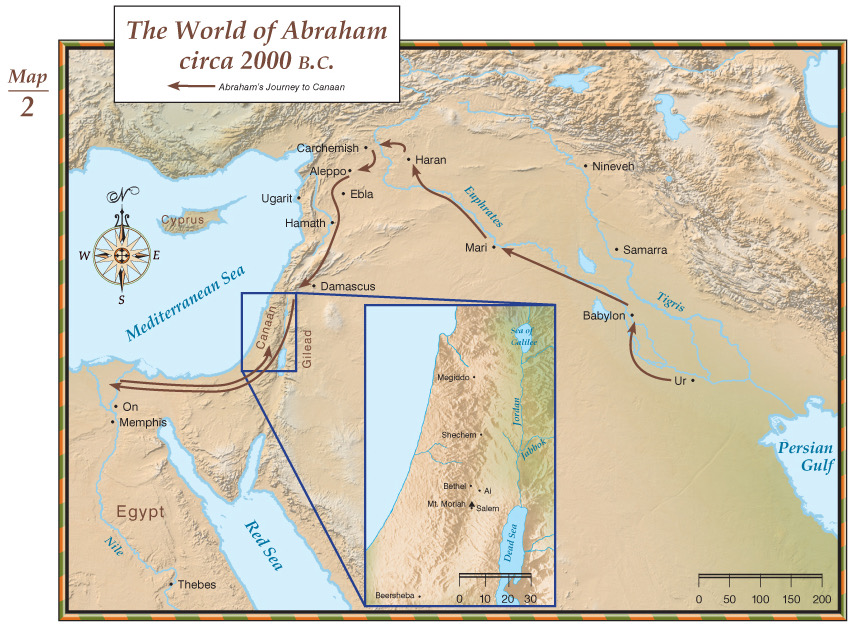
    It is beginning with Abraham in Mesopotamia/Ur, then Haran, then Canaan.

    Abraham’s Route
    Abraham’s Route

    Abraham was called while in Ur,2 and again in Haran.3

    He was called to enter into the country of Canaan, and claim that country as his own.

    That activity would begin the specific work of God in relation to His redemptive plan, the plan of Psalm 2:6-9 = the purpose of God to give to the Son the inheritance of Jerusalem, and a people, and the nations, on the earth as brethren.

    The key to the purpose of God, and one that has caused the most confusion for the contemporary church, is the role of Israel in that redemptive purpose.

    Remember:

    Jesus said:

    25 In the same way He took the cup also after supper, saying, “This cup is the new covenant in My blood; do this, as often as you drink it, in remembrance of Me.”  (1 Corinthians 11:25, LSB)

    The New Covenant, whatever that is, must have been important since He said that His blood secures it.

    His death, then, is the New Covenant “sacrifice” of some sort in order to accomplish the arrangement.

    And, the purpose of His death is also summed up in the New Covenant.

    The end result is that we are supposed to remember His death, and these things, when we participate in the Lord’s Supper.

    To be unaware of these things is to take the supper in ignorance, leading to ritualism, or, more likely, leads to eating and drinking in an unworthy manner.

    What we see, when we examine the death of Christ, and the New Covenant, carefully are the following:

    1. The New Covenant is the very core of the gospel of Jesus Christ.
    2. The New Covenant unites the OT and the NT.
    3. The New Covenant clarifies who Israel is.
    4. The New Covenant clarifies who the church is.
    5. The New Covenant is the only covenant made with Israel which forgives sins.
    6. Without the New Covenant, all the elect would remain in their sins.

    We have covered that: the New Covenant is the core of the gospel since it is the means of:

    • a new heart
    • the forgiveness of sins
    • Indwelling Holy Spirit
    • Provision of obedience to Mosaic Law, thus completing the Abrahamic promise (Leviticus 26:40-41)

    The New Covenant uniting the OT and NT in that all the OT covenants are with Israel and are the result of, and means of, the eternal purpose of God on earth through Christ.

    • Noahic Covenant
    • Abrahamic Covenant
    • Priestly Covenant
    • Mosaic Covenant
    • Davidic Covenant
    • New Covenant

    Today, we need to clarify who Israel is, and is not, in order to see how the New Covenant reflects on them.

    Without the clarity of who Israel is, we are also confused concerning the New Covenant as well as the Kingdom of God as a whole.

    NOTE: in the church today, we can see the grandchildren of the movement that equates the church with Israel, and vice-versa.

    • baptism equated with circumcision
    • land promises conflated to spiritual blessings
    • the Law of Moses equal to the church’s responsibility
    • the general promises of a kingdom to Israel given to the church thus removing them from Israel altogether.

    Overall, the modern church has little to no comprehension that Israel is the key to the fulfillment of the Father’s promise to the Son.

    The Origin of Israel

    The Mosaic Covenant

    The Apostasy of Israel

    Idolatry and the Crucifixion of Christ

    The Repentance of Israel

    The Holy Spirit and the New Covenant

    Once we have a clear handle on these things, we can see that:

    The church is not Israel.

    Israel is not the church.

    The Origin of Israel

    How did Israel begin?

    Since the New Covenant is a covenant with Israel alone, where did they come from?

    The origin of the nation of Israel began with one man, Abraham, and his wife Sarah. 
    

    14 And Yahweh said to Abram, after Lot had separated from him, “Now lift up your eyes and look from the place where you are, northward and southward and eastward and westward;

    15 for all the land which you see, I will give it to you and to your seed forever.

    16 “And I will make your seed as the dust of the earth, so that if anyone can number the dust of the earth, then your seed can also be numbered.

    17 “Arise, walk about the land through its length and breadth; for I will give it to you.”

    18 Then Abram moved his tent and came and lived by the oaks of Mamre, which are in Hebron, and there he built an altar to Yahweh.  (Genesis 13:14–18, LSB)

    And, the people who left Egypt at the Exodus were the descendants, the “seed,” of Abraham.

    Then God said to Abram, “Know for certain that your seed will be sojourners in a land that is not theirs, and they will be enslaved and mistreated four hundred years.

    14 “But I will also judge the nation to whom they are enslaved, and afterward they will come out with many possessions.

    15 “As for you, you shall go to your fathers in peace; you will be buried at a good old age.

    16 “Then in the fourth generation they will return here, for the iniquity of the Amorite is not yet complete.”  (Genesis 15:13–16, LSB)

    It was when they left Egypt that the seed went from a coalition of descendants of Abraham alone, to a functioning nation, who, over 40 years from the Exodus, entered the land God promised Abraham.

    The Exodus from Egypt identified the Hebrews as the nation of Jacob’s descendants, Israel.

    The Mosaic Covenant brought Israel into an agreement with YHWH in that, if they obeyed it fully, then YHWH would give to them the promise to Abraham.

    They had the Law, entered a land, had God as their King (until Saul), a means of sacrifice, and a working military.

    This was the point at which they became a nation.4

    They were separate from Egypt, Canaan, Amorites, and other nations.

    This was the fulfillment of God’s promise to Abraham…initially.

    The nation of Israel, then, endured existence from 1400 BC to around 586 BC as an independent, self-governing, and at times even a dominant nation, in the world.

    In 586 BC, Nebuchadnezzar took Judah into captivity and, after leaving some in the land, brought thousands of captives back to Babylon (Iraq).5

    Furthermore, all the leaders of the priests and the people were very unfaithful following all the abominations of the nations; and they defiled the house of Yahweh which He had set apart as holy in Jerusalem.  (2 Chronicles 36:14, LSB)

    15 And Yahweh, the God of their fathers, sent word to them again and again by the hand of His messengers, because He had compassion on His people and on His habitation;

    16 but they continually mocked the messengers of God, despised His words and scoffed at His prophets, until the wrath of Yahweh arose against His people, until there was no remedy.

    17 Therefore He brought up against them the king of the Chaldeans who killed their choice men with the sword in the house of their sanctuary, and had no compassion on choice man or virgin, old man or infirm; He gave them all into his hand.

    18 And all the articles of the house of God, great and small, and the treasures of the house of Yahweh, and the treasures of the king and of his officials, he brought them all to Babylon.

    19 Then they burned the house of God and tore down the wall of Jerusalem, and burned all its palaces with fire and destroyed all its valuable articles.

    20 And those who had escaped from the sword he took away into exile to Babylon; and they were slaves to him and to his sons until the rule of the kingdom of Persia,

    21 to fulfill the word of Yahweh by the mouth of Jeremiah, until the land had made up for its sabbaths. All the days of its desolation it kept sabbath until seventy years were fulfilled.  (2 Chronicles 36:15–21, LSB)

    The Apostasy of Israel

    Israel was under covenant with YHWH in order that they would confess their sins, offer sacrifices for their sins, walk in His righteousness, and love Him with all their heart.

    However, they almost never fulfilled their covenant with YHWH.

    In the 3,473 years of existence, there have only been (4) times of national faithfulness to YHWH:

    – The generation of Joshua, the commander of the army with Moses.

    • 16 And they answered Joshua, saying, “All that you have commanded us we will do, and wherever you send us we will go.
      17 “Just as we listened to Moses in all things, so we will listen to you; only may Yahweh your God be with you as He was with Moses.
      18 “Anyone who rebels against your command and does not listen to your words, in all that you command him, shall be put to death; only be strong and courageous.”  (Joshua 1:16–18, LSB)
      • 31 And Israel served Yahweh all the days of Joshua and all the days of the elders who survived Joshua, who knew all the work of Yahweh which He had done for Israel.  (Joshua 24:31, LSB)
        • 7 And the people served Yahweh all the days of Joshua and all the days of the elders who survived Joshua, who saw all the great work of Yahweh which He had done for Israel.  (Judges 2:7, LSB)

    – The generation under David’s rule

    5:1 Then all the tribes of Israel came to David at Hebron and said, “Behold, we are your bone and your flesh.

    2 “Previously, when Saul was king over us, you were the one who led out and brought in Israel; and Yahweh said to you, ‘You will shepherd My people Israel, and you will be a ruler over Israel.’”

    3 So all the elders of Israel came to the king at Hebron, and King David cut a covenant with them in Hebron before Yahweh; then they anointed David king over Israel.

    4 Now David was thirty years old when he became king, and he reigned forty years.  (2 Samuel 5:1–4, LSB)

    – The generation under Asa

    • 9 And he gathered all Judah and Benjamin and those from Ephraim, Manasseh and Simeon who sojourned with them, for many defected to him from Israel when they saw that Yahweh his God was with him.
      10 So they assembled at Jerusalem in the third month of the fifteenth year of Asa’s reign.
      11 And they sacrificed to Yahweh that day 700 oxen and 7,000 sheep from the spoil they had brought.
      12 They entered into the covenant to seek Yahweh, the God of their fathers, with all their heart and soul;
      13 and whoever would not seek Yahweh, the God of Israel, should be put to death, whether small or great, man or woman.  (2 Chronicles 15:9–13, LSB)

    – The generation under Josiah

    • 27 because your heart was soft and you humbled yourself before God when you heard His words against this place and against its inhabitants, and because you humbled yourself before Me, tore your clothes and wept before Me, I truly have heard you,” declares Yahweh.  (2 Chronicles 34:27 , LSB)

    The culmination of the apostasy of Israel was the generation of the Messiah, Jesus Christ.

    The generation which existed when Christ came was the generation most responsible for the height of hypocrisy and evil of all the generations of the nation of Israel.

    Nothing compares to the darkness of that generation in that:

    – Their father was the devil

    • “You are of your father the devil, and you want to do the desires of your father. He was a murderer from the beginning, and does not stand in the truth because there is no truth in him. Whenever he speaks a lie, he speaks from his own nature, for he is a liar and the father of lies.  (John 8:44, LSB)

    – The “hour of darkness” was theirs to use freely

    • “While I was with you daily in the temple, you did not stretch out your hands against Me, but this hour and the authority of darkness are yours.”  (Luke 22:53, LSB)

    – They resisted the believing in Christ

    • 24 The Jews then gathered around Him, and were saying to Him, “How long will You keep us in suspense? If You are the Christ, tell us openly.”
      25 Jesus answered them, “I told you, and you do not believe; the works that I do in My Father’s name, these bear witness of Me.
      26 “But you do not believe because you are not of My sheep.
      27 “My sheep hear My voice, and I know them, and they follow Me;
      28 and I give eternal life to them, and they will never perish—ever; and no one will snatch them out of My hand.  (John 10:24–28, LSB)

    – They tried to keep thousands out of the kingdom

    • 13 “But woe to you, scribes and Pharisees, hypocrites, because you shut off the kingdom of heaven from people; for you do not enter in yourselves, nor do you allow those who are entering to go in.  (Matthew 23:13, LSB)

    That generation of the Jews who were present at the coming of Christ, those in leadership and directing the affairs of the Temple, those established as the architects of Judaism and rabbinic theology, they, empowered by Satan and established by their own systemic and profound hypocrisy, executed the Messiah, who willingly owned their own guilt, and went to their graves with nothing but jealous hatred for God.

    At the judgment of God in the future, God will affect upon them all the guilt of all the righteous blood shed upon the earth in the entire history of Israel.

    They will even persecute the church (“prophets,” “wise men,” “scribes”), chasing them down to death and excommunication.

    34 “On account of this, behold, I am sending you prophets and wise men and scribes; some of them you will kill and crucify, and some of them you will flog in your synagogues, and persecute from city to city,

    35 so that upon you may fall the guilt of all the righteous blood shed on earth, from the blood of righteous Abel to the blood of Zechariah, the son of Berechiah, whom you murdered between the sanctuary and the altar.

    36 “Truly I say to you, all these things will come upon this generation.  (Matthew 23:34–36, LSB)

    It can appear that all hope is lost for the realization of the promise to Abraham.

    Remember, the promise to Abraham can only be realized by the admission of sin and guilt by the nation of Israel.

    40If they confess their iniquity and the iniquity of their fathers, in their unfaithfulness which they committed against Me, and also how they walked in hostility against Me—

    41 I also was walking in hostility against them, to bring them into the land of their enemies—or if their uncircumcised heart becomes humbled so that they then make up for their iniquity,

    42 then I will remember My covenant with Jacob, and I will remember also My covenant with Isaac and My covenant with Abraham as well, and I will remember the land.  (Leviticus 26:40–42, LSB)

    However….

    The Repentance of Israel

    8 ‘And it will be in that day,’ declares Yahweh of hosts, ‘that I will break his yoke from off your neck and will tear off your bonds; and strangers will no longer make them their slaves.

    9 ‘But they shall be a slave to Yahweh their God and David their king, whom I will raise up for them.

    10 ‘Fear not, O Jacob My servant,’ declares Yahweh,

    ‘And do not be dismayed, O Israel;

    For behold, I will save you from afar

    And your seed from the land of their captivity.

    And Jacob will return and will be quiet and at ease,

    And no one will make him tremble.  (Jeremiah 30:8–10, LSB)

    When that nation is made right with YHWH, by the keeping of their covenant, then all the promise God made to Abraham, the national transcendence, the people, and the land of Abraham, will be seen visibly in the world.

    13 For the promise to Abraham or to his seed that he would be heir of the world was not through the Law, but through the righteousness of faith.  (Romans 4:13, LSB)

    And, if the promise to Abraham is the very same promise to the Son, then how can the plan of the Father, the promise, be accomplished?

    It can only be accomplished by the repentance of Israel.

    Therefore, it is critical to the eternal purpose of God that Israel repent and believe in Messiah.

    NOTE: Yet, their unbelief produced the crucifixion of the Messiah, thus the atonement, and the fulfillment of the Word of God.

    “Then after the sixty-two weeks the Messiah will be cut off and have nothing, and the people of the prince who is to come will destroy the city and the sanctuary. And its end will come with a flood; even to the end there will be war; desolations are decreed.  (Daniel 9:26, LSB)

    How could Israel EVER circumcise their heart, love YHWH with all their heart, soul, and mind, and undo the damage done by the execution of the Messiah?!

    By the New Covenant

    The New Covenant

    31“Behold, days are coming,” declares Yahweh, “when I will cut a new covenant with the house of Israel and with the house of Judah,

    32 not like the covenant which I cut with their fathers in the day I took them by the hand to bring them out of the land of Egypt, My covenant which they broke, but I was a husband to them,” declares Yahweh.

    33 “But this is the covenant which I will cut with the house of Israel after those days,” declares Yahweh: “I will put My law within them, and on their heart I will write it; and I will be their God, and they shall be My people.

    34 “And they will not teach again, each man his neighbor and each man his brother, saying, ‘Know Yahweh,’ for they will all know Me, from the least of them to the greatest of them,” declares Yahweh, “for I will forgive their iniquity, and their sin I will remember no more.”  (Jeremiah 31:31–34, LSB)

    This new covenant, which is written like a promise, will not set aside the Old Covenant, as if that bilateral covenant does not need to be kept.

    In fact, unless the New Covenant comes, the nation of Israel cannot keep the Mosaic Covenant, which they promised to keep.

    The Lord’s Supper

    25 In the same way He took the cup also after supper, saying, “This cup is the new covenant in My blood; do this, as often as you drink it, in remembrance of Me.”  (1 Corinthians 11:25, LSB)

    This is the reason for the death of the Messiah.

    His death confirmed the New Covenant-the Lamb/sacrifice of the Son in order to provide the payment of the sins of Israel, and all who are elected of God.

    The means, then, by which God will truly atone for sins, not simply cover over them, but actually make the sinner new, is through the sacrifice of the Son of God on their behalf.

    But, here is the important question:

    How will the Son of God be sacrificed for Israel, and their once-for-all atonement?

    How will God accomplish the necessary security of a new sacrifice, not like the system of sacrifices of the Mosaic Covenant, and yet, secures the Abrahamic promise which depends upon the Mosaic Covenant?

    The Incognito Ministry of the Messiah

    And He earnestly warned them not to tell who He was.  (Mark 3:12, LSB)

    And He gave them orders not to tell anyone; but the more He was ordering them, the more widely they continued to proclaim it.  (Mark 7:36, LSB)

    And He gave them strict orders that no one should know about this, and He said that some food should be given to her to eat.  (Mark 5:43, LSB)

    The Lord established in His ministry the constant order to hold back from telling the people Who He was.

    This meant that He was not wanting the people to know about Him as Messiah, but only that He would do the works of the Messiah letting people to draw the conclusions based upon that.

    This was so that the true nature of the leadership of Israel would become evident, thus leading to the crucifixion, the necessary death of the New Covenant Lamb of God.

    13 Now when Jesus came into the district of Caesarea Philippi, He was asking His disciples, saying, “Who do people say that the Son of Man is?”

    14 And they said, “Some say John the Baptist; and others, Elijah; but still others, Jeremiah, or one of the prophets.”

    15 He said to them, “But who do you say that I am?”

    16 And Simon Peter answered and said, “You are the Christ, the Son of the living God.”

    17 And Jesus answered and said to him, “Blessed are you, Simon Bar-Jonah, because flesh and blood did not reveal this to you, but My Father who is in heaven.

    18 “And I also say to you that you are Peter, and upon this rock I will build My church; and the gates of Hades will not overpower it.

    19 “I will give you the keys of the kingdom of heaven; and whatever you bind on earth shall have been bound in heaven, and whatever you loose on earth shall have been loosed in heaven.”

    20 Then He warned the disciples that they should tell no one that He was the Christ.

    21 From that time Jesus began to show His disciples that He must go to Jerusalem, and suffer many things from the elders and chief priests and scribes, and be killed, and be raised up on the third day.  (Matthew 16:13–21, LSB)

    Have you ever wondered why Jesus would say this? 
    

    It is because of the requirement that He would draw out the murderous hearts of the leadership, their jealousy, by His works, and drive them to the murder that would 1) seal their eternal damnation, and 2) secure the atoning sacrifice of the Lamb.

    36 “But the witness I have is greater than the witness of John; for the works which the Father has given Me to finish—the very works that I do—bear witness about Me, that the Father has sent Me.

    37 “And the Father who sent Me, He has borne witness about Me. You have neither heard His voice at any time nor seen His form.

    38 “And you do not have His word abiding in you, for you do not believe Him whom He sent.  (John 5:36–38, LSB)

    This death, produced by the jealousy of the leadership of Israel as they witnessed His works, instead of snuffing out His influence, secured the atoning sacrifice for the sins of Israel and Gentiles…forever!

    Therefore, His kingdom was secured by His death and resurrection, but not through the nation of Israel, although the Mosaic Law is the keep component in fulfilling that kingdom promise, which was communicated in the Abrahamic Promise.

    His Kingdom, then, has been taken away from the nation of Israel, and given to the nations of the world!

    Conclusion

    33 “Listen to another parable. There was a landowner who planted a vineyard and put a wall around it and dug a wine press in it, and built a tower, and rented it out to vine-growers and went on a journey.

    34 “Now when the harvest time approached, he sent his slaves to the vine-growers to receive his fruit.

    35 “And the vine-growers took his slaves and beat one, and killed another, and stoned a third.

    36 “Again he sent another group of slaves larger than the first; and they did the same thing to them.

    37 “But afterward he sent his son to them, saying, ‘They will respect my son.’

    38 “But when the vine-growers saw the son, they said among themselves, ‘This is the heir; come, let us kill him and seize his inheritance.’

    39 “And they took him, and threw him out of the vineyard and killed him.

    40 “Therefore when the owner of the vineyard comes, what will he do to those vine-growers?”

    41 They said to Him, “He will bring those wretches to a wretched end, and will rent out the vineyard to other vine-growers who will pay him the proceeds at the proper seasons.”

    42 Jesus said to them, “Did you never read in the Scriptures,

    ‘The stone which the builders rejected,

    This has become the chief corner stone;

    This came about from the Lord,

    and it is marvelous in our eyes’?

    43 “Therefore I say to you, the kingdom of God will be taken away from you and given to a nation, producing the fruit of it.

    44 “And he who falls on this stone will be broken to pieces; but on whomever it falls, it will scatter him like dust.”

    45 And when the chief priests and the Pharisees heard His parables, they understood that He was speaking about them.

    46 And although they were seeking to seize Him, they feared the crowds, because they were regarding Him to be a prophet.  (Matthew 21:33–46, LSB)

    Footnotes:

    1. See Paul Tanner, “Old Testament Chronology and Its Implications For The Creation and Flood Accounts” Bibliotheca Sacra, vol. 172, Jan-Mar, 2015’ pp.24-44.
    2. And he said, “Hear me, brothers and fathers! The God of glory appeared to our father Abraham when he was in Mesopotamia, before he lived in Haran,
      3 and said to him, ‘Leave your country and your relatives, and come into the land that I will show you.’
      4 “Then he left the land of the Chaldeans and settled in Haran. From there, after his father died, God had him move to this country in which you are now living.  (Acts 7:2–4, LSB)
    3. So Abram went forth as Yahweh had spoken to him; and Lot went with him. Now Abram was seventy-five years old when he departed from Haran.  (Genesis 12:4, LSB)
    4. I am referring to the entire exodus event. This includes leaving Egypt, arriving at Mt. Sinai, receiving the Law from God, and being independent of any country around.
    5. At the return under Cyrus, there were 42,360 present.
      The whole assembly together was 42,360,  (Ezra 2:64, LSB)