Tag: New Covenant

  • The Effect of the Lord’s Supper

    The Effect of the Lord’s Supper

    Scripture Reading

    20 He was foreknown before the foundation of the world, but appeared in these last times for the sake of you

    21 who through Him are believers in God, who raised Him from the dead and gave Him glory, so that your faith and hope are in God.

    22 Since you have in obedience to the truth purified your souls for a love of the brothers without hypocrisy, fervently love one another from the heart,

    23 for you have been born again not of corruptible seed but incorruptible, that is, through the living and enduring word of God.

    24 For,

    “All flesh is like grass,

    And all its glory like the flower of grass.

    The grass withers,

    And the flower falls off,

    25 But the word of the Lord endures forever.”

    And this is the word which was proclaimed to you as good news.  (1 Peter 1:20–25, LSB)

    Introduction

    The Lord’s Supper is an act of remembrance of the Lord’s final meal with His beloved disciples.

    In that event, private, quiet, and normal in so many other ways, the Lord Jesus Christ conducted the men into a new and living way,1 a way that is the foundational expression of the New Covenant that God was to make with Israel, but Israel rejected…gladly.

    Because Israel refused to repent, the Lord turned His attention to the people, by passing the leaders of Israel, and to the nations.

    He did this by gathering Jews and Gentiles apart from the national identification with Israel, into a “new man,” a whole new group called “the church.”

    14 For He Himself is our peace, who made both groups one and broke down the dividing wall of the partition

    15 by abolishing in His flesh the enmity, the Law of commandments2 contained in ordinances, so that in Himself He might create the two into one new man, making peace,

    16 and might reconcile them both in one body to God through the cross, having in Himself put to death the enmity.

    17 And He came and preached the good news of peace to you who were far away, and peace to those who were near;

    18 for through Him we both have our access in one Spirit to the Father.  (Ephesians 2:14–18, LSB)

    The distinction between the Jew and the Gentile has always been the Law of Moses, the “Law of commandments,” as Paul calls it.

    The need for Israel to obey the Law, which required complete confession of sin and repentance, which they did not do, in order to see the promise to Abraham come to them, kept them from ever seeing the promise to Abraham.

    However, now, that promise can come since, in Christ, the Law is not fulfilled (i.e. kept obediently by the Jews), but the sinner dies in Christ.

    4 So, my brothers, you also were made to die to the Law through the body of Christ, so that you might be joined to another, to Him who was raised from the dead, in order that we might bear fruit for God.

    5 For while we were in the flesh, the sinful passions, which were aroused by the Law, were at work in our members to bear fruit for death.

    6 But now we have been released from the Law, having died to that by which we were constrained, so that we serve in newness of the Spirit and not in oldness of the letter.  (Romans 7:4–6, LSB)

    The Law could never be kept by Israel.

    Their dead spiritual condition made it impossible to obey the Law and keep the covenant with YHWH.

    Therefore, the curses of the Law were on them.

    However, as Jesus Christ died at the hands of men, God also places men in that death with Him so that the Law can no longer hold the man, the Jew.

    And, if that is the case for the Jew, the Gentiles are hopeless.

    They have no Law, and no part in the covenant(s).

    Yet, because of the kindness of YHWH, and His marvelous plan, He has extended the righteousness of the forgiveness of sins, i.e. the New Covenant, to the nations.

    This incredible and unique accomplishment by the Lord was done at the hands of His death.

    His death made the Jew die to the Law so that he could be made new again and be reconciled.

    His death made the Gentile, without covenants, the Law, or hope, die to the flesh, the world, the devil, so that he could be made new again and be reconciled.

    This very radical and complex accomplishment by the Lord, and His death on the cross at the hands of men, is the very heart of the New Covenant.

    It is His death that did this.

    And, it is this multifaceted accomplishment that His death succeeded in securing.

    Therefore....
    

    The memorial we keep, by the Lord’s command (Luke 22:19; cp 1 Corinthians 11:23-25), is a memorial of His death.

    This death, more than just a sacrifice for us so that we could go to heaven, but was a satisfaction of the Father’s plan, and accomplished the needed death of the elect so that the provisions of the New Covenant could come to both Jews and Gentiles, irregardless of whether the New Covenant was to be made with Israel or not.

    The Need For Love In The Church

    Therefore whoever eats the bread or drinks the cup of the Lord in an unworthy manner, shall be guilty of the body and the blood of the Lord.  (1 Corinthians 11:27, LSB)

    It makes sense, then, that eating the bread and drinking the cup in a way that does not resemble the motive and heart of the original bread and cup of Christ’s last meal, one we have examined a lot, makes the Christian guilty of tremendous charge against God.

    This is to such a degree that Paul even says that a man or woman who does this is “guilty of the body and blood of the Lord.”

    “Guilty”

    ἔνοχος ἔσται = he is guilty of a legal charge against some law.

    9 But if you show partiality, you are committing sin, being convicted by the law as transgressors.

    10 For whoever keeps the whole law and yet stumbles in one point, he has become guilty of all.  (James 2:9–10, LSB)

    This is the idea that the example and instruction of Jesus Christ to remember His death is the responsibility of the disciples.3

    Therefore, to do that in a way that does NOT fundamentally resemble His body and blood is to change that act into something else.

    Further, and this is what makes us “guilty,” we are fundamentally not saying the correct explanation of the death of Christ.

    The guilt is not “guilt” as in breaking the Law of Moses since the Law of Moses did not contain any kind of teaching concerning the body and blood of the Messiah.

    Rather, the guilt is the disobedience to the pattern set down by Christ at the Last Supper by:

    1. Washing the feet
      1. Giving His body for death
        1. Giving His blood in death
        2. Loving the disciples even into the point of death

    These are things the Lord set down as a pattern (not the actual acts, since we cannot repeat the sacrificial death) the motive, the heart.

    12 So when He had washed their feet, and taken His garments and reclined at the table again, He said to them, “Do you know what I have done to you?

    13 “You call Me Teacher and Lord; and you are right, for so I am.

    14 “If I then, the Lord and the Teacher, washed your feet, you also ought to wash one another’s feet.

    15 “For I gave you an example that you also should do as I did to you.4

    16 “Truly, truly, I say to you, a slave is not greater than his master, nor is one who is sent greater than the one who sent him.

    17 “If you know these things, you are blessed if you do them.  (John 13:12–17, LSB)

    13:1 Now before the Feast of the Passover, Jesus knowing that His hour had come that He would depart out of this world to the Father, having loved His own who were in the world, He loved them to the end.  (John 13:1, LSB)

    The example of Jesus Christ towards His disciples, an example He instructed the disciples to follow, was the example of serving the saints to the point of self-disregard.

    This is exactly what Paul is identifying in his rebuke of the Corinthians.

    He is bringing to their attention that they are in sin because of the selfishness and haughtiness that has filled their assembly, and especially the Lord’s Supper/Table.


    What is an “unworthy manner”?
    

    14 Therefore, my beloved, flee from idolatry.

    15 I speak as to prudent people. You judge what I say.

    16 Is not the cup of blessing which we bless a sharing in the blood of Christ? Is not the bread which we break a sharing in the body of Christ?

    17 Since there is one bread, we who are many are one body, for we all partake of the one bread.  (1 Corinthians 10:14–17, LSB)

    21 You cannot drink the cup of the Lord and the cup of demons. You cannot partake of the table of the Lord and the table of demons.

    22 Or do we provoke the Lord to jealousy? •Are we stronger than He? ]

    23 All things are lawful, but not all things are profitable. All things are lawful, but not all things build up.

    24 Let no one seek his own good, but that of the other person.  (1 Corinthians 10:21–24, LSB)

    Paul deal with this earlier in the book.

    The problems of the corruption of the assembly of the church was on his mind, and the echo of all the corruption is reverberating throughout the rebuke.

    17 But in giving this instruction, I do not praise you, because you come together not for the better but for the worse.

    18 For, in the first place, •when you come together as a church, I hear that divisions exist among you, and in part I believe it.

    19 For there must also be factions among you, so that •those who are approved may become evident among you.

    20 Therefore when you meet together in the same place, it is not to eat the Lord’s Supper,

    21 for in your eating each one takes his own supper first, and one •is hungry and another is drunk.

    22 For •do you not have houses in which to eat and drink? Or do you despise the church of God and shame those who have nothing? What shall I say to you? Shall I praise you? In this I will not praise you.  (1 Corinthians 11:17–22, LSB)

    Do you remember what Paul reprimanded the Corinthians about earlier in the chapter?

    “I do not praise you…What shall I say to you? Shall I praise you? In this I will not praise you!”

    = inclusio

    Paul cannot praise, congratulate, the Corinthians for their behavior during the worship assembly, particularly the Lord’s Supper meal.

    20 Therefore when you meet together in the same place, it is not to eat the Lord’s Supper,

    21 for in your eating each one takes his own supper first, and one •is hungry and another is drunk.

    The Corinthians were mechanically meeting, but were exercising the self-same mechanics without the same motive.

    Paul’s conclusion?

    “Therefore when you meet together in the same place, it is not to eat the Lord’s Supper…”

    Paul is separating the mechanics from the motive.

    How sad!!

    There are factions, divisions, and these are not the example and pattern of the Lord’s Supper.

    17 But in giving this instruction, I do not praise you, because you come together not for the better but for the worse.

    18 For, in the first place, •when you come together as a church, I hear that divisions exist among you, and in part I believe it.

    19 For there must also be factions among you, so that •those who are approved may become evident among you.

    20 Therefore when you meet together in the same place, it is not to eat the Lord’s Supper,  (1 Corinthians 11:17–20, LSB)

    ”…you come together not for the better, but for the worse…”

    “…for the better…”

    It would be “for the better” if they met as a church for the right reasons.

    This is a reference to coming together the way meant it to be.

    “…for the worse…”

    It is “for the worse” because they met as a church for the wrong reasons.

    This is a reference to coming together the way it was not meant to be.

    “for in your eating each one takes his own supper first, and one is hungry and another is drunk.  (1 Corinthians 11:21, LSB)

    And, Paul’s commentary on their behavior is:
    

    “For do you not have houses in which to eat and drink? Or do you despise the church of God and shame those who have nothing? What shall I say to you? Shall I praise you? In this I will not praise you.  (1 Corinthians 11:22, LSB)

    Therefore, the “unworthy manner” of which Paul is writing to the Corinthians must include all the sinful behavior of the Corinthians.

    However, it particularly refers to the audacious, selfish, self-important, and unloving behavior of the influential, and worldly.

    Other Warnings

    29 For he who eats and drinks, eats and drinks judgment to himself if he does not judge the body rightly.

    30 For this reason many among you are weak and sick, and a number sleep.  (1 Corinthians 11:29–30, LSB)

    32 But when we are judged, we are disciplined by the Lord so that we will not be condemned along with the world.  (1 Corinthians 11:32, LSB)

    V.29 = warning to not eat and drink resulting in judgment.

    V.30 = those who have eaten and drunk unworthily have been punished by the Lord.

    V.32 = when Christ punishes us, we are then given opportunity to not be ultimately punished by the Lord the way He punishes the world.

    32 κρινόμενοι δὲc ὑπὸ [τοῦ] κυρίουd παιδευόμεθα, ἵνα μὴ σὺν τῷ κόσμῳ κατακριθῶμεν.  (1 Corinthians 11:32, UBS5)

    How can the believer be condemned along with the world?

    Why would Paul even say this?

    It is not commendable to be punished by the Lord in this life.

    It is no badge of honor to be handed over to the Lord for punishment.

    In fact, Paul tells the believers how to avoid such chastening, even though this kind of chastening is a proof of sonship.

    5And you have forgotten the exhortation which is addressed to you as sons,

    “My son, do not regard lightly the discipline of the Lord,

    Nor faint when you are reproved by Him;

    6 For those whom the Lord loves He disciplines,

    And He flogs every son whom He receives.”

    7 It is for discipline that you endure; God deals with you as with sons; for what son is there whom his father does not discipline?

    8 But if you are without discipline, of which all have become partakers, then you are illegitimate children and not sons.

    9 Furthermore, we had earthly fathers to discipline us, and we respected them. Shall we not much rather be subject to the Father of spirits, and live?

    10 For they disciplined us for a short time as seemed best to them, but He disciplines us for our benefit, so that we may share His holiness.

    11 And all discipline for the moment seems not to be joyful, but sorrowful, but to those who have been trained by it, afterwards it yields the peaceful fruit of righteousness.  (Hebrews 12:5–11, LSB)

    Paul’s Correction

    28 But a man must test himself, and in so doing he is to eat of the bread and drink of the cup.  (1 Corinthians 11:28, LSB)

    The call from Paul is for repentance from this sin by means of examining themselves before it is too late.

    Paul warns the Corinthians that the remedy is self-verification.

    “examine” = “certify” “ prove” “verify what you are made of/that you are valuable”

    “δόκιμος as an adj. both of person and object thus denotes a. “tested in battle,” “reliable,” “trustworthy,” b. “a man who is tested, significant, recognised, esteemed, worthy” (e.g., πολίτου δοκίμου ἡ ἀρετὴ εἶναι τὸ δύνασθαι καὶ ἄρχειν καὶ ἄρχεσθαι καλῶς, Aristot. Pol., III, 4, p. 1277a, 26f.; Λυκούργου, τῶν Σπαρτιατῶν δοκίμου ἀνδρός, Hdt. I, 65: καλέσας δώδεκα τοὺς δοκιμωτάτους, Jos. Vit., 55), or “an object which is tested, genuine or valuable” (τούτους δοκίμοις ἵπποις καὶ ὅπλοις παρεσκευασμένους, Xenoph. Oec., 4, 7); it is particularly used of metals, as consistently in the LXX, Gn. 23:16; 1 Ch. 28:18; 29:4; 2 Ch. 9:17;”5

    Paul instructs the believers to examine themselves.

    What does it mean to “examine yourself”?

    It means to think about your motive and conduct and compare that with the objective facts of Scripture’s record of Jesus Christ (ie what He did).

    This assumes objective evidence of these conditions.

    29 For he who eats and drinks, eats and drinks judgment to himself if he does not judge the body rightly.

    30 For this reason many among you are weak and sick, and a number sleep.  (1 Corinthians 11:29–30, LSB)

    32But when we are judged, we are disciplined by the Lord so that we will not be condemned along with the world.  (1 Corinthians 11:32, LSB)

    Conclusion

    Example:

    The Seven Churches of Asia Minor

    1. The Church At Ephesus
      4 ‘But I have this against you, that you have left your first love.
      5 ‘Therefore remember from where you have fallen, and repent and do the deeds you did at first. But if not, I am coming to you and will remove your lampstand out of its place, unless you repent.  (Revelation 2:4–5, LSB)
      1. The Church At Smyrna
        9 ‘I know your tribulation and your poverty (but you are rich), and the blasphemy by those who say they are Jews and are not, but are a synagogue of Satan.
        10 ‘Do not fear what you are about to suffer. Behold, the devil is about to cast some of you into prison, so that you will be tested, and you will have tribulation for ten days. Be faithful until death, and I will give you the crown of life.  (Revelation 2:9–10, LSB)
      2. The Church At Pergamum
        14 ‘But I have a few things against you, that you have there some who hold the teaching of Balaam, who kept teaching Balak to put a stumbling block before the sons of Israel, to eat things sacrificed to idols and to commit sexual immorality.
        15 ‘So you also have some who in the same way hold the teaching of the Nicolaitans.
        16 ‘Therefore repent. But if not, I am coming to you quickly, and I will make war against them with the sword of My mouth.  (Revelation 2:14–16, LSB)
      3. The Church At Thyatira
        20‘But I have this against you, that you tolerate the woman Jezebel, who calls herself a prophetess, and she teaches and deceives My slaves so that they commit sexual immorality and eat things sacrificed to idols.
        21 ‘And I gave her time to repent, and she does not wish to repent of her sexual immorality.
        22 ‘Behold, I will throw her on a bed of sickness, and those who commit adultery with her into great tribulation, unless they repent of her deeds.
        23 ‘And I will kill her children with pestilence, and all the churches will know that I am He who searches the minds and hearts; and I will give to each one of you according to your deeds.  (Revelation 2:20–23, LSB)
      4. The Church At Sardis
        3:1 “And to the angel of the church in Sardis write:
        This is what He who has the seven Spirits of God and the seven stars, says: ‘I know your deeds, that you have a name that you are alive, but you are dead.
        2 ‘Wake up, and strengthen the things that remain, which were about to die, for I have not found your deeds complete in the sight of My God.
        3 ‘So remember what you have received and heard; and keep it, and repent. Therefore if you do not wake up, I will come like a thief, and you will not know at what hour I will come to you.
        4 ‘But you have a few names in Sardis who have not defiled their garments, and they will walk with Me in white, for they are worthy.
        5 ‘He who overcomes will thus be clothed in white garments, and I will never erase his name from the book of life, and I will confess his name before My Father and before His angels.  (Revelation 3:1–5, LSB)
      5. The Church At Philadelphia
        8 ‘I know your deeds. Behold, I have given before you an open door which no one can shut•, because you have a little power, and have kept My word, and have not denied My name.
        9 ‘Behold, I am giving up those of the synagogue of Satan, those who say that they are Jews and are not, but lie. Behold, I will make them •come and bow down before your feet, and make them know that I have loved you.
        10 ‘Because you have kept the word of My perseverance, I also will keep you from the hour of testing, which is about to come upon the whole world, to test those who dwell on the earth.
        11 ‘I am coming quickly; hold fast what you have, so that no one will take your crown.  (Revelation 3:8–11, LSB)
      6. The Church At Laodicea
        15‘I know your deeds, that you are neither cold nor hot. I wish that you were cold or hot.
        16 ‘So because you are lukewarm, and neither hot nor cold, I will spit you out of My mouth.
        17 ‘Because you say•, “I am rich, and have become wealthy, and have need of nothing,” and you do not know that you are wretched and pitiable and poor and blind and naked.
        18 I advise you to buy from Me gold refined by fire so that you may become rich, and white garments so that you may clothe yourself, and that the shame of your nakedness will not be manifested; and eye salve to anoint your eyes so that you may see.
        19 ‘Those whom •I love, I reprove and discipline. Therefore be zealous and repent.  (Revelation 3:15–19, LSB)
    1. 19 Therefore, brothers, since we have confidence to enter the holy places by the blood of Jesus,
      20 by a new and living way which He inaugurated for us through the veil, that is, His flesh,
      21 and since we have a great priest over the house of God,
      22 let us draw near with a sincere heart in full assurance of faith, having our hearts sprinkled from an evil conscience and our bodies washed with pure water.  (Hebrews 10:19–22, LSB)
    2. The Law of Commandments is not between God and Israel, but between Israel and Gentiles.
    3. 26 For as often as you eat this bread and drink the cup, you proclaim the death of the Lord until He comes.
      27 Therefore whoever eats the bread or drinks the cup of the Lord in an unworthy manner, shall be guilty of the body and the blood of the Lord. (1 Corinthians 11:26–27, LSB)
      When a church misunderstands and misrepresents the sufficiency, extent, and efficacy of the death of Christ, and then resembles those misrepresentations in the Lord’s Supper memorial, then that Table is misrepresenting the death of Christ, and those doing it are guilty of the body and blood of the Lord.
      It is that serious.
    4. The Lord cannot be saying, “Imitate the foot washing.” But, why not? We imitate the bread and the cup. Why not the foot washing? It seems that the Lord did not want us to imitate the foot washing, 1) because that was not the point of the meal, as the sacrifice of His body and blood was, 2) although the foot washing would be no more mechanical than the bread and cup, that act, although motivated by love, is not efficacious, 3) it is the motive which the Lord seems to be emphasizing. How do I know these things? Because, commemorating the act which was predetermined before the foundation of the World, and which provides atonement, and which is the core of the work of Christ, is the point. Everything revolves around that. Besides, there is no other instruction in the NT that the foot washing, 1) accompanied the Lord’s Supper (Paul did not mention it), 2) that it was part of the church’s assembly (except 1 Timothy 5:10, which refers to the normal act of service and hospitality of women in the home towards their guests).
    5. Walter Grundmann, “Δόκιμος, Ἀδόκιμος, Δοκιμή, Δοκίμιον, Δοκιμάζω, Ἀποδοκιμάζω, Δοκιμασία,” in Theological Dictionary of the New Testament, ed. Gerhard Kittel, Geoffrey W. Bromiley, and Gerhard Friedrich (Grand Rapids, MI: Eerdmans, 1964–), 255.
  • The Lord’s Supper and the New Covenant – pt.7

    The Lord’s Supper and the New Covenant – pt.7

    Scripture Reading

    13 Therefore, having girded your minds for action, being sober in spirit, fix your hope completely on the grace to be brought to you at the revelation of Jesus Christ.

    14 As obedient children, not being conformed to the former lusts which were yours in your ignorance,

    15 but like the Holy One who called you, be holy yourselves also in all your conduct;

    16 because it is written, “You shall be holy, for I am holy.”

    17 And if you address as Father the One who impartially judges according to each one’s work, conduct yourselves in fear during the time of your sojourn,

    18 knowing that you were not redeemed with corruptible things like silver or gold from your futile conduct inherited from your forefathers,

    19 but with precious blood, as of a lamb unblemished and spotless, the blood of Christ.  (1 Peter 1:13–19, LSB)

    Introduction

    Review:

    Paul wrote,

    25 In the same way He took the cup also after supper, saying, “This cup is the new covenant in My blood; do this, as often as you drink it, in remembrance of Me.”  (1 Corinthians 11:25, LSB)

    The importance of the Lord’s last meal with His disciples is directly linked to the importance of the New Covenant.

    As Paul wrote to the Corinthians, Jesus is “our Passover,” a statement of monumental importance.

    “our” = the church, believers, Jews and Gentiles who believe in the Messiah.

    Clean out the old leaven so that you may be a new lump, just as you are in fact unleavened. For Christ, our Passover lamb, also was sacrificed.  (1 Corinthians 5:7, LSB)

    He is not the Passover Lamb of the Exodus.

    His blood “speaks better than that of Abel,” and the Passover lamb of the Exodus.

    22 But you have come to Mount Zion and to the city of the living God, the heavenly Jerusalem, and to myriads of angels,

    23 to the festal gathering and assembly of the firstborn who are enrolled in heaven, and to God, the Judge of all, and to the spirits of the righteous made perfect,

    24 and to Jesus, the mediator of a new covenant, and to the sprinkled blood, which speaks better than the blood of Abel.  (Hebrews 12:22–24, LSB)

    The blood of Christ, which is a reference to His death, which was a predetermined death “instead of” the death for the sins of the elect, accomplished more and was from a better Man than even that of Abel.

    “…saying, “The Son of Man must suffer many things and be rejected by the elders and chief priests and scribes, and be killed and be raised up on the third day.”  (Luke 9:22, LSB)

    22“Men of Israel, listen to these words: Jesus the Nazarene, a man attested to you by God with miracles and wonders and signs which God did through Him in your midst, just as you yourselves know—

    23 this Man, delivered over by the predetermined plan and foreknowledge of God, you nailed to a cross by the hands of lawless men and put Him to death.

    24 “But God raised Him up again, putting an end to the agony of death, since it was impossible for Him to be held in its power.  (Acts 2:22–24, LSB)

    What was the result of His death?

    1. His death justified the sons of God.

    1. 45“For even the Son of Man did not come to be served, but to serve, and to give His life a ransom for many.”  (Mark 10:45, LSB)
      1. 11 As a result of the anguish of His soul,
        He will see it and be satisfied;
        By His knowledge the Righteous One,
        My Servant, will justify the many,
        As He will bear their iniquities.
        12 Therefore, I will divide for Him a portion with the many,
        And He will divide the spoil with the strong;
        Because He poured out His soul to death,
        And was numbered with the transgressors;
        Yet He Himself bore the sin of many,
        And interceded for the transgressors.  (Isaiah 53:11–12, LSB)

    2. His death pleased the Father.

    1. 16 “And I have other sheep, which are not from this fold; I must bring them also, and they will hear My voice; and they will become one flock with one shepherd.
      17 “For this reason the Father loves Me, because I lay down My life so that I may take it again.
      18 “No one takes it away from Me, but from Myself, I lay it down. I have authority to lay it down, and I have authority to take it up again. This commandment I received from My Father.”  (John 10:16–18, LSB)
    1. But Yahweh was pleased
      To crush Him, putting Him to grief;
      If You would place His soul as a guilt offering,
      He will see His seed,
      He will prolong His days,
      And the good pleasure of Yahweh will succeed in His hand.  (Isaiah 53:10, LSB)

    1. His death condemned Satan.

    1. And I will put enmity
      Between you and the woman,
      And between your seed and her seed;
      He shall bruise you on the head,
      And you shall bruise him on the heel.”  (Genesis 3:15, LSB)
      1. 9 And the great dragon was thrown down, the serpent of old who is called the devil and Satan, who deceives the whole world. He was thrown down to the earth, and his angels were thrown down with him.
        10 Then I heard a loud voice in heaven, saying,
        Now the salvation, and the power, and the kingdom of our God and the authority of His Christ have come, for the accuser of our brothers has been thrown down, he who accuses them before our God day and night.
        11 “And they overcame him because of the blood of the Lamb and because of the word of their witness, and they did not love their life even to death.  (Revelation 12:9–11, LSB)

    1. His death confirmed the New Covenant.

    1. 13 For if the blood of goats and bulls and the ashes of a heifer sprinkling those who have been defiled sanctify for the cleansing of the flesh,
      14 how much more will the blood of Christ, who through the eternal Spirit offered Himself without blemish to God, cleanse your conscience from dead works to serve the living God?
      15 And for this reason He is the mediator of a new covenant, so that, since a death has taken place for the redemption of the trespasses that were committed under the first covenant, those who have been called may receive the promise of the eternal inheritance.  (Hebrews 9:13–15, LSB)
      1. 10 We have an altar from which those who serve the tabernacle have no authority to eat.
        11 For the bodies of those animals whose blood is brought into the holy places by the high priest as an offering for sin, are burned outside the camp.
        12 Therefore Jesus also, that He might sanctify the people through His own blood, suffered outside the gate.  (Hebrews 13:10–12, LSB)

    1. His death was the means of the resurrection.

    1. 3 For I delivered to you as of first importance what I also received, that Christ died for our sins according to the Scriptures,
      4 and that He was buried, and that He was raised on the third day according to the Scriptures,  (1 Corinthians 15:3–4, LSB)
      1. 20 Now the God of peace, who brought up from the dead the great Shepherd of the sheep through the blood of the eternal covenant, our Lord Jesus,
        21 equip you in every good thing to do His will, by doing in us what is pleasing in His sight, through Jesus Christ, to whom be the glory forever and ever. Amen.  (Hebrews 13:20–21, LSB)

    The hidden plan of God, although hinted at in the OT, was that the Lamb of God, the Son, would be put to death in a particular fashion (crucifixion), with a particular means (betrayal), and by particular parties (Jewish leaders).

    7 In Him we have redemption through His blood, the forgiveness of our transgressions, according to the riches of His grace

    8 which He caused to abound to us in all wisdom and insight,

    9 making known to us the mystery of His will, according to His good pleasure which He purposed in Him

    10 for an administration of the fullness of the times, that is, the summing up of all things in Christ, things in the heavens and things on the earth in Him.  (Ephesians 1:7–10, LSB)

    Therefore, the purpose of God was that the Son would pay the death penalty on behalf of men, such that He could rescue them from death, the penalty of Adam’s sin.

    This leads us into the final consideration of the plan of God regarding the New Covenant:

    1. The New Covenant is the very core of the gospel of Jesus Christ.
    2. The New Covenant unites the OT and the NT.
    3. The New Covenant clarifies who Israel is.

    4. The New Covenant clarifies who the church is.

    5. The New Covenant is the only covenant made with Israel which forgives sins.

    6. Without the New Covenant, all the elect would remain in their sins.

    The Incognito Ministry of the Messiah

    And He earnestly warned them not to tell who He was.  (Mark 3:12, LSB)

    And He gave them orders not to tell anyone; but the more He was ordering them, the more widely they continued to proclaim it.  (Mark 7:36, LSB)

    And He gave them strict orders that no one should know about this, and He said that some food should be given to her to eat.  (Mark 5:43, LSB)

    The Lord established in His ministry the constant order to hold back from telling the people Who He was.

    This meant that He was not wanting the people to know about Him as Messiah, but only that He would do the works of the Messiah letting people to draw the conclusions based upon that.

    This was so that the true nature of the leadership of Israel would become evident, thus leading to the crucifixion, the necessary death of the New Covenant Lamb of God.

    13 Now when Jesus came into the district of Caesarea Philippi, He was asking His disciples, saying, “Who do people say that the Son of Man is?”

    14 And they said, “Some say John the Baptist; and others, Elijah; but still others, Jeremiah, or one of the prophets.”

    15 He said to them, “But who do you say that I am?”

    16 And Simon Peter answered and said, “You are the Christ, the Son of the living God.”

    17 And Jesus answered and said to him, “Blessed are you, Simon Bar-Jonah, because flesh and blood did not reveal this to you, but My Father who is in heaven.

    18 “And I also say to you that you are Peter, and upon this rock I will build My church; and the gates of Hades will not overpower it.

    19 “I will give you the keys of the kingdom of heaven; and whatever you bind on earth shall have been bound in heaven, and whatever you loose on earth shall have been loosed in heaven.”

    20 Then He warned the disciples that they should tell no one that He was the Christ.

    21 From that time Jesus began to show His disciples that He must go to Jerusalem, and suffer many things from the elders and chief priests and scribes, and be killed, and be raised up on the third day.  (Matthew 16:13–21, LSB)

    Have you ever wondered why Jesus would say this? 
    

    It is because of the requirement that He would draw out the murderous hearts of the leadership, their jealousy, by His works, and drive them to the murder that would 1) seal their eternal damnation, and 2) secure the atoning sacrifice of the Lamb.

    36 “But the witness I have is greater than the witness of John; for the works which the Father has given Me to finish—the very works that I do—bear witness about Me, that the Father has sent Me.

    37 “And the Father who sent Me, He has borne witness about Me. You have neither heard His voice at any time nor seen His form.

    38 “And you do not have His word abiding in you, for you do not believe Him whom He sent.  (John 5:36–38, LSB)

    This death, produced by the jealousy of the leadership of Israel as they witnessed His works, instead of snuffing out His influence, secured the atoning sacrifice for the sins of Israel and Gentiles…forever!

    Therefore, His kingdom was secured by His death and resurrection, but not through the nation of Israel, although the Mosaic Law is the keep component in fulfilling that kingdom promise, which was communicated in the Abrahamic Promise.

    His Kingdom, then, has been taken away from the nation of Israel, and given to the nations of the world!

    The Parable:

    33 “Listen to another parable. There was a landowner who planted a vineyard and put a wall around it and dug a wine press in it, and built a tower, and rented it out to vine-growers and went on a journey.

    34 “Now when the harvest time approached, he sent his slaves to the vine-growers to receive his fruit.

    35 “And the vine-growers took his slaves and beat one, and killed another, and stoned a third.

    36 “Again he sent another group of slaves larger than the first; and they did the same thing to them.

    37 “But afterward he sent his son to them, saying, ‘They will respect my son.’

    38 “But when the vine-growers saw the son, they said among themselves, ‘This is the heir; come, let us kill him and seize his inheritance.’

    39 “And they took him, and threw him out of the vineyard and killed him.

    40 “Therefore when the owner of the vineyard comes, what will he do to those vine-growers?”

    41 They said to Him, “He will bring those wretches to a wretched end, and will rent out the vineyard to other vine-growers who will pay him the proceeds at the proper seasons.”

    42 Jesus said to them, “Did you never read in the Scriptures,

    ‘The stone which the builders rejected,

    This has become the chief corner stone;

    This came about from the Lord,

    and it is marvelous in our eyes’?

    43 “Therefore I say to you, the kingdom of God will be taken away from you and given to a nation, producing the fruit of it.

    44 “And he who falls on this stone will be broken to pieces; but on whomever it falls, it will scatter him like dust.”

    45 And when the chief priests and the Pharisees heard His parables, they understood that He was speaking about them.

    46 And although they were seeking to seize Him, they feared the crowds, because they were regarding Him to be a prophet.  (Matthew 21:33–46, LSB)

    The Son came into the world, and the world did not receive Him-neither the Jews nor the Romans.

    The end result was that the Son would be killed, and made to look like the enemy of the world.

    This death, seeming to be the execution of a failed insurrectionist, in realty secured the atonement needed to accomplish the plan of God.

    This death, as described for the last 6 weeks, has a vast array of accomplishments.

    Not the least of which is the creation of a following known as the “church.”

    The New Covenant clarifies who the church is.

    It is this following that Jesus came to create.

    17 And Jesus answered and said to him, “Blessed are you, Simon Bar-Jonah, because flesh and blood did not reveal this to you, but My Father who is in heaven.

    18 “And I also say to you that you are Peter, and upon this rock I will build My church; and the gates of Hades will not overpower it.  (Matthew 16:17–18, LSB)

    The church is a group of people, chosen before the foundation of the world, who will inherit the promise to the Son, i.e. sonship.

    The means by which these people will become sons and daughters is the sacrifice of the Man, Christ Jesus, satisfying the Father, and permitting their own justification.

    This group, then, is different from Israel in that, unlike Israel, it has received the benefits of the New Covenant.

    Israel has not received the promises of the New Covenant because they have not confessed their sins, as John the Baptist, and Jesus Christ, commanded them to do.

    Therefore, the New Covenant is experience of the church, and not Israel.

    13 and are not like Moses, who used to put a veil over his face so that the sons of Israel would not look intently at the consequence of what was being brought to an end.

    14 But their minds were hardened; for until this very day at the reading of the old covenant the same veil remains unlifted, because it is brought to an end in Christ.

    15 But to this day whenever Moses is read, a veil lies over their heart,

    16 but whenever a person turns to the Lord, the veil is taken away. (2 Corinthians 3:13–16, LSB)

    One of the clearest distinctions, if not the most clear, between the church and Israel is that the church has received the benefits of the New Covenant, and Israel has not.

    It is really that simple; that basic.

    The New Covenant is the only covenant made with Israel which forgives sins.

    33 “But this is the covenant which I will cut with the house of Israel after those days,” declares Yahweh: “I will put My law within them, and on their heart I will write it; and I will be their God, and they shall be My people.

    34 “And they will not teach again, each man his neighbor and each man his brother, saying, ‘Know Yahweh,’ for they will all know Me, from the least of them to the greatest of them,” declares Yahweh, “for I will forgive their iniquity, and their sin I will remember no more.”  (Jeremiah 31:33–34, LSB)

    The previous covenants with Israel (Abrahamic, Priestly, Mosaic, Davidic) do nothing to take away sins.

    8 The Holy Spirit is indicating this, that the way into the holy places has not yet been manifested while that first part of the tabernacle is still standing,

    9 which is a symbol for the present time. Accordingly both gifts and sacrifices are offered which cannot make the worshiper perfect in conscience,

    10 since they relate only to food and drink and various washings, requirements for the body imposed until a time of reformation.  (Hebrews 9:8–10, LSB)

    Sin is the symptom of a spiritually dead person.

    In order to make a worshipper clean, he must become perfect in conscience, and in order to do that, he must become new since he is dead to God.

    This power to re-create the dead person is simply the work of God to join a spiritually dead person to Jesus Christ in His death.

    It is also the work of God to join the spiritually dead person to Jesus Christ in His resurrection.

    This power is inherent to the New Covenant.

    NOTE: Jeremiah 31 does not tell us HOW God is going to accomplish this work of 1) forgiveness of sins, 2) indwelling of the Holy Spirit, 3) making a new heart (Ezekiel 36). 
    

    But, we now know that all these things are accomplished by the death of Jesus Christ.

    6. Without the New Covenant, all the elect would remain in their sins.

    As stated, there are no arrangements, with Israel nor anyone else, in which a person who is dead to God would be made alive to Him.

    The only means by which God can accomplish His eternal purpose is by forgiveness of sins.

    And the only means by which He can forgive sins is if someone die in the place of the sinner.

    The Death of the Mediator

    15 And for this reason He is the mediator of a new covenant, so that, since a death has taken place for the redemption of the trespasses that were committed under the first covenant, those who have been called may receive the promise of the eternal inheritance.

    16 For where a covenant is, there must of necessity be the death of the one who made it.  (Hebrews 9:15–16, LSB)

    We learn that the requirements of the Old Covenant were that the agreement was made, and Israel failed to follow through.

    That created a binding to the agreement from which Israel could not release herself.

    Therefore, in order to realize the Abrahamic Covenant, sins had to be forgiven, but they could not be forgiven in a vacuum.

    Rather, sins had to be forgiven of the guilty by means of the death of the innocent, and thereby the death of the guilty.

    3 Or do you not know that all of us who were baptized into Christ Jesus were baptized into His death?

    4 Therefore we were buried with Him through baptism into death, so that as Christ was raised from the dead through the glory of the Father, so we too might walk in newness of life.

    5 For if we have become united with Him in the likeness of His death, certainly we shall also be in the likeness of His resurrection,

    6 knowing this, that our old man was crucified with Him, in order that our body of sin might be done away with, so that we would no longer be slaves to sin;

    7 for he who has died has been justified from sin.  (Romans 6:3–7, LSB)

    THIS IS HOW WE HAVE BEEN JUSTIFIED-WE DIED, IN AND ALONG WITH, HIM!

    “Christ’s death alone is the ground of our justification, and when we make that our own by faith we are united with Christ—united with him in his death, united with him in his burial, united with him in his rising again, united with him in life.”1

    Isaiah 53:11 (LSB)

         11 As a result of the anguish of His soul, 
         He will see it and be satisfied; 
         By His knowledge the Righteous One, 
         My Servant, will justify the many, 
         As He will bear their iniquities.
    

    The Death of the Believer

    Not only has the Passover Lamb died, but we, previously dead to God (in Adam), died in union with Him.

    12 having been buried with Him in baptism, in which you were also raised up with Him through faith in the working of God, who raised Him from the dead.

    13 And you being dead in your transgressions and the uncircumcision of your flesh, He made you alive with Him, having graciously forgiven us all our transgressions.2  (Colossians 2:12–13, LSB)

    The reality, when God made the promise of the New Covenant to Israel, all the while knowing that they would not repent, and all the while knowing what He would do, He then took those promises to Israel and have given them to the church, Gentiles.

    Further, the mystery of the kingdom is that we are united with Him in His death, burial, and resurrection.

    This is unique to the church, and is not what will happen to Israel in the future.

    25 of which I was made a minister according to the stewardship from God given to me for you, so that I might fully carry out the preaching of the word of God,

    26 that is, the mystery which has been hidden from the past ages and generations, but has now been manifested to His saints,

    27 to whom God willed to make known what is the riches of the glory of this mystery among the Gentiles, which is Christ in you, the hope of glory.  (Colossians 1:25–27, LSB)

    In no way does this destroy the need for Israel to repent.

    In no way does this remove the land, kingdom, Abrahamic promise from Israel .

    In no way does this remove the national condition of Israel in the future.

    However, in this Messianic age, this Kingdom age, this Church Age, the promise to forgive sins, indwell men with the Spirit of God, give a new heart/spirit, are all promises given to the church due to Israel’s refusal to repent.

    Without the New Covenant, all the elect would remain in their sins.

    Ephesians 2:1–7 (LSB)

    1 And you were dead in your transgressions and sins, 
    2 in which you formerly walked according to the course of this world, according to the ruler of the power of the air, the spirit that is now working in the sons of disobedience, 
    3 among whom we all also formerly conducted ourselves in the lusts of our flesh, doing the desires of the flesh and of the mind, and were by nature children of wrath, even as the rest. 
    4 But God, being rich in mercy because of His great love with which He loved us, 
    5 even when we were dead in our transgressions, made us alive together with Christ—by grace you have been saved—
    6 and raised us up with Him, and seated us with Him in the heavenly places in Christ Jesus, 
    7 so that in the ages to come He might show the surpassing riches of His grace in kindness toward us in Christ Jesus.
    

    “Even as the rest”

    = the elect were just as dead to God as those who will never be saved.

    The conclusion of this is that we were by nature children of wrath.

    That is to say that we were destined for wrath just as the wicked are.

    “When we were dead in our transgressions…”

    = dead

    Romans 5:12 (LSB)

    12 Therefore, just as through one man sin entered into the world, and death through sin, and so death spread to all men, because all sinned—
    

    Summary

    As you can see, the statement by the Lord that His blood was the “blood of the New Covenant” was a huge and vast statement spanning many different situations and conditions.

    Here is the review of it all:

    1. The Corinthians had degenerated their assembly to remember the Lord’s Last Supper to a scramble for privilege and priority.
      1. This completely contradicted the Lord’s example in washing the feet of the disciples.
        1. This also contradicted the cross, upon which the Lord shed His blood for a sacrifice.
      2. The disciples and the Lord met over the Passover meal in order to commemorate the Passover in Exodus.
        1. However, the Lord took liberties pertaining to washing, the Passover meal, the cup, and Himself.
        2. In doing so, He demonstrated that He is the Passover Lamb of God, not of the Exodus.
        3. His body and blood were to be commemorated by the disciples thereafter.
      3. The body of Jesus Christ was designed and created by the Father to bear the punishment of sins, although He, Himself, was sinless.
        1. His bodily death would establish that the Father’s plan to make sons and daughters of God has been accomplished.
        2. Since the children were spiritually dead, so the Son of God became a Man in order to rescue (“seek and save the lost” – Luke 19:10; cf Hebrews 2:9-14).
      4. The blood of Jesus Christ was “poured out”3 on behalf of the “many.”
        1. This blood was His life, His “soul.”
        2. This blood was from “our Passover,” the Passover of the New Covenant.
      5. Israel was called to the Kingdom of the Messiah, the Kingdom of Heaven, but they would not repent.
        1. The Kingdom was handed over to the nation producing the fruit of it, the Gentiles.
        2. They became the church, a collection of the elect who believe in Jesus Christ as Messiah.
      6. The nation of Israel will, one day, by the means of the New Covenant, keep their covenant, confessing their sins, and the sins of their fathers, and look at the One they pierced with incredible regret and repentance.
        1. This will usher in the Kingdom of God.
        2. This will also fulfill the promise to the Son.
      7. As a result, the church is the bearer of the New Covenant ministry of the Messiah by means of the gospel of Jesus Christ.
        1. When we preach Christ, and Him crucified, we are preaching the sacrifice of the Lamb for the New Covenant.
        2. Men and women can have their sins forgiven, be in dwelt with the Holy Spirit, and receive a new heart fit for likeness to Jesus Christ.
        3. These are the promises of the New Covenant.

    Conclusion

    The Lord Jesus Christ must not be minimized, neglected, nor misrepresented by the Corinthian’s sinful selfishness in their commemoration of the Lord’s Supper.

    By their scramble for the chiefs seats in Titius’ home, the neglect of the poorer brethren, and the self-elevation based upon their favorite, idolized teachers, the Corinthians completely denied the Lord they professed.

    15 To the pure, all things are pure, but to those who are defiled and unbelieving, nothing is pure, but both their mind and their conscience are defiled.

    16 They profess to know God, but by their works they deny Him, being detestable and disobedient and unfit for any good work.  (Titus 1:15–16, LSB)

    The contemporary church also does the Lord’s Supper in similar selfishness when she takes it with ignorance, selfish self-righteousness, and a general unwillingness to conduct themselves among the body with love and self-denial, as Jesus did in that upper room that night.

    1. Leon Morris, The Epistle to the Romans, The Pillar New Testament Commentary (Grand Rapids, MI; Leicester, England: W.B. Eerdmans; Inter-Varsity Press, 1988), 247.
    2. This is the New Covenant!!
    3. Psalm 2:6; cp. Isaiah 53:12
  • The Blood of the Lamb; The Body of the Lord

    Scripture Reading

    Hebrews 10:5–13 (LSB)

    5 Therefore, when He comes into the world, He says, 
         “SACRIFICE AND OFFERING YOU HAVE NOT DESIRED, 
         BUT A BODY YOU HAVE PREPARED FOR ME; 
         6 IN BURNT OFFERINGS AND sacrifices FOR SIN YOU HAVE TAKEN NO PLEASURE. 
         7 “THEN I SAID, ‘BEHOLD, I HAVE COME, 
         IN THE SCROLL OF THE BOOK IT IS WRITTEN OF ME, 
         TO DO YOUR WILL, O GOD.’” 
    8 After saying above, “SACRIFICES AND OFFERINGS AND BURNT OFFERINGS AND sacrifices FOR SIN YOU HAVE NOT DESIRED, NOR HAVE YOU TAKEN PLEASURE in them” (which are offered according to the Law), 
    9 then He said, “BEHOLD, I HAVE COME TO DO YOUR WILL.” He takes away the first in order to establish the second. 
    10 By this will we have been sanctified through the offering of the body of Jesus Christ once for all. 
    11 And every priest stands daily ministering and offering time after time the same sacrifices, which can never take away sins; 
    12 but He, having offered one sacrifice for sins for all time, SAT DOWN AT THE RIGHT HAND OF GOD, 
    13 waiting from that time UNTIL HIS ENEMIES ARE PUT AS A FOOTSTOOL FOR HIS FEET.
    

    Introduction

    1 Corinthians 5:7 (LSB)

    7 Clean out the old leaven so that you may be a new lump, just as you are in fact unleavened. For Christ, our Passover lamb, also was sacrificed.

    It is without question that the Lord Jesus Christ died on a cross of Rome, by the demand of the Jews, and the mockery of the Romans.

    It is further without questions that the Lord Jesus Christ died on a cross of Rome in the place of men, particular men.

    However, how this death produced the relief to men, their salvation, is often unclear, forgotten, or simply overlooked for a more simple statement: “Jesus died on the cross for our sins.”

    But, we cannot do that.

    For us, the death of Jesus Christ is the clear purpose of God, motivated by His own glorious will, and purpose, and is to be remembered perpetually, until He comes back for us.

    Because of the important nature of the death of Christ, as well as the importance of the Lord’s death itself as stated by Him during His last supper with His disciples, for the church to disregard, neglect, or misrepresent His death, is simply a sin without equal.

    We cannot set His death aside, or eclipse it for anything in the church.

    We must have a real accounting of it so that we might worship Him in spirit and truth.

    What does this have to do with Resurrection Sunday?

    The priority of the resurrection of Jesus Christ from the dead necessitates that He die.

    And, the necessity of the presence of death in the world, which was the purpose of the Father in His eternal plan and yet He is not guilty of its presence, is the very tool which would accomplish the glorious redemption of His beloved.

    Today, somewhat within our series on the Lord’s Supper and the New Covenant, we are going to give more attention to the sacrifice of Jesus Christ, what it was, how it fits into the plan of God, and how it resulted in the resurrection of the Lord from the dead.

    The Blood of the Lamb

    1 Corinthians 5:7 (LSB)

    7 Clean out the old leaven so that you may be a new lump, just as you are in fact unleavened. For Christ, our Passover lamb, also was sacrificed.
    

    When we went through that text a few months ago,1 we saw then that it is appropriate to worship God with holiness and without the hypocritical worship of hidden malice and wickedness.

    However, within that text Paul wrote something that I don’t feel I gave the best attention to back then.

    Paul comes back to this meal, somewhat, in his explanation of the Lord’s Supper, which was taken during the Passover.

    The significance of this is without question one of the most important facts of the redemption of God in all of Scripture.

    If we don’t understand these things, we can’t rightly “do this in remembrance of (Him).”

    The Passover of Israel

    Exodus 12:1–8 (LSB)

    1 Now Yahweh said to Moses and Aaron in the land of Egypt,

    2 “This month shall be the beginning of months for you; it is to be the first month of the year to you.

    3 “Speak to all the congregation of Israel, saying, ‘On the tenth of this month they are each one to take a lamb for themselves, according to their fathers’ households, a lamb for each household.

    4 ‘Now if the household is too small for a lamb, then he and his neighbor nearest to his house are to take one according to the number of persons in them; according to what each man should eat, you are to apportion the lamb.

    5 ‘Your lamb shall be a male, without blemish, a year old; you may take it from the sheep or from the goats.

    6 ‘And you shall keep it until the fourteenth day of the same month, then the whole assembly of the congregation of Israel shall slaughter it at twilight.

    7 ‘Moreover, they shall take some of the blood and put it on the two doorposts and on the lintel of the houses in which they eat it.

    8 ‘And they shall eat the flesh that night, roasted with fire, and they shall eat it with unleavened bread and bitter herbs.

    The Lord’s commands to the nation of Israel were given in order to remember the delivery from Egypt, that stupendous and magnificent act of God’s power over the nations, and love for Israel in reference to Abraham.2

    YHWH delivered the sons of Jacob from the mightiest nation on the planet at that time, Egypt.

    This deliverance was, simultaneously, a deliverance of the sons of Abraham, and a judgment on the nation of Egypt.3

    Each year, at the first month of their calendar, the children of Israel were to “reenact” that meal that they had that night,4 a meal which provided the blood that covered their lintels and doorposts, which, then, protected them from the angel of death.

    Exodus 12:14 (LSB)

    14 ‘Now this day will be a memorial to you, and you shall celebrate it as a feast to Yahweh; throughout your generations you are to celebrate it as a perpetual statute.

    This was Israel’s Passover, the “Paschal Lamb.”

    There are a few things to note here:
    • the lamb was to be the best offering
      Exodus 12:5 (LSB)
    5 ‘Your lamb shall be a male, without blemish, a year old; you may take it from the sheep or from the goats.
    
    • the leg bones of the lamb must not be broken
      Exodus 12:46 (LSB)
    46 “It shall be eaten in a single house; you shall not bring forth any of the flesh outside of the house, and you shall not break any bone of it.
    
    • the lamb was to be eaten “in haste.”
      Exodus 12:11 (LSB)
    11 ‘Now you shall eat it in this manner: with your loins girded, your sandals on your feet, and your staff in your hand; and you shall eat it in haste—it is the Passover of Yahweh.
    
    • the lamb was to be eaten at home, and not in the Temple.

    Exodus 12:46 (LSB)

    46 “It shall be eaten in a single house; you shall not bring forth any of the flesh outside of the house, and you shall not break any bone of it.
    
    • the lamb was a demonstration of the obedience to the command of YHWH, which, when witnessed by the Angel of Death, he will “pass over” that household and not take the life of anyone in that household.
      Exodus 12:23 (LSB)
    23 “And Yahweh will pass through to smite the Egyptians; and He will see the blood on the lintel and on the two doorposts, and Yahweh will pass over the doorway and will not allow the destroyer to come into your houses to smite you.
    

    This lamb, eaten in the home, is to be recounted each year and this event was one of three main feasts in the nation each year (the first the three; Passover, Feast of Weeks, Feast of Booths5).

    Testimony of Jesus Christ

    Connections and similarities to Jesus Christ, our Passover, which testifies that He is the Lamb of God, God’s Lamb, whose blood covers the one who believes His Words.

    the Lamb was the most beloved by the Father.

    Hebrews 9:13–14 (LSB)

    13 For if the blood of goats and bulls and the ashes of a heifer sprinkling those who have been defiled sanctify for the cleansing of the flesh, 
    14 how much more will the blood of Christ, who through the eternal Spirit offered Himself without blemish to God, cleanse your conscience from dead works to serve the living God?
    

    – the Lamb’s legs were not broken

    John 19:30–37 (LSB)

    30 Therefore when Jesus had received the sour wine, He said, “It is finished!” And bowing His head, He gave up His spirit. 
    31 Then the Jews, because it was the day of Preparation, so that the bodies would not remain on the cross on the Sabbath (for that Sabbath was a high day), asked Pilate that their legs might be broken, and that they might be taken away. 
    32 So the soldiers came, and broke the legs of the first man and of the other who was crucified with Him; 
    33 but coming to Jesus, when they saw that He was already dead, they did not break His legs. 
    34 But one of the soldiers pierced His side with a spear, and immediately blood and water came out. 
    35 And he who has seen has borne witness, and his witness is true; and he knows that he is telling the truth, so that you also may believe. 
    36 For these things came to pass in order that the Scripture would be fulfilled, “NOT A BONE OF HIM SHALL BE BROKEN.” 
    37 And again another Scripture says, “THEY SHALL LOOK ON HIM WHOM THEY PIERCED.”
    

    – His flesh and blood were to be consumed, a reference to faith/belief

    John 6:48 (LSB)

    48 “I am the bread of life.
    

    John 6:51 (LSB)

    51 “I am the living bread that came down from heaven; if anyone eats of this bread, he will live forever; and also the bread which I will give for the life of the world is My flesh.”
    

    – He was offered outside of the Temple

    Hebrews 13:12–13 (LSB)

    12 Therefore Jesus also, that He might sanctify the people through His own blood, suffered outside the gate. 
    13 So, let us go out to Him outside the camp, bearing His reproach.
    

    Jesus Christ, Himself, the Son ofGod, is “our Passover.”

    And, like the Passover of Israel, our “Passover Lamb” is to be remembered as well.

    And, like the Passover of Israel, our “Passover Lamb’s” death is to be proclaimed.


    :But, what does that mean?!

    The New Covenant

    The animal of the Mosaic Covenant, was not the Passover Lamb.

    The bulls, goats which were offered in the Temple, on the altar were other than the Passover Lamb for Israel.

    The atonement those animals made for Israel were temporary, insufficient, and did not please the Father.

    Those offerings were offered in obedience to the Mosaic structure, and never took away sins.

    Further, the Passover Lamb was offered for a one-time, immediate death threat situation.

    And, its annual offering was not for sins, but for a memorial of an event, a one-time event.

    1 Corinthians 11:24–25 (LSB)

    24 and when He had given thanks, He broke it and said, “This is My body, which is for you. Do this in remembrance of Me.” 
    25 In the same way He took the cup also after supper, saying, “This cup is the new covenant in My blood; do this, as often as you drink it, in remembrance of Me.”
    

    The New Covenant was inaugurated by the blood, death, of Jesus Christ when He died.

    This New Covenant, the New Covenant made with Israel, but now extended to the Gentiles because of Israel’s execution of the Messiah and their unwillingness to believe in Him, has been secured because the blood of “our”Passover Lamb has covered us.

    His death was an offering of sacrifice which gave sin no place to reside.

    His death removed sins from those who are called.

    Hebrews 10:10 (LSB)

    10 By this will we have been sanctified through the offering of the body of Jesus Christ once for all.
    

    The Body Of The Lord

    Hebrews 10:12–13 (LSB)

    12 but He, having offered one sacrifice for sins for all time, SAT DOWN AT THE RIGHT HAND OF GOD, 
    13 waiting from that time UNTIL HIS ENEMIES ARE PUT AS A FOOTSTOOL FOR HIS FEET.
    

    After His offering, His body and His blood, as a Passover, as an offering of a superior kind, He was clearly received back to heaven, the glory which He had before the world began.

    John 17:5 (LSB)

    5 “Now, Father, glorify Me together with Yourself, with the glory which I had with You before the world was.
    

    The Lord was received back into heaven by the Father in order that He would serve the Father as a priest in the Temple.

    His service was a better service, allowed upon a better offering, and results in a better condition-the cleansing of sins.

    His offering accomplished all of this.

    But, it was His resurrection from the dead which demonstrated to the world, that what He did was received by the Father as good, acceptable, and sufficient.

    As such, this resurrection is our message to the world, as a testimony of the sacrifice of Jesus Christ.

    We can, and must, therefore, call all men of every nation to repent and submit to Christ, to believe in Him-“eat His flesh; drink His blood.”

    Acts 17:30–31 (LSB)

    30 “Therefore having overlooked the times of ignorance, God is now commanding men that everyone everywhere should repent, 
    31 because He has fixed a day in which He will judge the world in righteousness through a Man whom He determined, having furnished proof to all by raising Him from the dead.”
    
    But, how does His resurrection from the dead prove the acceptability of His sacrifice?

    Romans 1:1–4 (LSB)

    1 Paul, a slave of Christ Jesus, called as an apostle, having been set apart for the gospel of God, 
    2 which He promised beforehand through His prophets in the holy Scriptures, 
    3 concerning His Son, who was born of the seed of David according to the flesh, 
    4 who was designated as the Son of God in power, according to the Spirit of holiness, by the resurrection from the dead, Jesus Christ our Lord,
    

    “The Son of God”

    = Psalm 2 reference.

    Psalm 2:6–7 (LSB)

    6 “But as for Me, I have installed My King 
         Upon Zion, My holy mountain.” 
    
    7 “I will surely tell of the decree of Yahweh: 
         He said to Me, ‘You are My Son, 
         Today I have begotten You.
    

    In the Old Testament, the Messiah would be known as the “Son of God.”

    2 Samuel 7:12–14 (LSB)

    12 “When your days are fulfilled and you lie down with your fathers, I will raise up one of your seed after you, who will come forth from your own body, and I will establish his kingdom. 
    13 “He shall build a house for My name, and I will establish the throne of his kingdom forever. 
    14 “I will be a father to him and he will be a son to Me; when he commits iniquity, I will reprove him with the rod of men and the strikes from the sons of men,
    

    The Messiah was spoken of in the OT as a Son.

    The Father referred to Jesus as a “Son”:

    Luke 1:35 (LSB)

    35 The angel answered and said to her, “The Holy Spirit will come upon you, and the power of the Most High will overshadow you; and for that reason the holy Child shall be called the Son of God.
    

    Matthew 3:16–17 (LSB)

    16 And after being baptized, Jesus came up immediately from the water; and behold, the heavens were opened, and he saw the Spirit of God descending like a dove and coming upon Him, 
    17 and behold, there was a voice out of the heavens saying, “This is My beloved Son, in whom I am well-pleased.”
    

    Matthew 17:5–6 (LSB)

    5 While he was still speaking, behold, a bright cloud overshadowed them, and behold, a voice out of the cloud said, “This is My beloved Son, with whom I am well-pleased; listen to Him!” 
    6 And when the disciples heard this, they fell on their faces and were terrified.
    

    His Sonship was the point of confirmation of Satan as well.

    Matthew 4:1–7 (LSB)

    1 Then Jesus was led up by the Spirit into the wilderness to be tempted by the devil. 
    2 And after He had fasted forty days and forty nights, He then became hungry. 
    3 And the tempter came and said to Him, “If You are the Son of God, command that these stones become bread.” 
    4 But He answered and said, “It is written, ‘MAN SHALL NOT LIVE ON BREAD ALONE, BUT ON EVERY WORD THAT PROCEEDS OUT OF THE MOUTH OF GOD.’” 
    5 Then the devil took Him into the holy city and had Him stand on the pinnacle of the temple, 
    6 and said to Him, “If You are the Son of God, throw Yourself down; for it is written, 
         ‘HE WILL COMMAND HIS ANGELS CONCERNING YOU’; 
    and 
         ‘ON their HANDS THEY WILL BEAR YOU UP, 
         LEST YOU STRIKE YOUR FOOT AGAINST A STONE.’” 
    7 Jesus said to him, “Again, it is written, ‘YOU SHALL NOT PUT THE LORD YOUR GOD TO THE TEST.’”
    

    The point is that only the Son was to be raised from the dead, bodily, in order to demonstrate His Sonship, and the perfection of His sacrifice.

    His resurrection, therefore, demonstrates that He is, indeed, the Son of God.

    And, if He is the Son of God, then He is the heir of the world:

    Hebrews 1:1–2 (LSB)

    1 God, having spoken long ago to the fathers in the prophets in many portions and in many ways, 
    2 in these last days spoke to us in His Son, whom He appointed heir of all things, through whom also He made the worlds,
    

    Psalm 2:7 (LSB)

    7 “I will surely tell of the decree of Yahweh: 
         He said to Me, ‘You are My Son, 
         Today I have begotten You.
    

    “Begotten” = bodily resurrection

    It is the pinnacle of God’s eternal plan.

    Without the bodily resurrection, there would be no reception of the inheritance.

    Without the bodily resurrection, we would not be raised from the dead, and have new bodies, and be like Jesus Christ.

    The bodily resurrection of Jesus Christ is absolutely vital to the purpose of God.

    Conclusion

    We praise God for His Son’s sacrifice-His body and blood for our eternal life.

    We praise God for His Son’s resurrection-a new body fit for His glory.

    Revelation 1:12–18 (LSB)

    12 Then I turned to see the voice that was speaking with me. And having turned I saw seven golden lampstands; 
    13 and in the middle of the lampstands I saw one like a son of man, clothed in a robe reaching to the feet, and girded across His chest with a golden sash. 
    14 And His head and His hair were white like white wool, like snow; and His eyes were like a flame of fire. 
    15 His feet were like burnished bronze, when it has been made to glow in a furnace, and His voice was like the sound of many waters, 
    16 and having in His right hand seven stars, and a sharp two-edged sword which comes out of His mouth, and His face was like the sun shining in its power. 
    17 And when I saw Him, I fell at His feet like a dead man. And He placed His right hand on me, saying, “Do not fear; I am the first and the last, 
    18 and the living One; and I was dead, and behold, I am alive forever and ever, and I have the keys of death and of Hades.
    
    1. I started 1 Corinthians on September 24, 2023. I preached 1 Corinthians 5:7 on 12/9/2024
    2. Genesis 15:12–16 (LSB)
      12Now it happened that when the sun was going down, a deep sleep fell upon Abram; and behold, terror and great darkness fell upon him.
      13Then God said to Abram, “Know for certain that your seed will be sojourners in a land that is not theirs, and they will be enslaved and mistreated four hundred years.
      14“But I will also judge the nation to whom they are enslaved, and afterward they will come out with many possessions.
      15“As for you, you shall go to your fathers in peace; you will be buried at a good old age.
      16“Then in the fourth generation they will return here, for the iniquity of the Amorite is not yet complete.”
    3. Genesis 15:14 (LSB)
      14“But I will also judge the nation to whom they are enslaved, and afterward they will come out with many possessions.
    4. Exodus 12:11 (LSB)
      11‘Now you shall eat it in this manner: with your loins girded, your sandals on your feet, and your staff in your hand; and you shall eat it in haste—it is the Passover of Yahweh.
    5. Deuteronomy 16:16 (LSB)
      16 “Three times in a year all your males shall appear before Yahweh your God in the place which He chooses, at the Feast of Unleavened Bread and at the Feast of Weeks and at the Feast of Booths, and they shall not appear before Yahweh empty-handed.
  • The Lord’s Supper and the New Covenant – pt.6

    Scripture Reading

    1 Peter 1:6–12 (LSB)

    6 In this you greatly rejoice, even though now for a little while, if necessary, you have been grieved by various trials, 
    7 so that the proof of your faith, being more precious than gold which is perishable, even though tested by fire, may be found to result in praise and glory and honor at the revelation of Jesus Christ. 
    8 And though you have not seen Him, you love Him, and though you do not see Him now, but believe in Him, you rejoice with joy inexpressible and full of glory, 
    9 receiving as the outcome of your faith the salvation of your souls. 
    10 Concerning this salvation, the prophets, who prophesied of the grace that would come to you, made careful searches and inquiries, 
    11 inquiring to know what time or what kind of time the Spirit of Christ within them was indicating as He was predicting the sufferings of Christ and the glories to follow. 
    12 It was revealed to them that they were not serving themselves, but you, in these things which now have been declared to you through those who proclaimed the gospel to you by the Holy Spirit sent from heaven—things into which angels long to look.
    

    Introduction


    Especially, as the return of the Lord approaches, the need to define Israel is critical.

    There are very few nations in the world who have existed as long as Israel has.

    And, in light of that, we need to know what and who Israel is since, being in existence for so long, there appears to be a reason for their existence all these millennia.

    Egypt has existed longer than Israel.

    Persia = Iran (600 BC)

    Babylon = Iraq (Creation)

    India = India (Flood-2600 BC)1

    Israel = Abraham (2166 BC)

    Yet, we do not see Hittites, Amorites, etc… nationally in the world.

    But, there are those early ANE nations who are still in the world.

    Israel is unique.

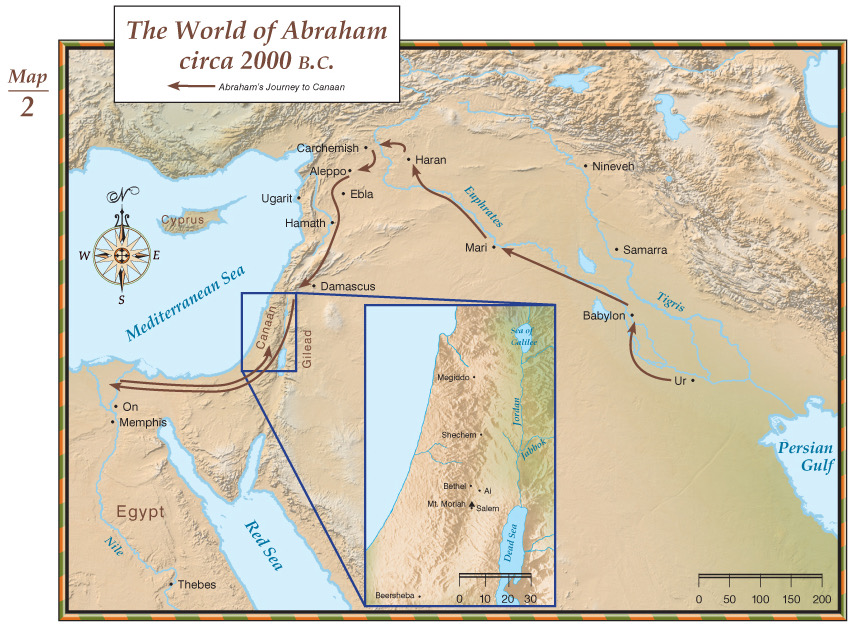
    It is beginning with Abraham in Mesopotamia/Ur, then Haran, then Canaan.

    Abraham’s Route
    Abraham’s Route

    Abraham was called while in Ur,2 and again in Haran.3

    He was called to enter into the country of Canaan, and claim that country as his own.

    That activity would begin the specific work of God in relation to His redemptive plan, the plan of Psalm 2:6-9 = the purpose of God to give to the Son the inheritance of Jerusalem, and a people, and the nations, on the earth as brethren.

    The key to the purpose of God, and one that has caused the most confusion for the contemporary church, is the role of Israel in that redemptive purpose.

    Remember:

    Jesus said:

    25 In the same way He took the cup also after supper, saying, “This cup is the new covenant in My blood; do this, as often as you drink it, in remembrance of Me.”  (1 Corinthians 11:25, LSB)

    The New Covenant, whatever that is, must have been important since He said that His blood secures it.

    His death, then, is the New Covenant “sacrifice” of some sort in order to accomplish the arrangement.

    And, the purpose of His death is also summed up in the New Covenant.

    The end result is that we are supposed to remember His death, and these things, when we participate in the Lord’s Supper.

    To be unaware of these things is to take the supper in ignorance, leading to ritualism, or, more likely, leads to eating and drinking in an unworthy manner.

    What we see, when we examine the death of Christ, and the New Covenant, carefully are the following:

    1. The New Covenant is the very core of the gospel of Jesus Christ.
    2. The New Covenant unites the OT and the NT.
    3. The New Covenant clarifies who Israel is.
    4. The New Covenant clarifies who the church is.
    5. The New Covenant is the only covenant made with Israel which forgives sins.
    6. Without the New Covenant, all the elect would remain in their sins.

    We have covered that: the New Covenant is the core of the gospel since it is the means of:

    • a new heart
    • the forgiveness of sins
    • Indwelling Holy Spirit
    • Provision of obedience to Mosaic Law, thus completing the Abrahamic promise (Leviticus 26:40-41)

    The New Covenant uniting the OT and NT in that all the OT covenants are with Israel and are the result of, and means of, the eternal purpose of God on earth through Christ.

    • Noahic Covenant
    • Abrahamic Covenant
    • Priestly Covenant
    • Mosaic Covenant
    • Davidic Covenant
    • New Covenant

    Today, we need to clarify who Israel is, and is not, in order to see how the New Covenant reflects on them.

    Without the clarity of who Israel is, we are also confused concerning the New Covenant as well as the Kingdom of God as a whole.

    NOTE: in the church today, we can see the grandchildren of the movement that equates the church with Israel, and vice-versa.

    • baptism equated with circumcision
    • land promises conflated to spiritual blessings
    • the Law of Moses equal to the church’s responsibility
    • the general promises of a kingdom to Israel given to the church thus removing them from Israel altogether.

    Overall, the modern church has little to no comprehension that Israel is the key to the fulfillment of the Father’s promise to the Son.

    The Origin of Israel

    The Mosaic Covenant

    The Apostasy of Israel

    Idolatry and the Crucifixion of Christ

    The Repentance of Israel

    The Holy Spirit and the New Covenant

    Once we have a clear handle on these things, we can see that:

    The church is not Israel.

    Israel is not the church.

    The Origin of Israel

    How did Israel begin?

    Since the New Covenant is a covenant with Israel alone, where did they come from?

    The origin of the nation of Israel began with one man, Abraham, and his wife Sarah. 
    

    14 And Yahweh said to Abram, after Lot had separated from him, “Now lift up your eyes and look from the place where you are, northward and southward and eastward and westward;

    15 for all the land which you see, I will give it to you and to your seed forever.

    16 “And I will make your seed as the dust of the earth, so that if anyone can number the dust of the earth, then your seed can also be numbered.

    17 “Arise, walk about the land through its length and breadth; for I will give it to you.”

    18 Then Abram moved his tent and came and lived by the oaks of Mamre, which are in Hebron, and there he built an altar to Yahweh.  (Genesis 13:14–18, LSB)

    And, the people who left Egypt at the Exodus were the descendants, the “seed,” of Abraham.

    Then God said to Abram, “Know for certain that your seed will be sojourners in a land that is not theirs, and they will be enslaved and mistreated four hundred years.

    14 “But I will also judge the nation to whom they are enslaved, and afterward they will come out with many possessions.

    15 “As for you, you shall go to your fathers in peace; you will be buried at a good old age.

    16 “Then in the fourth generation they will return here, for the iniquity of the Amorite is not yet complete.”  (Genesis 15:13–16, LSB)

    It was when they left Egypt that the seed went from a coalition of descendants of Abraham alone, to a functioning nation, who, over 40 years from the Exodus, entered the land God promised Abraham.

    The Exodus from Egypt identified the Hebrews as the nation of Jacob’s descendants, Israel.

    The Mosaic Covenant brought Israel into an agreement with YHWH in that, if they obeyed it fully, then YHWH would give to them the promise to Abraham.

    They had the Law, entered a land, had God as their King (until Saul), a means of sacrifice, and a working military.

    This was the point at which they became a nation.4

    They were separate from Egypt, Canaan, Amorites, and other nations.

    This was the fulfillment of God’s promise to Abraham…initially.

    The nation of Israel, then, endured existence from 1400 BC to around 586 BC as an independent, self-governing, and at times even a dominant nation, in the world.

    In 586 BC, Nebuchadnezzar took Judah into captivity and, after leaving some in the land, brought thousands of captives back to Babylon (Iraq).5

    Furthermore, all the leaders of the priests and the people were very unfaithful following all the abominations of the nations; and they defiled the house of Yahweh which He had set apart as holy in Jerusalem.  (2 Chronicles 36:14, LSB)

    15 And Yahweh, the God of their fathers, sent word to them again and again by the hand of His messengers, because He had compassion on His people and on His habitation;

    16 but they continually mocked the messengers of God, despised His words and scoffed at His prophets, until the wrath of Yahweh arose against His people, until there was no remedy.

    17 Therefore He brought up against them the king of the Chaldeans who killed their choice men with the sword in the house of their sanctuary, and had no compassion on choice man or virgin, old man or infirm; He gave them all into his hand.

    18 And all the articles of the house of God, great and small, and the treasures of the house of Yahweh, and the treasures of the king and of his officials, he brought them all to Babylon.

    19 Then they burned the house of God and tore down the wall of Jerusalem, and burned all its palaces with fire and destroyed all its valuable articles.

    20 And those who had escaped from the sword he took away into exile to Babylon; and they were slaves to him and to his sons until the rule of the kingdom of Persia,

    21 to fulfill the word of Yahweh by the mouth of Jeremiah, until the land had made up for its sabbaths. All the days of its desolation it kept sabbath until seventy years were fulfilled.  (2 Chronicles 36:15–21, LSB)

    The Apostasy of Israel

    Israel was under covenant with YHWH in order that they would confess their sins, offer sacrifices for their sins, walk in His righteousness, and love Him with all their heart.

    However, they almost never fulfilled their covenant with YHWH.

    In the 3,473 years of existence, there have only been (4) times of national faithfulness to YHWH:

    – The generation of Joshua, the commander of the army with Moses.

    • 16 And they answered Joshua, saying, “All that you have commanded us we will do, and wherever you send us we will go.
      17 “Just as we listened to Moses in all things, so we will listen to you; only may Yahweh your God be with you as He was with Moses.
      18 “Anyone who rebels against your command and does not listen to your words, in all that you command him, shall be put to death; only be strong and courageous.”  (Joshua 1:16–18, LSB)
      • 31 And Israel served Yahweh all the days of Joshua and all the days of the elders who survived Joshua, who knew all the work of Yahweh which He had done for Israel.  (Joshua 24:31, LSB)
        • 7 And the people served Yahweh all the days of Joshua and all the days of the elders who survived Joshua, who saw all the great work of Yahweh which He had done for Israel.  (Judges 2:7, LSB)

    – The generation under David’s rule

    5:1 Then all the tribes of Israel came to David at Hebron and said, “Behold, we are your bone and your flesh.

    2 “Previously, when Saul was king over us, you were the one who led out and brought in Israel; and Yahweh said to you, ‘You will shepherd My people Israel, and you will be a ruler over Israel.’”

    3 So all the elders of Israel came to the king at Hebron, and King David cut a covenant with them in Hebron before Yahweh; then they anointed David king over Israel.

    4 Now David was thirty years old when he became king, and he reigned forty years.  (2 Samuel 5:1–4, LSB)

    – The generation under Asa

    • 9 And he gathered all Judah and Benjamin and those from Ephraim, Manasseh and Simeon who sojourned with them, for many defected to him from Israel when they saw that Yahweh his God was with him.
      10 So they assembled at Jerusalem in the third month of the fifteenth year of Asa’s reign.
      11 And they sacrificed to Yahweh that day 700 oxen and 7,000 sheep from the spoil they had brought.
      12 They entered into the covenant to seek Yahweh, the God of their fathers, with all their heart and soul;
      13 and whoever would not seek Yahweh, the God of Israel, should be put to death, whether small or great, man or woman.  (2 Chronicles 15:9–13, LSB)

    – The generation under Josiah

    • 27 because your heart was soft and you humbled yourself before God when you heard His words against this place and against its inhabitants, and because you humbled yourself before Me, tore your clothes and wept before Me, I truly have heard you,” declares Yahweh.  (2 Chronicles 34:27 , LSB)

    The culmination of the apostasy of Israel was the generation of the Messiah, Jesus Christ.

    The generation which existed when Christ came was the generation most responsible for the height of hypocrisy and evil of all the generations of the nation of Israel.

    Nothing compares to the darkness of that generation in that:

    – Their father was the devil

    • “You are of your father the devil, and you want to do the desires of your father. He was a murderer from the beginning, and does not stand in the truth because there is no truth in him. Whenever he speaks a lie, he speaks from his own nature, for he is a liar and the father of lies.  (John 8:44, LSB)

    – The “hour of darkness” was theirs to use freely

    • “While I was with you daily in the temple, you did not stretch out your hands against Me, but this hour and the authority of darkness are yours.”  (Luke 22:53, LSB)

    – They resisted the believing in Christ

    • 24 The Jews then gathered around Him, and were saying to Him, “How long will You keep us in suspense? If You are the Christ, tell us openly.”
      25 Jesus answered them, “I told you, and you do not believe; the works that I do in My Father’s name, these bear witness of Me.
      26 “But you do not believe because you are not of My sheep.
      27 “My sheep hear My voice, and I know them, and they follow Me;
      28 and I give eternal life to them, and they will never perish—ever; and no one will snatch them out of My hand.  (John 10:24–28, LSB)

    – They tried to keep thousands out of the kingdom

    • 13 “But woe to you, scribes and Pharisees, hypocrites, because you shut off the kingdom of heaven from people; for you do not enter in yourselves, nor do you allow those who are entering to go in.  (Matthew 23:13, LSB)

    That generation of the Jews who were present at the coming of Christ, those in leadership and directing the affairs of the Temple, those established as the architects of Judaism and rabbinic theology, they, empowered by Satan and established by their own systemic and profound hypocrisy, executed the Messiah, who willingly owned their own guilt, and went to their graves with nothing but jealous hatred for God.

    At the judgment of God in the future, God will affect upon them all the guilt of all the righteous blood shed upon the earth in the entire history of Israel.

    They will even persecute the church (“prophets,” “wise men,” “scribes”), chasing them down to death and excommunication.

    34 “On account of this, behold, I am sending you prophets and wise men and scribes; some of them you will kill and crucify, and some of them you will flog in your synagogues, and persecute from city to city,

    35 so that upon you may fall the guilt of all the righteous blood shed on earth, from the blood of righteous Abel to the blood of Zechariah, the son of Berechiah, whom you murdered between the sanctuary and the altar.

    36 “Truly I say to you, all these things will come upon this generation.  (Matthew 23:34–36, LSB)

    It can appear that all hope is lost for the realization of the promise to Abraham.

    Remember, the promise to Abraham can only be realized by the admission of sin and guilt by the nation of Israel.

    40If they confess their iniquity and the iniquity of their fathers, in their unfaithfulness which they committed against Me, and also how they walked in hostility against Me—

    41 I also was walking in hostility against them, to bring them into the land of their enemies—or if their uncircumcised heart becomes humbled so that they then make up for their iniquity,

    42 then I will remember My covenant with Jacob, and I will remember also My covenant with Isaac and My covenant with Abraham as well, and I will remember the land.  (Leviticus 26:40–42, LSB)

    However….

    The Repentance of Israel

    8 ‘And it will be in that day,’ declares Yahweh of hosts, ‘that I will break his yoke from off your neck and will tear off your bonds; and strangers will no longer make them their slaves.

    9 ‘But they shall be a slave to Yahweh their God and David their king, whom I will raise up for them.

    10 ‘Fear not, O Jacob My servant,’ declares Yahweh,

    ‘And do not be dismayed, O Israel;

    For behold, I will save you from afar

    And your seed from the land of their captivity.

    And Jacob will return and will be quiet and at ease,

    And no one will make him tremble.  (Jeremiah 30:8–10, LSB)

    When that nation is made right with YHWH, by the keeping of their covenant, then all the promise God made to Abraham, the national transcendence, the people, and the land of Abraham, will be seen visibly in the world.

    13 For the promise to Abraham or to his seed that he would be heir of the world was not through the Law, but through the righteousness of faith.  (Romans 4:13, LSB)

    And, if the promise to Abraham is the very same promise to the Son, then how can the plan of the Father, the promise, be accomplished?

    It can only be accomplished by the repentance of Israel.

    Therefore, it is critical to the eternal purpose of God that Israel repent and believe in Messiah.

    NOTE: Yet, their unbelief produced the crucifixion of the Messiah, thus the atonement, and the fulfillment of the Word of God.

    “Then after the sixty-two weeks the Messiah will be cut off and have nothing, and the people of the prince who is to come will destroy the city and the sanctuary. And its end will come with a flood; even to the end there will be war; desolations are decreed.  (Daniel 9:26, LSB)

    How could Israel EVER circumcise their heart, love YHWH with all their heart, soul, and mind, and undo the damage done by the execution of the Messiah?!

    By the New Covenant

    The New Covenant

    31“Behold, days are coming,” declares Yahweh, “when I will cut a new covenant with the house of Israel and with the house of Judah,

    32 not like the covenant which I cut with their fathers in the day I took them by the hand to bring them out of the land of Egypt, My covenant which they broke, but I was a husband to them,” declares Yahweh.

    33 “But this is the covenant which I will cut with the house of Israel after those days,” declares Yahweh: “I will put My law within them, and on their heart I will write it; and I will be their God, and they shall be My people.

    34 “And they will not teach again, each man his neighbor and each man his brother, saying, ‘Know Yahweh,’ for they will all know Me, from the least of them to the greatest of them,” declares Yahweh, “for I will forgive their iniquity, and their sin I will remember no more.”  (Jeremiah 31:31–34, LSB)

    This new covenant, which is written like a promise, will not set aside the Old Covenant, as if that bilateral covenant does not need to be kept.

    In fact, unless the New Covenant comes, the nation of Israel cannot keep the Mosaic Covenant, which they promised to keep.

    The Lord’s Supper

    25 In the same way He took the cup also after supper, saying, “This cup is the new covenant in My blood; do this, as often as you drink it, in remembrance of Me.”  (1 Corinthians 11:25, LSB)

    This is the reason for the death of the Messiah.

    His death confirmed the New Covenant-the Lamb/sacrifice of the Son in order to provide the payment of the sins of Israel, and all who are elected of God.

    The means, then, by which God will truly atone for sins, not simply cover over them, but actually make the sinner new, is through the sacrifice of the Son of God on their behalf.

    But, here is the important question:

    How will the Son of God be sacrificed for Israel, and their once-for-all atonement?

    How will God accomplish the necessary security of a new sacrifice, not like the system of sacrifices of the Mosaic Covenant, and yet, secures the Abrahamic promise which depends upon the Mosaic Covenant?

    The Incognito Ministry of the Messiah

    And He earnestly warned them not to tell who He was.  (Mark 3:12, LSB)

    And He gave them orders not to tell anyone; but the more He was ordering them, the more widely they continued to proclaim it.  (Mark 7:36, LSB)

    And He gave them strict orders that no one should know about this, and He said that some food should be given to her to eat.  (Mark 5:43, LSB)

    The Lord established in His ministry the constant order to hold back from telling the people Who He was.

    This meant that He was not wanting the people to know about Him as Messiah, but only that He would do the works of the Messiah letting people to draw the conclusions based upon that.

    This was so that the true nature of the leadership of Israel would become evident, thus leading to the crucifixion, the necessary death of the New Covenant Lamb of God.

    13 Now when Jesus came into the district of Caesarea Philippi, He was asking His disciples, saying, “Who do people say that the Son of Man is?”

    14 And they said, “Some say John the Baptist; and others, Elijah; but still others, Jeremiah, or one of the prophets.”

    15 He said to them, “But who do you say that I am?”

    16 And Simon Peter answered and said, “You are the Christ, the Son of the living God.”

    17 And Jesus answered and said to him, “Blessed are you, Simon Bar-Jonah, because flesh and blood did not reveal this to you, but My Father who is in heaven.

    18 “And I also say to you that you are Peter, and upon this rock I will build My church; and the gates of Hades will not overpower it.

    19 “I will give you the keys of the kingdom of heaven; and whatever you bind on earth shall have been bound in heaven, and whatever you loose on earth shall have been loosed in heaven.”

    20 Then He warned the disciples that they should tell no one that He was the Christ.

    21 From that time Jesus began to show His disciples that He must go to Jerusalem, and suffer many things from the elders and chief priests and scribes, and be killed, and be raised up on the third day.  (Matthew 16:13–21, LSB)

    Have you ever wondered why Jesus would say this? 
    

    It is because of the requirement that He would draw out the murderous hearts of the leadership, their jealousy, by His works, and drive them to the murder that would 1) seal their eternal damnation, and 2) secure the atoning sacrifice of the Lamb.

    36 “But the witness I have is greater than the witness of John; for the works which the Father has given Me to finish—the very works that I do—bear witness about Me, that the Father has sent Me.

    37 “And the Father who sent Me, He has borne witness about Me. You have neither heard His voice at any time nor seen His form.

    38 “And you do not have His word abiding in you, for you do not believe Him whom He sent.  (John 5:36–38, LSB)

    This death, produced by the jealousy of the leadership of Israel as they witnessed His works, instead of snuffing out His influence, secured the atoning sacrifice for the sins of Israel and Gentiles…forever!

    Therefore, His kingdom was secured by His death and resurrection, but not through the nation of Israel, although the Mosaic Law is the keep component in fulfilling that kingdom promise, which was communicated in the Abrahamic Promise.

    His Kingdom, then, has been taken away from the nation of Israel, and given to the nations of the world!

    Conclusion

    33 “Listen to another parable. There was a landowner who planted a vineyard and put a wall around it and dug a wine press in it, and built a tower, and rented it out to vine-growers and went on a journey.

    34 “Now when the harvest time approached, he sent his slaves to the vine-growers to receive his fruit.

    35 “And the vine-growers took his slaves and beat one, and killed another, and stoned a third.

    36 “Again he sent another group of slaves larger than the first; and they did the same thing to them.

    37 “But afterward he sent his son to them, saying, ‘They will respect my son.’

    38 “But when the vine-growers saw the son, they said among themselves, ‘This is the heir; come, let us kill him and seize his inheritance.’

    39 “And they took him, and threw him out of the vineyard and killed him.

    40 “Therefore when the owner of the vineyard comes, what will he do to those vine-growers?”

    41 They said to Him, “He will bring those wretches to a wretched end, and will rent out the vineyard to other vine-growers who will pay him the proceeds at the proper seasons.”

    42 Jesus said to them, “Did you never read in the Scriptures,

    ‘The stone which the builders rejected,

    This has become the chief corner stone;

    This came about from the Lord,

    and it is marvelous in our eyes’?

    43 “Therefore I say to you, the kingdom of God will be taken away from you and given to a nation, producing the fruit of it.

    44 “And he who falls on this stone will be broken to pieces; but on whomever it falls, it will scatter him like dust.”

    45 And when the chief priests and the Pharisees heard His parables, they understood that He was speaking about them.

    46 And although they were seeking to seize Him, they feared the crowds, because they were regarding Him to be a prophet.  (Matthew 21:33–46, LSB)

    Footnotes:

    1. See Paul Tanner, “Old Testament Chronology and Its Implications For The Creation and Flood Accounts” Bibliotheca Sacra, vol. 172, Jan-Mar, 2015’ pp.24-44.
    2. And he said, “Hear me, brothers and fathers! The God of glory appeared to our father Abraham when he was in Mesopotamia, before he lived in Haran,
      3 and said to him, ‘Leave your country and your relatives, and come into the land that I will show you.’
      4 “Then he left the land of the Chaldeans and settled in Haran. From there, after his father died, God had him move to this country in which you are now living.  (Acts 7:2–4, LSB)
    3. So Abram went forth as Yahweh had spoken to him; and Lot went with him. Now Abram was seventy-five years old when he departed from Haran.  (Genesis 12:4, LSB)
    4. I am referring to the entire exodus event. This includes leaving Egypt, arriving at Mt. Sinai, receiving the Law from God, and being independent of any country around.
    5. At the return under Cyrus, there were 42,360 present.
      The whole assembly together was 42,360,  (Ezra 2:64, LSB)